The post The comparison of 9 HIPAA-compliant web analytics platforms appeared first on Piwik PRO.
]]>Choosing a platform that doesn’t match your needs or available resources can put sensitive patient information at risk, leading to costly compliance violations and loss of patient trust. As a healthcare organization, you must consider privacy and security-related aspects, such as security protocols, certifications, data protection and anonymization features, hosting options, and regulatory compliance. At the same time, your selected platform should meet your expectations in terms of usability, product capabilities, data integration options, analytics, and reporting features, and others.
In this comparison, we will analyze the leading HIPAA-compliant web analytics platforms, including Piwik PRO, Freshpaint, Matomo, Mixpanel, Amplitude, Heap, Tealium, Adobe Customer Journey Analytics and Piano Analytics. We will cover essential criteria such as data security, encryption standards, business associate agreements (BAAs), integration capabilities, hosting options, data anonymization features, reporting and analytics features, customer support options, and much more.
By understanding how these platforms stack up, you’ll be better equipped to select a solution that not only meets your compliance requirements but also allows your organization to turn healthcare data into actionable insights.
COMPARISON
The comparison of 9 HIPAA-compliant web analytics platforms
Compare the main features of Piwik PRO, Freshpaint, Matomo, Mixpanel, Amplitude, Heap, Tealium, Adobe CJA and Piano Analytics.
How to find the right HIPAA-compliant web analytics platform for your healthcare organization
For each platform, we outline and compare features from the following categories:
General overview
The first section includes an overview of each platform’s HIPAA compliance status, privacy and security measures, available plans, pricing, and product capabilities. This helps you quickly understand the overall suitability of the solution for your needs.
Data privacy and security
Data privacy and security features directly impact how protected health information (PHI) is handled. Key elements such as data control, the availability of business associate agreements (BAAs), regulatory compliance adherence, access controls, audit logs, server-side tagging, encryption, anonymization, hosting environment, backups, security certifications, and integration with consent management systems collectively ensure that patient data is protected against unauthorized access and breaches.
Data collection flexibility
Data collection flexibility determines how different platforms accommodate the diverse technical environments and tracking requirements of healthcare organizations. The availability of JavaScript tags and software development kits (SDKs), support for custom variables and dimensions, data freshness and retention policies, and the number of properties or custom domains that can be tracked show how well the platform can capture relevant user interactions without compromising compliance.
Data processing and connectivity
Data processing and connectivity features such as raw data access, reporting APIs, data sampling methods, and integrations with business intelligence (BI) and data visualization tools enable healthcare organizations to analyze data effectively and integrate analytics insights into broader decision-making workflows. The availability of direct integrations with a customer data platform (CDP) and tag manager further enhances the ability to comprehensively manage and activate patient data.
Reporting features
Reporting features determine how well healthcare teams can derive insights from the collected data. In this section, we outline features like access to detailed reports and metrics, customizable dashboards, event and goal tracking, funnel and product analytics, user flow visualization, session logs, real-time data, calculated metrics, automatic insights, and user-level reporting.
Support and customer care
Support and customer care options play a vital role in successful platform adoption and ongoing compliance. Basic support, such as help centers, community forums, and email assistance, provides foundational help, while more extensive services, like dedicated support specialists, personalized implementation, and onboarding, ensure that organizations can tailor the platform to their specific HIPAA requirements and operational needs.
Overview of web analytics vendors offering HIPAA compliance
Our comparison includes the following vendors:
Tealium
Tealium is an enterprise customer data platform and tag management leader, specializing in secure, compliant, and real-time customer data management across large organizations. With certifications such as HIPAA, ISO 27001, and SOC 2, plus private cloud hosting options, Tealium is tailored for large organizations with complex data governance and compliance requirements. It is the best fit for enterprises needing granular control over customer data and seamless integration across multiple channels.
Adobe Customer Journey Analytics (CJA)
Adobe CJA is an enterprise analytics solution designed to unify and analyze customer journeys across multiple channels in real time. Integrated deeply within the Adobe Experience Cloud, CJA provides advanced segmentation, visualization, and reporting capabilities while maintaining strong privacy and compliance controls, including HIPAA readiness. It is particularly well-suited for large enterprises that require comprehensive cross-channel insights and already leverage Adobe’s ecosystem for marketing and customer experience management.
Piano Analytics
Piano Analytics (formerly AT Internet) is a European-focused analytics platform that emphasizes privacy, compliance, and actionable digital insights. It supports GDPR compliance and flexible data hosting options, providing detailed web and product analytics along with segmentation and reporting features. Piano Analytics is ideal for organizations in Europe or those with stringent privacy requirements seeking a robust analytics solution tailored to digital content and marketing performance.
Mixpanel
Mixpanel is an advanced product analytics tool offering interactive dashboards and experimentation tools that empower product managers and marketers to optimize user engagement and feature adoption. It provides real-time event tracking, cohort analysis, and user segmentation, helping product and marketing teams optimize patient engagement and retention while maintaining compliance. Mixpanel is a good fit for healthcare SaaS and digital health companies that need actionable behavioral analytics combined with HIPAA safeguards.
Matomo
Matomo is an open-source web analytics platform. It was founded in 2007 and was known as Piwik until 2018, when it rebranded. Matomo enables organizations to control their analytics data while complying with GDPR and other privacy regulations. Its customizable dashboards, heatmaps, and session recordings provide rich insights into user behavior. Because there is no option to sign a BAA, HIPAA-covered organizations need to self-host their analytics if they choose Matomo. The platform is suitable for companies seeking an open-source alternative to mainstream analytics tools.
Amplitude
Amplitude provides advanced behavioral analytics designed for growth-driven digital businesses. It enables healthcare organizations to analyze patient journeys, retention, and product usage with advanced segmentation and predictive analytics. Amplitude’s strong privacy controls, data governance and integration options make it suitable for large healthcare enterprises and digital health teams focused on growth and compliance.
Heap
Heap is a digital insights platform that gives teams a complete understanding of customers’ digital journeys to improve conversion, retention, and customer satisfaction. It automatically captures all user interactions and supports HIPAA compliance through BAAs, data encryption, and privacy controls. Its retroactive analytics and journey analysis capabilities allow healthcare teams to gain insights without manual event tagging, reducing implementation complexity. Heap is ideal for healthcare organizations seeking fast deployment and comprehensive analytics while ensuring PHI security.
Freshpaint
Freshpaint is a healthcare-focused platform built with privacy and HIPAA compliance in mind. It can be used to collect website and app data while preventing the sharing of protected health information (PHI) with non-compliant tools, such as analytics or ad platforms. Using cryptographic hashing and anonymous user IDs, Freshpaint enables organizations to analyze complete visitor journeys without exposing individual identities. At the same time, because it serves as an intermediary to prevent PHI from being sent to non-compliant tools, it requires significant technical skills and resources to set up and maintain.
Piwik PRO
Piwik PRO Analytics Suite is a digital analytics and data activation platform that helps businesses collect, analyze, and put user data into action. The platform includes integrated analytics, tag manager, consent management, and customer data platform capabilities, allowing healthcare providers to safely connect first-party data from various touchpoints. It offers compliant data encryption, secure hosting with Microsoft Azure, customizable BAAs, advanced anonymization options, and more. Recently certified as HIPAA-compliant through its SOC-2 Type II audit, Piwik PRO is ideal for healthcare institutions seeking actionable marketing insights without compromising HIPAA compliance.
COMPARISON
The comparison of 9 HIPAA-compliant web analytics platforms
Compare the main features of Piwik PRO, Freshpaint, Matomo, Mixpanel, Amplitude, Heap, Tealium, Adobe CJA and Piano Analytics.
The post The comparison of 9 HIPAA-compliant web analytics platforms appeared first on Piwik PRO.
]]>The post Piwik PRO vs. Google Analytics for Shopify: A comparison appeared first on Piwik PRO.
]]>While Google Analytics 4 (GA4) remains a popular default, many merchants discover its limitations too late: missing transactions, inconsistent reporting, lack of flexibility, and difficulty activating data outside Shopify.
Piwik PRO offers a powerful alternative. With full data accuracy, built-in tools for segmentation and activation, and seamless Shopify integration, it’s built for businesses that want more than just page views.
The complete Piwik PRO Shopify app playbook
Tap into advanced analytics and a built-in customer data platform (CDP) to improve your Shopify store’s performance. This playbook offers actionable strategies, real-world examples, and step-by-step instructions to help you grow your business while staying compliant with global privacy laws.
Why GA4 often falls short for Shopify merchants
Google Analytics 4 is designed for general-purpose web and app tracking, not for the specific needs of ecommerce platforms like Shopify. Here are some common challenges:
- Missing or delayed ecommerce events: GA4 sometimes fails to track all Shopify interactions reliably, especially without a custom setup.
- Lack of built-in reporting for Shopify-specific metrics: To obtain meaningful sales data, you often need an extra configuration or GA4 BigQuery exports.
- Data sampling and thresholds: In some cases, especially for larger stores, Google samples data or hides it entirely due to user privacy thresholds.
- Limited activation options: GA4 keeps your data within the Google ecosystem. Activating it in external platforms or marketing tools often requires workarounds or extra software.

Learn more: How to install Piwik PRO app for Shopify
Key differences: Piwik PRO vs. Google Analytics
Choosing the right analytics platform can make or break your data strategy. Here’s how Piwik PRO stacks up against Google Analytics 4, from data accuracy and privacy to Shopify integration and activation capabilities.
| Piwik PRO | Google Analytics 4 | |
|---|---|---|
| Shopify compatibility | Shopify-optimized integration with reliable session and event tracking | Requires advanced setup to track core events |
| Data accuracy | 100% unsampled data with no hidden thresholds | Sampling and privacy thresholds can hide data |
| Data activation | Built-in tools to activate data across ad platforms, CRM, and email tools | Limited activation outside the Google Ads ecosystem |
| Data ownership | Full control — data is never sold or reused | Google controls and processes the data |
| Customer data platform (CDP) | Built-in CDP (available on Business and Enterprise plans) | No native CDP support |
| Privacy compliance | Compliant with GDPR, CCPA, and other regulations out of the box | Requires configuration to achieve compliance |
| Ad blocker resilience | More effective tracking despite ad blockers | Easily blocked, causing incomplete data |
| Consent compatibility | Anonymous mode integrated with Shopify Privacy API; works with content management platforms (CMPs) | Consent tracking must be implemented separately |
Why Piwik PRO stands out for reliable Shopify analytics
1. Accurate tracking from day one
Piwik PRO delivers clean, accurate data with no sampling. You’ll get the full picture of your store’s performance, capturing every transaction and visitor journey, without the uncertainty often introduced by GA4.
2. Data you can activate, not just analyze
What good is analytics data if it can’t drive action? With Piwik PRO, you can segment and send audience data to external platforms — ad networks, CRMs, email platforms without relying on third-party tools or cloud workarounds. This capability turns insights into revenue.

External data activation
Piwik PRO helps you to unlock the full potential of your data across all marketing channels. Activate your Shopify analytics data on external platforms and marketing tools:
- Direct integration with email marketing platforms for targeted campaigns
- Seamless data export to advertising platforms for enhanced audience targeting
- Real-time data synchronization with CRM systems for improved customer relationship management
- Custom API connections for specialized marketing tools and platforms
3. Built for ecommerce
Piwik PRO’s integration with Shopify ensures accurate event tracking and full compatibility with the platform’s privacy and data-sharing features. You’ll get the key data you need to drive conversions and improve customer experience.
4. More control, fewer limitations
Piwik PRO gives you full control over your data, which can be securely stored in the EU or a region of your choice. Most importantly, it’s never shared, sold, or used to train advertising algorithms.
5. Privacy support when you need it
Piwik PRO helps you comply with regulations like GDPR and CCPA automatically. Its anonymous tracking mode integrates with Shopify’s Privacy API and respects consent collected through any compatible platform.
When to choose Piwik PRO over Google Analytics
Consider switching to Piwik PRO if:
- You’re frustrated by GA4’s limited Shopify event tracking and inconsistent reporting
- You need clean, unsampled data you can trust
- You want to activate analytics data across external marketing platforms
- You need more flexibility, transparency, and control than Google Analytics offers
Ecommerce marketing: How to get enhanced online store analytics
Check out our masterclass and learn how to go beyond ecommerce analytics with Piwik PRO to act on customer insights and drive more sales.
Conclusion
Google Analytics 4 can feel like a black box, especially for Shopify merchants who need precision and performance. If you’re looking for a platform that gives you reliable insights, full data control, and the power to activate your data anywhere, Piwik PRO is the better choice.
It’s more than just privacy compliance. It’s analytics that work for your business.
Ready to go beyond basic analytics?
Start using Piwik PRO for Shopify and get the insights you need
The post Piwik PRO vs. Google Analytics for Shopify: A comparison appeared first on Piwik PRO.
]]>The post EU-US data transfers uncertainties: How an EU-based analytics platform can improve your marketing performance appeared first on Piwik PRO.
]]>This article details the recent regulatory changes impacting cross-Atlantic data transfers and highlights the challenges marketers are facing. We’ll also demonstrate why you should look for an EU-based web analytics solution and outline the steps you need to take to ensure fully compliant analytics.
The current state of data transfers between the EU and the US
The transfer of personal data between the EU and the US has been disputed for years, primarily due to fundamental differences in privacy laws. The EU’s General Data Protection Regulation (GDPR) enforces strict individual rights and control over personal data. The US, however, operates with more fragmented privacy laws, and intelligence agencies have broad data access powers under legislation such as the Foreign Intelligence Surveillance Act (FISA 702).
These concerns have triggered major legal challenges, including the Schrems I and Schrems II cases, invalidating previous data transfer frameworks (Safe Harbor and Privacy Shield). The core issue is that these frameworks failed to adequately protect EU citizens’ data against US government surveillance.
Recent political developments
Recent developments in the US political landscape and European regulatory actions have intensified the situation, with significant implications for businesses, regulators, and transatlantic relations. Donald Trump’s return to the US presidency is a major source of uncertainty.
Situation in the United States
Early in his new term, Trump questioned the Biden-era executive orders that underpin the Transatlantic Data Privacy Framework (DPF), adopted in July 2023. It introduced three key elements:
- Data Protection Review Court (DPRC): An independent redress body allowing EU individuals to challenge how US intelligence agencies handle data with binding decision-making authority.
- Executive order 14086: Signed by President Biden in October 2022, establishes proportionality and necessity requirements for US surveillance activities.
- Self-certification system: Requires US companies to publicly commit to DPF principles for streamlined transfers administered by the Department of Commerce.
However, the most destabilizing event was the loss of quorum at the US Privacy and Civil Liberties Oversight Board (PCLOB) after Trump requested the resignation of its Democratic members in January 2025. The shutdown of PLOB, a core oversight body referenced in the DPF, has intensified European doubts about the long-term viability and independence of US redress mechanisms for EU citizens. As privacy advocate Max Schrems of NOYB points out, the current oversight mechanisms “may not even stand the test of just the first days of a Tump presidency.”
European regulatory actions
In response to these developments, European Data Protection Authorities (DPAs) and governments are taking a series of regulatory and political actions, signaling a broader shift in the EU-US relationship:
- Norway: The Norwegian DPA issued a new guidance warning against EU-US data transfers, citing concerns about the legal framework’s stability and adequacy.
- Netherlands: The Dutch Parliament voted to reduce reliance on US tech companies, requiring government agencies to prioritize European cloud and data processing alternatives.
- Denmark: The Danish Ministry of Industry recommended that companies develop exit strategies from American cloud services.
- Germany: Germany’s Interior Minister stated that businesses should develop contingency plans, as the government can no longer guarantee the long-term stability of transatlantic data flow mechanisms.
These steps reflect a growing consensus in Europe that relying on US-based solutions carries increasing legal and strategic risks.
Read more about the wave of decisions by European DPAs declaring the use of Google Analytics (GA) illegal under GDPR:
- Norwegian DPA warns against EU-US data transfers – what it means for your website
- Denmark’s data protection authority says Google Analytics is illegal under GDPR
- Sweden’s data protection authority orders companies to stop using Google Analytics
- Google Analytics might soon be banned in Norway
- Is Google Analytics (3 & 4) GDPR-compliant? [Updated]
Why you need an EU-based web analytics solution
The current regulatory environment is unstable. With European authorities increasingly willing to issue immediate compliance orders, companies relying on US-based analytics tools risk sudden operational paralysis. Using non-compliant data tools risks fines of up to 4% of global revenue under GDPR. A single enforcement decision could leave marketers scrambling to replace core infrastructure overnight.
Main challenges for marketers
As the legal landscape shifts faster than ever, marketers face new and pressing challenges. Understanding these risks is the first step toward securing your data strategy.
Campaign interruptions that devastate performance metrics
Regulatory actions often come without warning. In past cases, enforcement orders have immediately suspended marketing tools tied to unlawful data transfers. For marketers, this means pausing campaigns mid-flight, cutting off personalization, and creating reporting gaps that impede optimization.
Analytics blackouts that force blind decision-making
Turning off third-party analytics due to compliance concerns means you’re flying blind. You lose the ability to segment audiences, evaluate creative performance, or justify spend allocation. Many brands using tools like GA or Meta Ads have already reported shifting to temporary EU-hosted or server-side alternatives that may offer reduced capabilities and slower insights.
Attribution failures that cut down your budget
Attribution is how marketers defend their budgets. However, trust in the numbers declines when tracking breaks due to deactivation, missing consent, or blocked data transfers. Without complete visibility into multi-channel performance, marketing ROI becomes harder to prove, and budget reductions follow.
Wasted ad spend that drains resources
Without real-time feedback, marketers overinvest in underperforming ads and can’t scale what’s working. This has been a common pain point for brands forced to migrate analytics setups under pressure, often leading to weeks of reduced optimization and reactive decisions.
Personalization gaps that stall conversions
With consent under scrutiny and restricted data flows, many marketers are forced to revert to generic messaging strategies. When you lose the ability to personalize content by behavior, preferences, or segments, conversion can be significantly lower.
Competitive disadvantage that costs market share
As some companies scramble to react to policy changes, others with EU-hosted analytics and consent-first marketing stacks gain a competitive advantage. Even short periods of interrupted optimization can create lasting performance gaps.
Key features to look for in your next analytics platform
Selecting an analytics platform that is future-proof and fully compliant with European standards is essential. As 78% of EU users say they would abandon brands that mishandle data, proactively adopting compliant solutions signals responsibility and builds loyalty. Here is the list of the most important features you should seek:
Full data residency and processing within the EU/EEA
Ensure all user data is collected, processed, and stored exclusively within the EU or EEA to avoid legal uncertainties related to international data transfers.
Compliance with GDPR and upcoming regulations (Data Act, DORA)
Your analytics provider should meet current GDPR requirements and be prepared for new EU regulations like the Data Act and DORA to demonstrate a commitment to ongoing compliance.
Transparent data governance and security certifications (ISO 27001, SOC2)
Look for platforms with recognized security certifications, such as ISO 27001 or SOC2, demonstrating robust data governance, risk management, and security practices.
Compliant consent management and automation of data subject rights
The analytics platform should offer built-in tools for managing user consent, automating responses to data subject requests, and documenting compliance actions.
Flexibility to integrate with other marketing tools
Choose analytics platforms that connect easily with your existing marketing stack, CRM, and advertising tools to streamline tracking and boost campaign performance.
User-friendly interface with customizable dashboards
An intuitive, customizable dashboard empowers your team to access insights quickly and tailor reports to specific business needs.
Support for anonymization and pseudonymization of personal data
Select an analytics platform that offers strong anonymization and pseudonymization features, such as IP masking and cookieless tracking, to reduce compliance risks.
Clear data export and deletion options
Your next analytics platform should provide straightforward options for exporting, deleting, and modifying user data to fulfill the GDPR’s rights to data portability and to be forgotten.
Leading EU-based analytics alternatives
Finding alternatives to US-based analytics platforms that carry EU-US data transfer risks is not an easy task. Find below a list of providers that offer varying combinations of compliance protection, marketing optimization, and operational integration.
Piwik PRO Analytics Suite
Piwik PRO Analytics Suite is a comprehensive EU-based analytics platform designed to ensure full compliance with data protection laws while delivering powerful marketing insights. It offers flexible hosting options across multiple EU countries, supports both event-based tracking and session-level aggregation, and enables advanced user behavior analysis with features like funnels and user flows.
Plausible
Plausible is a lightweight, privacy-focused analytics tool fully hosted in the EU. As it doesn’t use cookies or collect personal data, you don’t need to include it in your website consent banner or cookie policy. It’s an open-source and GDPR-compliant solution that offers transparent and minimalistic analytics.
Simple Analytics
Simple Analytics is a Dutch provider that processes and stores all data within the EU, ensuring full GDPR compliance. It does not use cookies or track personal data, so you don’t need to include it in your website consent banner or cookie policy. The platform delivers easy-to-understand reports, suitable for companies that need simple, privacy-respecting insights.
Statcounter
Statcounter is an open-source, self-hosted analytics tool designed for EU-based organizations. It collects no personal data and uses no cookies, ensuring GDPR compliance and a privacy focus. The platform only provides essential website metrics, making it basic, privacy-first analytics.
| Country | Analytics capabilities | Free version | Privacy friendliness | |
|---|---|---|---|---|
| Piwik PRO | Poland |  |  | |
| Plausible | Estonia |  |  | |
| Simple Analytics | Netherlands | | | |
| Statcounter | Ireland | | | |
Visit our pricing page for more details about the available plans.
Piwik PRO Analytics Suite – the ideal EU-based web analytics platform for marketers
Transitioning to Piwik PRO ensures you meet stringent data protection requirements and maintain or even enhance your analytical capabilities. These key features prove it is the best choice for compliant, EU-based web analytics.
Simplified privacy compliance
Piwik PRO enables you to collect data in a manner that is fully compliant with privacy laws, including GDPR, HIPAA, CCPA, and TTDSG. Privacy settings embedded directly in the user interface make managing compliance intuitive and straightforward.
Complete EU data sovereignty
It offers hosting across multiple EU countries, guaranteeing data residency and complete control over where your data is stored. Such options help you adhere to local data residency requirements, minimizing transfer risks.
Data residency and sovereignty
Piwik PRO allows you to choose data storage locations, ensuring compliance with local data residency requirements.
Advanced analytics with familiar concepts
Piwik PRO supports both event-based tracking and session-level aggregation, allowing marketers to analyze user behavior with advanced reports such as funnels and user flows.
Also, to avoid chaos with your data, you can implement Piwik PRO alongside your existing Google Analytics setup. This will ensure continuity in your reporting when the EU-US DTF is invalidated as well as the safety of your data in case of any further changes in European or US privacy laws.
Seamless migration and setup
Implement Piwik PRO with a single tracking tag and start analyzing data in under an hour. The platform follows a familiar logic for those transitioning from Universal Analytics or GA4.
Well-integrated product suite
Benefit from an advanced analytics ecosystem that includes a Customer Data Platform, a Tag Manager, a Consent Manager, and multiple integration options for better data activation and personalization.
The strong connection between analytics and consent management
EU-based consent management is equally important when implementing an EU-based analytics platform. Proper analytics becomes meaningless if your consent management platform still transfers data to the US. The solution is simple: pair your EU-based analytics with EU-based consent management to create a compliant and fully protected marketing intelligence system.
Cookie Information, headquartered in Copenhagen with a few data centers across the EU, has established itself as the marketer’s first choice when both compliance protection and performance optimization are priorities.
As an EU-based consent management platform, Cookie Information benefits your marketing operations in at least 5 ways:
- Industry-leading consent optimization technology.
- Proprietary cookie scanning engine that automatically identifies and categorizes all marketing technologies, including those commonly missed by basic scanners.
- A strong consent record and export system designed to satisfy inquiries by data protection authorities (DPAs) about marketing data flows.
- Seamless integration with all major CMSs such as Shopify, Drupal, and WordPress, as well as advertising and analytics platforms like Google Tag Manager and Piwik PRO.
- Multi-language cookie consent banners for a localized website experience.
Conclusion: How to protect marketing performance and compliance when the future is uncertain
With international politics potentially reducing your ROI, acting proactively to protect your marketing operations is crucial.
Start with a comprehensive audit of your marketing technology, focusing on EU-US data transfers and compliance mechanisms. Next, you should deploy EU-based analytics tools to replace the ones sending data to the US, ensuring both compliance and uninterrupted marketing insights. Review advertising platform data flows to implement EU data residency options where possible.
As with your remaining marketing stack you should implement an EU-based consent management solution that optimizes consent rates and integrates easily with your existing setup. Finally, make sure to showcase your privacy-first approach to marketing – positioning your brand as the privacy leader in your niche – to build consumer trust.
A risk-free decision is implementing an European analytics solution like Piwik PRO alongside your current US-based analytics tools. With free options available, this parallel approach ensures marketing continuity while building valuable historical data in a privacy-compliant environment.
By following these strategic steps, you’ll minimize regulatory risks, avoid disruptions, and secure your marketing performance in the turbulent EU privacy landscape.
Switch to a secure EU-based web analytics platform
Take control of your data and maintain operational continuity with Piwik PRO Analytics Suite.
The post EU-US data transfers uncertainties: How an EU-based analytics platform can improve your marketing performance appeared first on Piwik PRO.
]]>The post Comparison of 10 leading consent management platforms appeared first on Piwik PRO.
]]>In the report by Gartner, it is expected that by 2024 75 percent of the global population will be covered under modern privacy regulations. The forecast for the year 2023 was 65 percent, up sharply from only 10 percent in 2020.
Most data privacy regulations share one goal – to give individuals more control over their personal data. At the same time, with the growing awareness of the importance of privacy rights amongst users, organizations have to take privacy compliance seriously. Users want to know what information is being collected about them. That’s why companies need to precede their marketing activities with user consent if they’re going to build relationships based on trust.
A consent management platform (CMP) makes consent collection and management easier and more transparent.
pro tip
Learn more about Piwik PRO Consent Manager.
What is a consent management platform?
| In late 2023, Cookie Information and Piwik PRO joined forces to provide an integrated analytics and consent management offering, combining privacy-focused analytics with robust CMP capabilities. |
A consent management platform is a piece of software that helps you collect and manage personal information and consent in line with data protection laws and regulations.
With a consent management platform, you can display consent banners and pop-ups to users. Cookie consent pop-ups give users detailed information on how their online behavior may be tracked, the purposes for which that information is collected, and the specific entities that will use it. Users can choose whether to grant, refuse, or revoke consent to collect their data for any specified purpose.
CMPs enable you to gain insight into users’ personal data lifecycle from the moment of opt-in to the moment of data removal.
A CMP also helps you fire tags based on users’ consent decisions and prevent them from running before you obtain legal consent.
How to choose the right consent management platform
Selecting the right CMP requires careful consideration. Thanks to the recent merger of Piwik PRO and Cookie Information, organizations now benefit from a streamlined, privacy-first solution that combines powerful consent features with actionable data insights. When evaluating platforms, consider available deployment options, resources, and key requirements.
Experts opinion
Santi Roc Castells
Director of Marketing at Cookie Information
In the selection of a consent management platform, focus on its ability to provide clear and concise consent options to users, ensuring compliance with legal requirements like GDPR and CCPA. It’s important to choose a platform that offers detailed reporting and analytics, helping you understand user preferences and consent patterns. Also, consider the vendor’s reputation, customer support, and the community or resources available for ongoing guidance in the ever-changing data privacy field.

Below, we list some things you should consider when seeking a consent management platform that suits your business needs.
Privacy and compliance
Since a consent management platform is supposed to streamline your compliance efforts, look into the privacy aspects of the CMP you go for.
You can ask a few key questions:
- Does the CMP offer flexible data residency options? For example, if you process data of EU residents, it might be a good idea to store the data in the EU and not transfer it overseas.
- What privacy regulations does the CMP help you address and how? Beyond laws that require valid user consent, there are regulations like the France’s CNIL or Germany’s TTDSG/TDDDG that you can observe by applying zero-cookie load. If you’re subject to these laws, look for a CMP that offers this feature.
- Does the CMP support different tracking methods? For example, anonymous tracking can help you satisfy compliance requirements by not collecting personal data without consent but still gathering valuable insights.
Ensure that the CMP you choose complies with relevant data privacy regulations in your jurisdiction. Look for platforms that offer features specifically designed to help you comply with these regulations, such as granular consent options and documentation capabilities.
Integration
Evaluate the integration capabilities of the CMP with your existing systems and workflows. Look for platforms that can integrate easily with your website, mobile apps, and other digital properties, as well as with your data management and marketing automation tools.
Inspect the options for integrating channels that need consent collection to ensure a smooth, secure, and synchronized data flow. Make sure that all customer actions – consents, preference changes, unsubscription requests, and data subject access request logs – are consistently reflected in all systems.
You should also check if the consent management platform can be connected with a tag management system, if you use one. This way, you can adjust settings in these tools to respond based on users’ consent.
Customization
Look for a CMP that allows for flexibility and customization to tailor the consent collection process to your specific needs and preferences. This includes the ability to customize consent banners and dialogs, as well as the flexibility to adjust consent preferences and settings based on evolving regulatory requirements or organizational policies.
Consider the customization options:
- How easily can marketers adjust the content and appearance of opt-in banners and forms?
- Can you design and connect your own fully customized consent banner if needed?
Make sure that your consent banner allows you to reflect your site’s or app’s design and branding.
Technical requirements
See whether the setup and maintenance of your consent manager requires technical resources. If you don’t want to rely on developers, choose a platform that can be managed even by less tech-savvy people.
Consider the scalability of the CMP to accommodate changes in your organization’s needs and growth over time. Choose a platform that can scale with your business, whether you’re a small startup or a large enterprise, and that can handle increasing volumes of consent transactions as your user base grows.
Evaluate the level of support and maintenance offered by the CMP provider, including availability of customer support, documentation, training resources, and software updates. Choose a provider that offers responsive and reliable support to help you troubleshoot issues and stay up-to-date with changes in regulations and best practices.
Get more details on consent collection and data flows:
Overview of vendors
We know that finding the right software is a complex endeavor. We’ve researched leading consent management platforms in-depth to help you find the best fit for your business.
Below is a list of vendors included in our comparison. These short descriptions are just a preview, as the comparison itself is much longer.
Piwik PRO
Piwik PRO is an analytics platform built with a strong focus on data privacy and security. It includes features for web and product analytics, tag management, and integrations with consent tools like Cookie Information. Together, they offer a complete solution for tracking and compliance across digital channels.
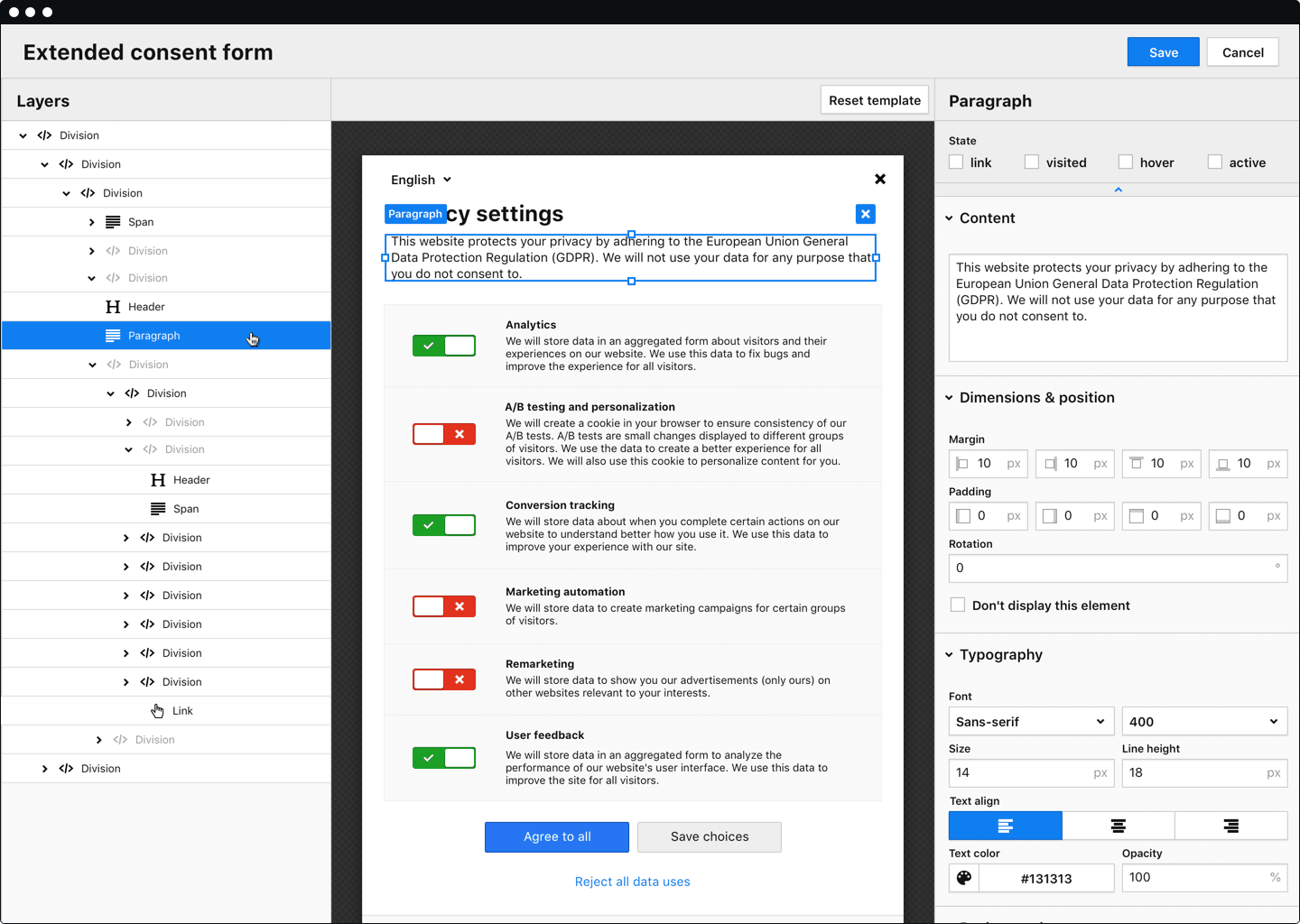
Cookie Information
Cookie Information is a leading consent management platform, trusted by thousands of organizations globally to meet GDPR and other privacy law requirements. It offers extensive features such as automatic cookie detection and categorization, customizable banners, consent log retention, and support for frameworks like IAB TCF 2.2.
With out-of-the-box support for 44 languages and seamless integration with platforms like Piwik PRO, it’s an ideal solution for businesses of all sizes seeking robust compliance, transparency, and ease of implementation.

Cookiebot
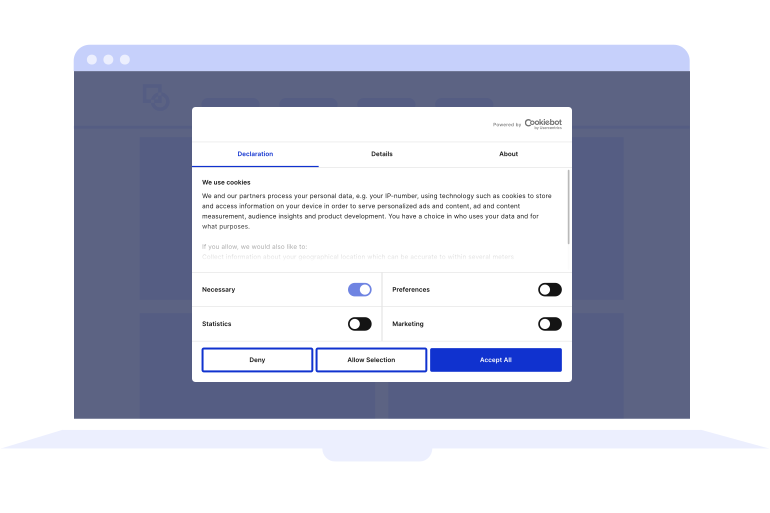
Cookiebot CMP provides transparency and control over all the cookies and similar tracking technologies on your website. It enables proper compliance with privacy legislation through respectful and transparent data exchange between users and the websites they visit to make privacy an integrated part of each site.
Usercentrics
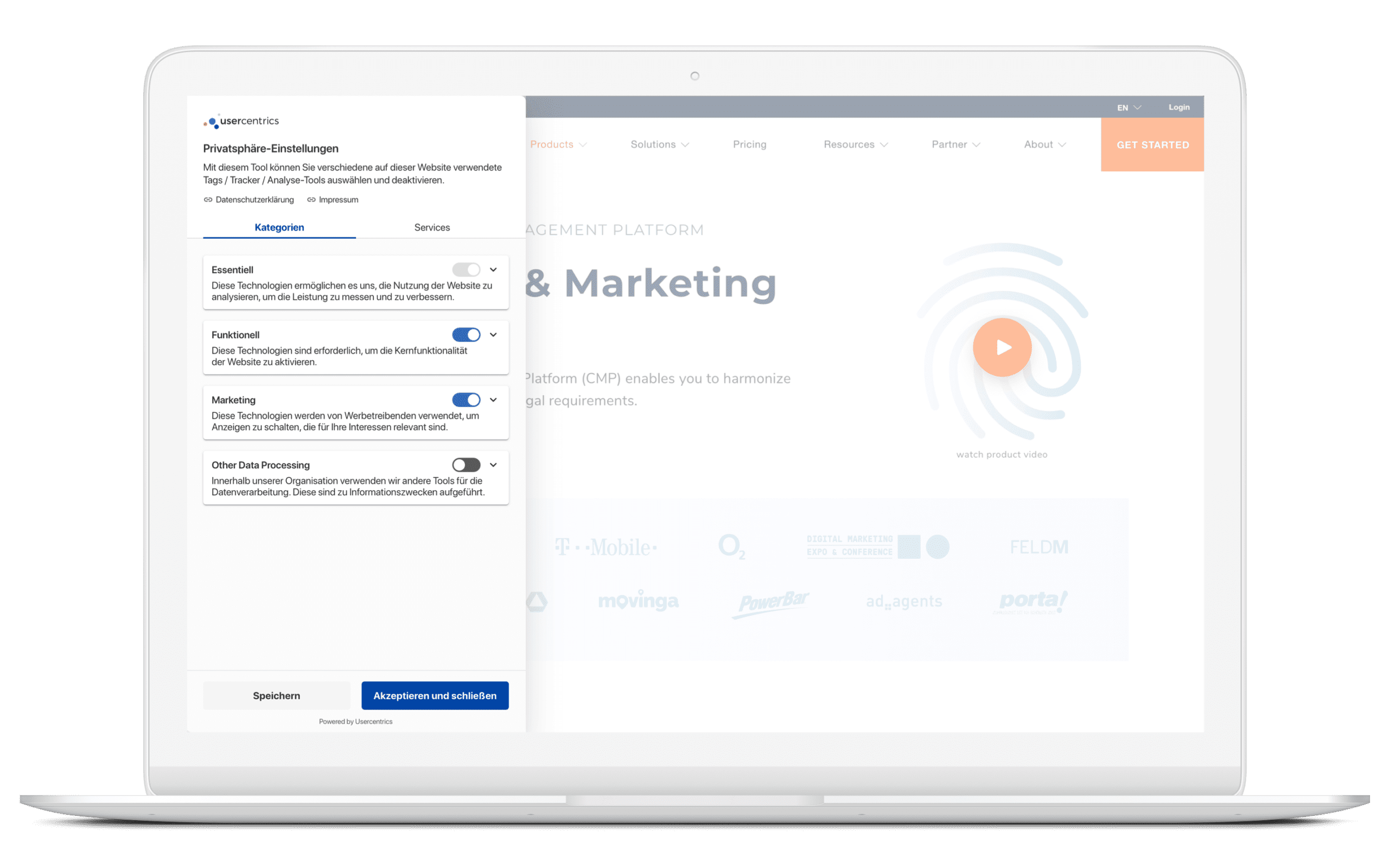
Usercentrics allows businesses to collect, manage, and document user consents across websites and apps, ensuring compliance with global privacy regulations. It provides smooth capture and management of user preferences and marketing permissions, empowering users with complete control over their data.
OneTrust
OneTrust provides privacy management and marketing compliance technology that helps organizations comply with global regulations. The platform lets you visualize and manage the data coming into your organization while ensuring compliance and honoring customer rights, choice, and transparency.
UniConsent
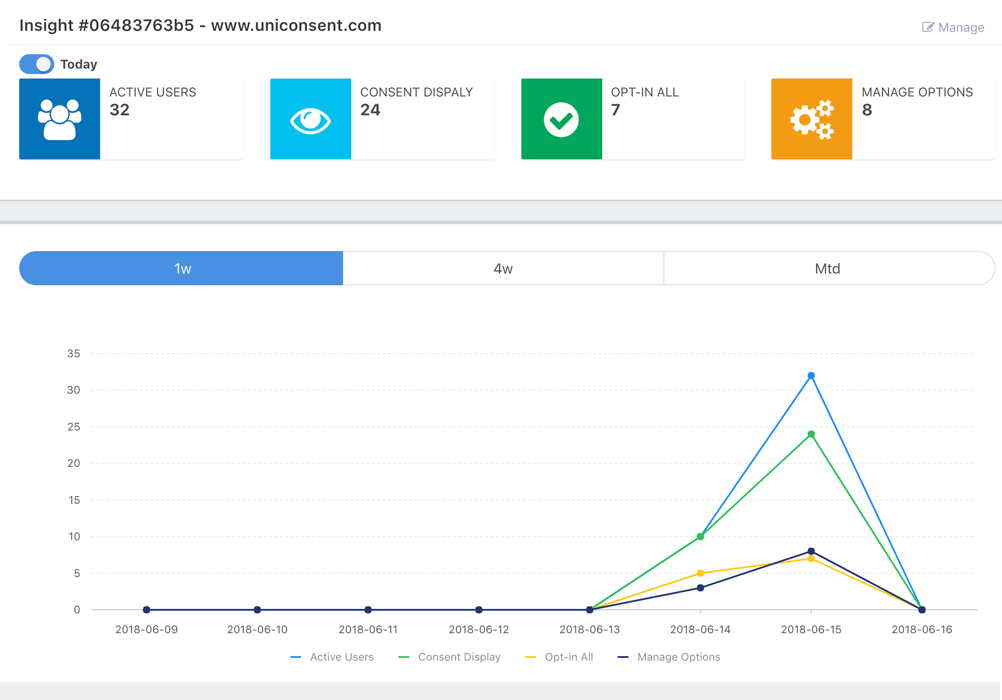
UniConsent is an independent CMP that helps publishers and marketers align with privacy laws like ePrivacy, GDPR, and CCPA. It offers a variety of additional features, like cookie scanning and disclosure, cookie banners, and data subject requests management, as well as consent analytics and insights.
Didomi
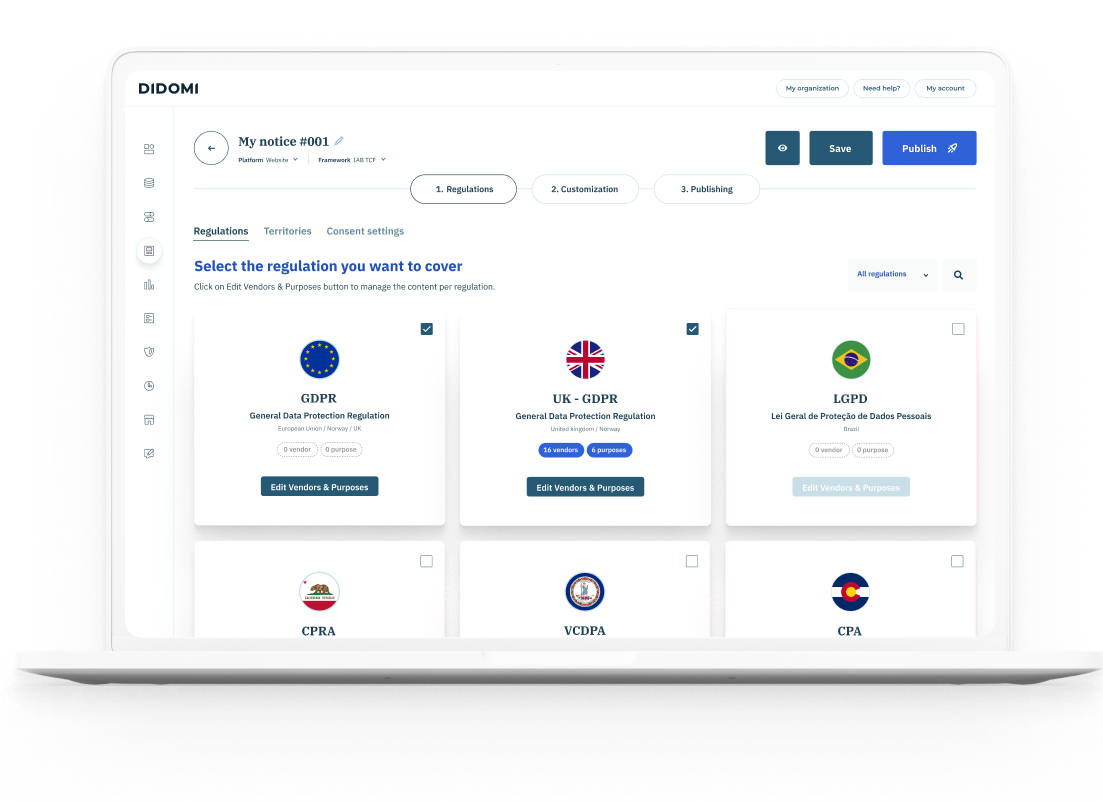
Didomi is a comprehensive suite with a wide range of integrations. Its focus on quality user experience and compliance with major data privacy laws helps companies put customers in control of their data, generating trust and revenue. It is a robust consent management platform perfect for users who can harness its customization options and integration capabilities.
Osano
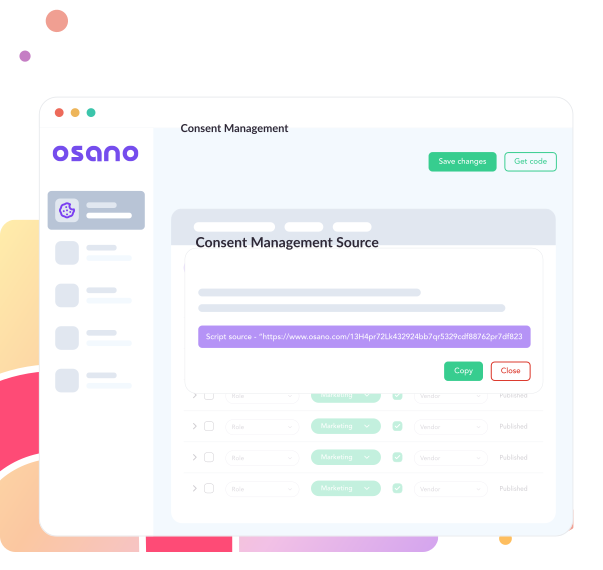
Osano offers a range of tools and solutions to ensure compliance with data protection regulations and effectively manage user consent. It supports value-added services for analyzing and mitigating risks associated with third-party vendors, along with customizable cookie consent banners.
CookieYes
CookieYes offers a straightforward platform with essential functionalities, such as a fully customizable cookie banner, tracking user consent, or a unified interface. It’s a simple tool focusing on its core consent management processes. The platform delivers a quick path to compliance at a low cost.
Ketch
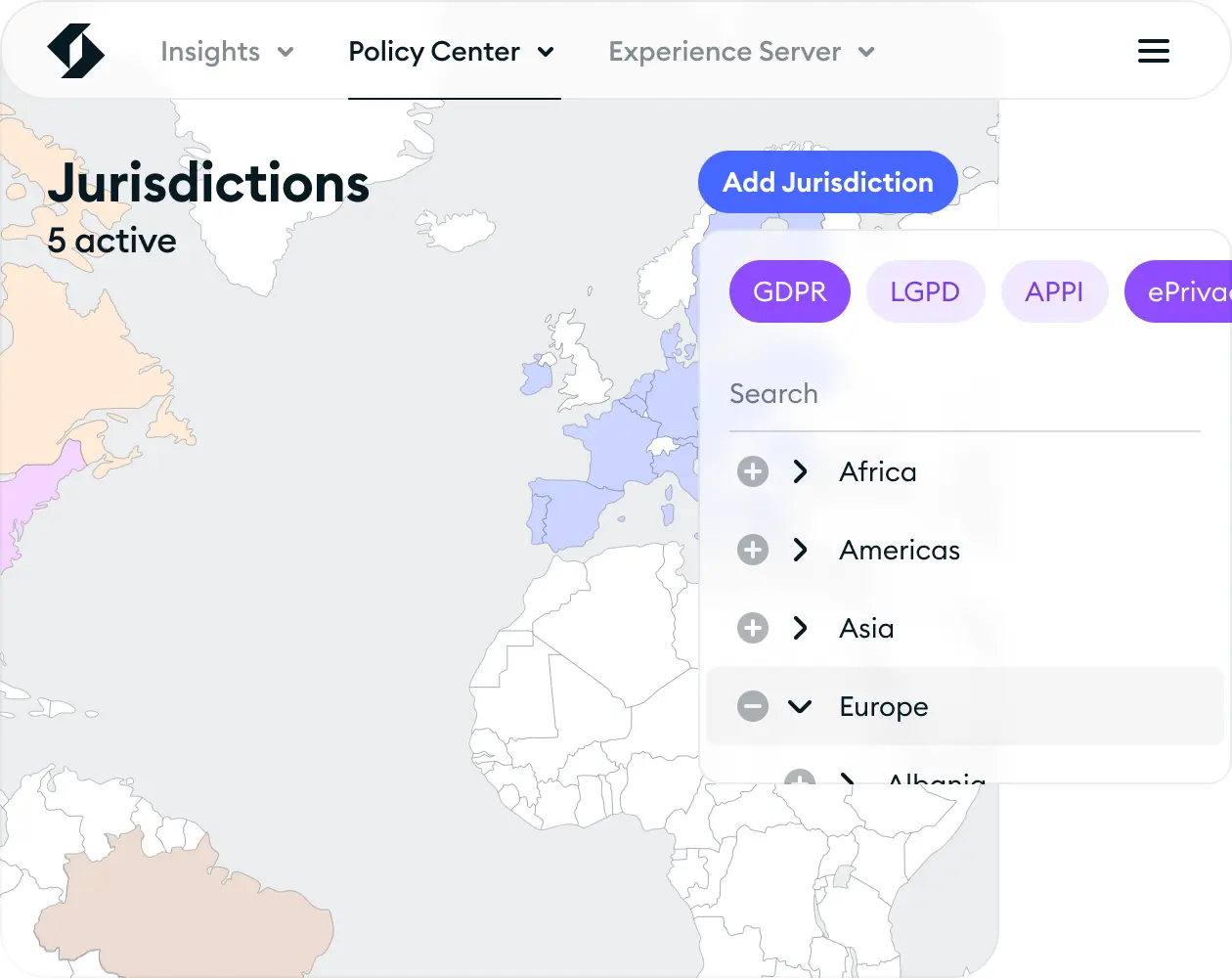
Ketch is a comprehensive privacy management platform offering features such as data usage and storage management, consent management, risk assessment, and handling data subject access requests. While it provides robust tools for privacy compliance, its focus is primarily aligned with U.S. regulations. Some of its messaging and features are not fully compliant with GDPR, which positions it as a stronger fit for U.S.-based companies rather than those targeting the EU market. As such, Ketch may be a competitive choice for enterprises seeking AI-based privacy solutions tailored to the U.S. regulatory landscape but is less suitable for businesses with a GDPR-centric compliance strategy.
What we have covered in our CMP comparison
Our comparison consists of the following sections:
General overview
This section includes the most important features of the analyzed consent managers. You can see what hosting options are available, such as private cloud hosting or choosing data residency. Also, you can check which platforms have ISO 27001 certifications.
It’s also important to know whether these platforms comply with the General Data Protection Regulation (GDPR) that gives individuals full control over their personal data.
| Type of hosting | ISO 27001 certified | GDPR compliance | 100% data ownership | |
|---|---|---|---|---|
| Piwik PRO | Cloud or private cloud | | | |
| Cookie Information | Cloud | | | |
| Cookiebot | Cloud | | | |
| Usercentrics | Google cloud servers | | | |
| OneTrust | Cloud, private cloud or on-premises | | | |
| UniConsent | Cloud | | | |
| Didomi | Cloud | | | |
| Osano | Cloud | | | n/a |
| CookieYes | Cloud | | | n/a |
| Ketch | Cloud | | | n/a |
Features and functionalities
Check if the platform enables reporting features and dashboards, the option to export reports, or view user consent history. Learn which privacy-facing features related to cookies are available – for example, cookie scanning to detect what cookies load on the site, zero-cookie load that lets you comply with some strict laws, or cookie whitelisting. Some tools may also include Do-Not-Track support, cookie library, or can share consent across various domains.
Find out which vendors allow you to re-ask users for consent or offer real-time geotargeting. See if you can display the consent banner in different languages and whether the visitor’s language will be automatically detected. For example, Cookie Information supports features like zero-cookie load, consent log retention, and language localization – all designed to ensure both legal compliance and a smooth user experience.
Integrations
Check which consent management platform offers integrations with Google Consent Mode, v.1 and 2, Microsoft Universal Event Tracking (UET) Consent Mode, and Google Tag Manager. Such capabilities simplify compliance with data privacy regulations, enhance user experience, and streamline tag management processes, ultimately benefiting both users and businesses.
| Google Consent Mode | Google Consent Mode v.2 | Google Tag Manager | |
|---|---|---|---|
| Piwik PRO | | | |
| Cookie Information | | | |
| Cookiebot | | | |
| Usercentrics | | | |
| OneTrust | | | |
| UniConsent | | | |
| Didomi | | | |
| Osano | | | |
| CookieYes | | | |
| Ketch | | | |
Banner customization options
Highly customizable consent banners can be adjusted to match your organization’s design and brand voice. Learn if you can visually customize the banner and the consent text, create the popup or bar layout, and add visual elements. Also, discover which consent management platform offers pre-built templates compatible with IAB TCF.
To check which of your banners perform better, you should also be able to perform A/B testing. One of the key features to look for in a CMP vendor is the ability to set consent collection for specific purposes, which we also include in this section.
| Visual customization | Popup layout | Bar layout | Ability to add visual elements | |
|---|---|---|---|---|
| Piwik PRO | | | | |
| Cookie Information | | | | |
| Cookiebot | | | | |
| Usercentrics | | | | |
| OneTrust | | | | |
| UniConsent | | | | |
| Didomi | | | | |
| Osano | | | | |
| CookieYes | | | | |
| Ketch | | | | |
Data subject access requests
Processing data subject requests is a significant benefit of using a CMP. Find out if the compared tools allow you to handle data subject requests and if they offer data subject request widgets.
Customer care
Customer support helps solve some issues you might experience with the CMP platform. If you need troubleshooting or assistance in configuration, it’s crucial to get the support you need from the vendor’s customer care department. Find out what customer support features are available – such as contact via email, online help center, or community forum.
Some vendors may offer more personalized assistance, like a dedicated support specialist. You might opt for personalized onboarding or training or benefit from custom integrations and development if needed.
Comparison of 10 leading consent management platforms
If you want more details about the most popular consent management platforms and how they stack up against each other in more categories than listed in the article, download our whitepaper (in English). The comparison includes insights from the recent merger between Cookie Information and Piwik PRO, reflecting their combined capabilities for enterprise-grade privacy and analytics solutions.
Comparison
Comparison of 10 leading consent management platforms
Compare 40 key differences to determine which CMP fits your business needs: Piwik PRO, Cookie Information, Cookiebot, Usercentrics, OneTrust, UniConsent, Didomi, Osano, CookieYes and Ketch.
The post Comparison of 10 leading consent management platforms appeared first on Piwik PRO.
]]>The post The comparison of 10 web and app analytics platforms [UPDATE] appeared first on Piwik PRO.
]]>Web analytics platforms help companies surface useful insights to better understand their users and how they interact with their sites or apps. The data they gather helps businesses refine their operations and marketing strategies. Equipped with analytics data, companies can personalize content, optimize user experience and track the performance of marketing campaigns together with all parts of their sites or apps.
Web analytics software has evolved a lot since the beginning of the Internet, and it is now reaching the prime of its life. For a while, Google Analytics was the default solution for most companies. Today, there are dozens of great tools that can address practically every use case and expectation. To help you decide, we’ve compiled a comparison of the most popular web analytics tools, particularly those recommended for enterprises and other large organizations.
Our comparison includes Piwik PRO Enterprise, Google Analytics 4, Matomo Cloud, Adobe Analytics, AT Internet, Countly Enterprise, Mixpanel Enterprise, Amplitude Enterprise, Snowplow Enterprise, and Heap Premier. See how they differ in terms of analytics capabilities, reporting features, data privacy and security, customer care, and much more.
Choosing an enterprise web analytics partner is hard
The aim of all enterprise-level web analytics vendors is very similar, but with different tools come different functionalities and services. There is no one-size-fits-all web analytics platform.
Remember that if you invest in web and app analytics software, ensure you have sufficient development, analytics and management resources within your organization. At the same, your chosen web analytics vendor can help you fill any gaps through the support they offer.
After reviewing our comparison, you will be able to identify which platforms align with your requirements.
COMPARISON
The comparison of 10 web and app analytics platforms
Learn the key differences between Piwik PRO Enterprise, Google Analytics 4, Matomo Cloud, Adobe Analytics, AT Internet, Countly Enterprise, Mixpanel Enterprise, Amplitude Enterprise, Snowplow Enterprise, and Heap Premier.
How to find the right web and app analytics platform for your business
For each vendor, we outline and compare features from the following categories:
Data collection flexibility
Web and app analytics platforms vary in terms of flexibility in data collection. See the extent of the available custom variables and dimensions, JavaScript tags and mobile SDKs, and the number of properties you can track. If you have a lot of sites or apps, consider vendors that let you track an unlimited amount of properties. Learn how fresh the data is and how long you can retain it. Finally, check out what hosting options are available – go for the public cloud, or choose more secure variants, like private cloud or storing data on your own servers.
Data processing and connectivity
Another field we explored is data processing and connectivity. Find out which platforms offer unsampled data and whether you can benefit from raw data access and a reporting API to gain more flexibility when working with data. You can also explore the options to extend each platform’s capabilities with connectors to common BI and data visualization software or integrations with a customer data platform or tag manager.
Data privacy and security
Some web and app analytics vendors offer data privacy and security measures, but they aren’t the industry standard yet. If you must follow strict privacy requirements, select a platform that provides 100% data control, advanced data anonymization, an integrated consent manager and compliance with GDPR or HIPAA. Check out which platforms offer data backups and redundancy, IP anonymization and security certificates, like ISO 27001 or SOC 2. If you work in an industry that handles sensitive data, such as healthcare, finance or government, ensure your chosen analytics platform suits that field.
Reporting features
Reporting features are the most crucial aspect that makes an analytics platform useful. Explore the available types of reports and customization options for reports and dashboards. Find out how you can better understand user behavior – for example, some platforms show funnels, user flows and customer journeys. See what data you can track, how you can visualize it, and the possibilities for sharing reports. We also included information about additional reporting characteristics, like detailed session logs, custom channel groupings or automatic insights.
Support and customer care
Depending on the complexity of your analytics setup, you might require extensive customer support. Some vendors limit their offer to a self-service help center, email support or community forum. If you expect more, choose a vendor with personalized implementation and onboarding or a dedicated support specialist.
Overview of web and app analytics vendors
Our comparison includes the following vendors:
Mixpanel
Mixpanel is an advanced product analytics tool specializing in tracking in-app behaviors, segmenting users, and monitoring metrics like feature usage, retention, engagement, lifetime value, and churn. Its setup process provides granular control over every user action you track. The feature set includes detailed product analytics reports and an option to add historical event info to your data.
Matomo
Matomo is an open-source alternative to Google Analytics. It was founded in 2007 and was known as Piwik until 2018, when it rebranded. Depending on your infrastructure and needs, you can choose between Matomo On-Premise and Matomo Cloud. The latter gives you access to all Matomo features, automatic software updates, free customer support, and complete control and ownership of your data. Matomo also offers a marketplace with paid and free add-ons.
AT Internet
AT Internet provides a web analytics tool and services for websites, intranet, mobile sites and apps. It is designed to adapt to the specific needs of each project in all business models and industries. AT Internet helps companies measure their audience and optimize their digital performance across marketing channels, from data collection to exploration, activation and sharing insights.
Amplitude
Amplitude develops a product analytics and event-tracking solution that works in real-time and is collaborative and self-serve for companies. It’s a single platform that allows you to unite all your data, spot product and behavior trends, and review insights with automated reports and industry templates to get quick answers.
Snowplow
Snowplow Analytics is an open-source enterprise event analytics platform that enables data collection from multiple platforms for advanced data analytics. Snowplow allows organizations to generate and model first-party customer data from across their digital interfaces to capture customer journeys and build user profiles. The platform allows companies to fulfill obligations of privacy laws such as GDPR and CCPA.
Heap
Heap is a digital insights platform that gives teams a complete understanding of customers’ digital journeys to improve conversion, retention, and customer satisfaction. Heap allows its clients to test, measure, and enhance product-market fit. You can use the platform’s capabilities without heavy coding, access complete historical data for events, and explore integrated session replays and data science-surfaced insights.
Adobe Analytics
Adobe Analytics is a part of Adobe Marketing Cloud. It lets you measure the performance of your websites and marketing activities and is highly customizable for users with the right know-how. Adobe Analytics can be integrated with other Adobe marketing products. It offers advanced segmentation, real-time automation, ad-hoc analysis, and other features. Adobe Analytics is used in the enterprise environment and provides support and consulting to its clients.
Google Analytics 4 (GA4)
Google Analytics 4 (GA4) is the newest analytics platform from Google that supersedes Universal Analytics. Google’s new platform represents a new approach to data modeling. GA4 relies on user-based tracking, focusing on user interactions and events across various digital platforms. It introduces new features and enhancements compared to its predecessor. At the same time, it offers fewer default data collection settings, which translates into the need for extensive customizations.
Countly
Countly is a product analytics platform that helps teams track, analyze, and act on their user actions and behavior on mobile, web and desktop apps. It allows you to innovate your products to provide personalized and customized customer experiences. You can build better applications and experiences while maintaining full control over the product analytics data flow.
Piwik PRO
Piwik PRO provides analytics software for websites, apps, and digital products that lets you track complete customer journeys and gives you access to accurate user data, including in post-login areas. With the collected insights, you can analyze and improve user engagement and ensure a smooth experience with your website and app. Through Piwik PRO’s privacy-by-design focus, you can also benefit from enhanced data anonymization, full data control, and a number of secure hosting options, including on EU servers.
COMPARISON
The comparison of 10 web and app analytics platforms
Learn the key differences between Piwik PRO Enterprise, Google Analytics 4, Matomo Cloud, Adobe Analytics, AT Internet, Countly Enterprise, Mixpanel Enterprise, Amplitude Enterprise, Snowplow Enterprise, and Heap Premier.
The post The comparison of 10 web and app analytics platforms [UPDATE] appeared first on Piwik PRO.
]]>The post Piwik PRO vs. Adobe Analytics: Comparison of enterprise analytics platforms appeared first on Piwik PRO.
]]>You may already be using Adobe Analytics but are considering an alternative that offers similar or better features, including Piwik PRO Analytics Suite in the paid Enterprise plan. Or you might be a Universal Analytics user who’s not interested in switching to Google Analytics 4 (GA4) or its paid version, GA4 360, and wants to explore their options.
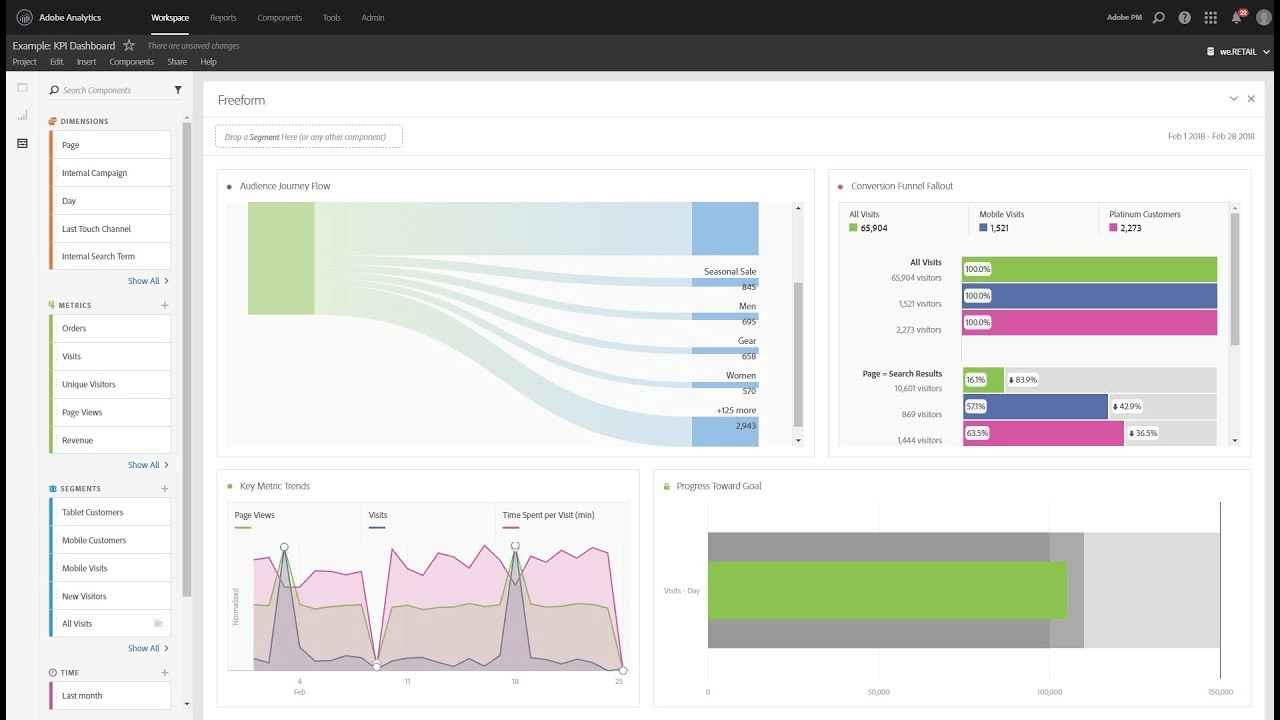
That is why we’ve placed Piwik PRO Enterprise and Adobe Analytics side by side for you to see the key differences between them and decide what’s your best bet. See how they differ, especially regarding analytics capabilities, data privacy and security, and customer care.
What is Adobe Analytics?
Adobe Analytics is part of Adobe Marketing Cloud. It is the result of a series of acquisitions between 2007 and 2014. The foundation of Adobe Analytics is the SiteCatalyst solution by Omniture, which was acquired by Adobe in 2009.
Users with the right know-how can customize the tool to measure the performance of their websites and marketing efforts. Adobe Analytics can be integrated with other Adobe marketing products like Adobe Campaign or Adobe Target. In addition to advanced segmentation and real-time automation, it offers ad-hoc analysis. Adobe Analytics provides various services for enterprise clients, including support.
Adobe charges based on every 1,000 server calls (page views + downloads + custom events) generated from the client’s website.
Its customers include Sony, Asos, and B&Q.
If you want to learn more about migrating to GA4 read:
What is Piwik PRO?
Piwik PRO was established in 2013. The company develops enterprise-class analytics that ensure data privacy and security. Piwik PRO is available in the Business plan or paid Enterprise plan. In this comparison we discuss Piwik PRO Enterprise.
Visit our pricing page for more details about the available plans.
Since its release, Piwik PRO has consisted of four modules: Analytics, Tag Manager, Customer Data Platform, and Consent Manager. All of these products are now part of the Piwik PRO Analytics Suite.
Piwik PRO is designed for medium-sized and enterprise-level organizations. Hosting options include:
- Private cloud in a dedicated database or dedicated hardware. The Bring Your Own Key encryption on private cloud (dedicated hardware) allows for the encryption of analytical data using the customer’s key, but it applies only to hosting provided by Azure.
- Cloud-hosted models (with servers in Germany, France, Sweden, Hong Kong, the Netherlands, and the United States) depending on the client’s requirements.
Each module follows strict privacy and security regulations while ensuring partners retain complete control of their data.
Its customers include Würth, HP, the European Commission, and Crédit Agricole.
You may also like: The comparison of leading enterprise web analytics platforms: which solution will be right for you?
Differences between the products
Both platforms are designed to meet enterprise clients’ needs and support web and app analytics. That said, Piwik PRO is different from Adobe Analytics in some aspects.
Getting started with the platform
Piwik PRO is easy to set up and makes it effortless to configure key data collection settings, such as the use of cookies, without having to leave the interface or write code. The platform comes with a number of built-in reports similar to those found in Universal Analytics. It offers a high level of customization, allowing users to tailor the platform to their specific needs, and provides open APIs to facilitate integration with other tools and systems.
The Piwik PRO team lends you a hand when setting up and configuring your web analytics instance. You can also count on personalized support, on-demand custom training and workshops. The SLA ensures all your needs are addressed while using the product. You may also use robust resources like the help center and community forum. Finally, you get 24/7 monitoring and incident handling, so issues are immediately spotted and fixed.
Adobe Analytics offers a wide range of pre-built features and integrations, but the implementation and customization options may be challenging if you are not a pro analytics user. With Adobe, you will have extensive online documentation at your fingertips, and you can reach out to the community, but Adobe Analytics support does not provide implementation services or training. Adobe offers a separate consulting service for implementation, and also provides certification.
| Adobe Analytics | Piwik PRO Enterprise | |
|---|---|---|
| Standard reporting | Reports & Analytics will be sunsetted in December 2023 | rich set of standard reports |
| Web and mobile app analytics | | |
| Custom reports | | |
| Custom dimensions | | |
| Reporting API | | |
| Customer care | | |
| Dedicated support specialist | Ultimate support package only | |
| Personalized implementation & onboarding | Ultimate support package only | |
| Personalized product training | Ultimate support package only | |
| Analytics consulting | | |
| SLA 99% uptime | | |
| Self-service help center | | |
| Community forum | | |
| Email support | | |
| Live chat support | | |
Reports and features
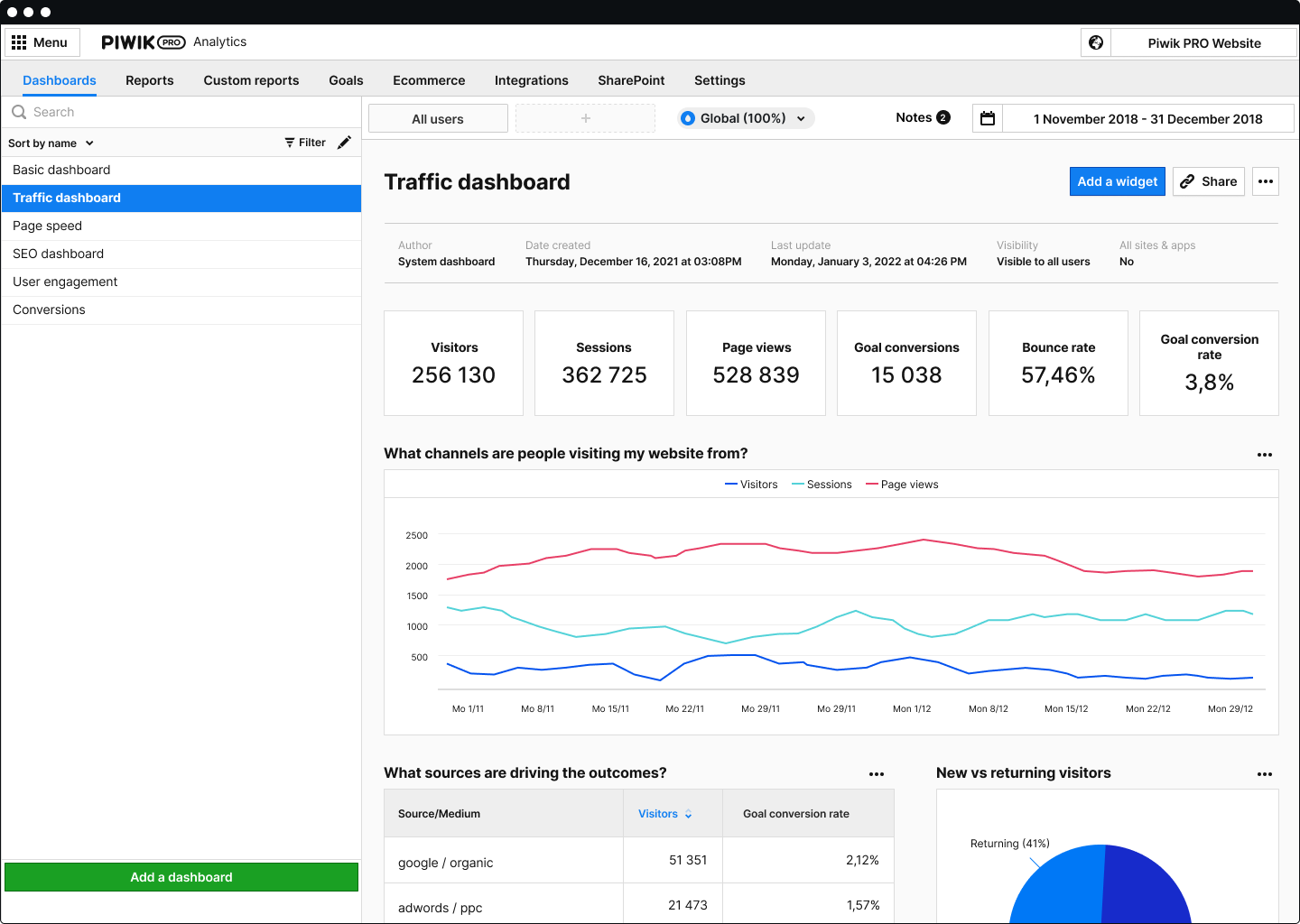
Piwik PRO provides a user-friendly interface with customizable dashboards and reports. It offers various standard and advanced reports and visualizations for analyzing website data. You will find audience reports, traffic acquisition reports, behavior reports to analyze top pages, and conversion-focused reports.
Piwik PRO offers a high level of customization, allowing users to tailor the platform to their needs. The platform also has a multi-channel attribution report with a selection of attribution models, including custom ones. It is essential for assessing conversion.
Piwik PRO also has ecommerce tracking capabilities. It allows you to track product views, add-to-cart actions, completed purchases, and other relevant metrics. Piwik PRO’s ecommerce reporting features are constantly evolving. The ecommerce module has recently been updated to support product-scope reporting (including custom reports).

Currency conversion
The new Currency Conversions feature empowers businesses to consolidate revenue data from various currencies into one standard currency, facilitating more accurate and comprehensive financial reporting. Learn more in our article: Currency conversion.
If we consider data processing, in Piwik PRO, you can count on data freshness every 30 minutes, and sampling is done only on request. In other words, even if your website records hundreds of millions of actions monthly, you still have smooth access to complete analytics data sets.
Piwik PRO offers also real-time reporting capabilities. Moreover, in Piwik PRO you can see the number of live conversions related to the channel/campaign. So if you run marketing campaigns, their performance can be measured not only based on traffic but also on the number of conversions per channel or type of campaigns. Keeping an eye on these conversion rates offers a useful way to analyze and compare the effectiveness of various advertising channels in real-time.
Adobe Analytics offers a feature-rich user interface with advanced reporting capabilities. It provides powerful data visualization tools and allows for in-depth analysis and segmentation. Analysis Workspace should be the go-to user interface for all your reporting and analysis needs. The Reports menu provides access to the complete set of reports. They are highly customizable, and you can shape the report to view and analyze the data according to your needs. You can filter report data, change how data is presented graphically, change date granularity, and more.
Adobe Analytics offers multi-channel attribution and data-driven attribution. The platform’s ecommerce tracking is fully-featured. It was designed specifically for ecommerce businesses. The data freshness is 45-120 min. There is no sampling except for selected Audience Manager reports.
| Adobe Analytics | Piwik PRO Enterprise | |
|---|---|---|
| Regular expressions in filters, segments & groupings | | |
| Advanced segmentation & data filtering | | |
| Data freshness | 45 – 120 min (typically, except for real-time reports) | 30 min |
| Data sampling | none, except for selected Audience Manager reports | none by default. can be enabled for high-traffic properties to improve reports load time |
| Custom dashboards | | |
| Funnel reporting | | advanced |
| User flow reporting | | |
| User-level reporting | (can be set up) | |
| Site speed reports | setup required | |
| Ecommerce tracking | | new features coming soon |
| Detailed real-time reporting | | |
| Consent reports | | |
| Predefined attribution models | | |
| Data-driven attribution | | |
Integrations
Piwik PRO Analytics Suite provides flexible data collection and reports, consent management, tag management, and a customer data platform. With a customer data platform, you can create complete customer profiles and segment your data into audiences. It allows you to provide a personalized experience and run effective campaigns across channels. At the same time, you can keep your clients’ data safe with Piwik PRO’s privacy-first approach.
Piwik PRO integrates well with the ecosystem of Google products like BigQuery, Looker Studio, Google Search Console, and Google Ads as well as with various third-party platforms.
Unlock the power of your Shopify store with Piwik PRO
Drive smarter decisions with Piwik PRO’s Shopify app. Track customer behavior, product interactions, and sales performance with ease, without the hassle.
The app simplifies setup, ensures GDPR-compliant data collection, and integrates seamlessly with your Shopify store. Gain valuable insights that help you optimize your ecommerce business and stay ahead of the competition.
With Piwik PRO you can use integration with Google Tag Manager to collect data server-side and client-side.
Adobe Analytics integrates well with the whole Adobe Marketing Cloud. Adobe Analytics is part of a powerful 10-product suite. Customer Data Platform is available as an additional product.
Though Adobe Analytics can be integrated with BigQuery, it doesn’t integrate well with Google products. There are no Google Search Console or Google Ads integrations. Adobe Analytics provides powerful data visualization tools but lacks integrations with popular BI and data visualization software (for example, Tableau, Power BI, or Google’s Looker Studio).
| Adobe Analytics | Piwik PRO Enterprise | |
|---|---|---|
| BigQuery | | |
| Customer data platform | (available as an additional product) | (native integration with Piwik PRO Customer Data Platform) |
| Google Search Console | | |
| Google Ads | | |
| Looker Studio | | |
| Integrations with popular BI and data visualization software (e.g., Tableau, Power BI) | | |
| Shopify integration | Manual integration through custom setup or 3rd-party apps like Adobe Experience Platform | Native Shopify app available for easy installation, full-store tracking, and data compliance |
Hosting
You can access Piwik PRO through our certified providers in a private cloud across over 60 locations, including Microsoft Azure, and Elastx in Sweden. You can also use public clouds in Germany, the Netherlands, Hong Kong, Sweden, France, or the US. The data center where your information will be stored is up to you.
Adobe Analytics is a cloud-based analytics solution provided by Adobe Systems. It requires a subscription and is hosted on Adobe’s servers. Adobe Analytics’ data center locations currently include the following locations: Oregon, Virginia, Ireland, Paris, Mumbai, Singapore, Tokyo, Sydney, and China.
| Adobe Analytics | Piwik PRO Enterprise | |
|---|---|---|
| Cloud | | selected data center: Germany, the Netherlands, France, Sweden, the US or Hong Kong |
| Private-cloud | | selected data center: one of 60+ Azure regions, or Elastx in Sweden |
Data control and privacy
Piwik PRO emphasizes data control and privacy. This can be important for compliance with data protection regulations like GDPR and HIPAA. The company included GDPR- and HIPAA-related features and controls when developing the product and security policies, comprising an in-built consent manager tool and advanced data anonymization options.
Because of that, it can easily support your analytics use cases in healthcare. You can sign a BAA with Piwik PRO, allowing you to send all types of PHI to your analytics setup. This means you don’t need to take on the task of de-identifying PHI.
Read more: Piwik PRO is officially HIPAA-certified!
Additionally, you can enable zero-identity tracking, a method that combines several privacy settings in Piwik PRO to let you obtain as much data as possible without personal data. You gather event statistics without using visitor or session identifiers, only anonymous data. In this process, consent isn’t necessary.
Adobe Analytics is a US company that collects and stores data on Adobe’s servers. You should consider this when assessing your compliance risks.
If you want to learn more about US-EU data transfers, read: Everything you need to know about the Data Privacy Framework (Privacy Shield 2.0)
Regarding HIPAA, Adobe Analytics is not listed as HIPAA-ready on Adobe’s site. It means that Adobe won’t sign a BAA with you to use Adobe Analytics. As a result, you are not permitted to create, receive, maintain, or transmit PHI through Adobe Analytics. So if you’re a HIPAA-covered entity and want to use Adobe Analytics, you must ensure that your data is stripped of any identifiers that could turn it into PHI. This imposes some serious burdens on your end.
Finally, Adobe Analytics doesn’t offer zero-identity tracking.
| Adobe Analytics | Piwik PRO Enterprise | |
|---|---|---|
| 100% data control | | |
| Advanced data anonymization | Not provided out-of-the-box. can be implemented with data collection | |
| Out-of-the-box anonymous and de-anonymized data streams | | |
| Zero-identity tracking | | |
| IP anonymization | | |
| Local data residency | | EMEA region |
| GDPR compliance | policies, disclosures, and consent must be implemented | |
| HIPAA compliance | | |
| Integrated consent manager (with data subject requests management) | | |
Pricing
Piwik PRO offers two plans – Business (monthly action limit 2M) and Enterprise. The price of Piwik PRO Analytics depends on many factors, including the number of modules you’re interested in, your monthly traffic, your preferred hosting option (e.g., private cloud is more expensive than public cloud), and your chosen SLA package.
Adobe Analytics is considered one of the most expensive solutions on the market. The basic Select version has an analytics workspace to build customized reports with a drag-and-drop interface, rule-based attribution, and the ability to integrate up to three offline data sources. The Prime and Ultimate versions are richer in features, offering add-ons such as segmentation capabilities, data anomaly detection, extended storage, and additional data source connections. Pricing runs over $100K.
| Adobe Analytics | Piwik PRO Enterprise | |
|---|---|---|
| Price of Enterprise plans |  |  check our pricing |
| Free plan | | |
Vendor
Piwik PRO has an engaged and continuously growing community of experts. With its rich set of default reports and advanced yet easy customization options, it is a universal solution that meets the needs of both analysts and marketers.
Adobe Analytics has a large community of practitioners and consultants. Its complex structure and user interface better suit an organization with a well-defined separation of roles: architects, implementation, and analysts.
| Adobe Analytics | Piwik PRO Enterprise | |
|---|---|---|
| Community of experts | | |
| Suitable for analysts and marketers | steep learning curve | |
| Suitable for an organization with a well-defined separation of roles | | |
There are many enterprise web analytics vendors, but different services and functionalities come with different tools. There is no one-size-fits-all web analytics platform.
Let’s discuss the pros and cons of Adobe Analytics and Piwik PRO Enterprise.
Advantages and disadvantages of Adobe Analytics
PROS:
 It is built as a more bespoke solution, allowing you to customize your data collection and reporting fully. It has real-time reporting capabilities*.It offers a data-driven attribution model similar to the one in Google Analytics 4 360.It has vast features and functionalities. Particularly when it comes to segmentation capabilities, it offers flexibility and customizability. It integrates well with the whole Adobe Marketing Cloud. It offers fully-featured ecommerce tracking.
* You can typically expect to see complete data in reports to 2 hours after data is collected, except for real-time reports (create up to 3 real-time reports per report suite).
CONS:
 It is one of the most expensive solutions on the market.It requires technically skilled analysts to use all the features and set the platform up correctly. It doesn’t integrate well with Google products.It doesn’t offer personalized support and onboarding.
You can integrate Adobe Analytics with Adobe Target to better test and optimize digital experiences. Adobe Target is an AI-powered user experience testing and personalization platform that helps you automate the process of delivering personalized content to your users.
Find out more about A/B testing tools: Best 9 A/B testing tools for 2023: Google Optimize alternatives
Advantages and disadvantages of Piwik PRO Enterprise
PROS:
It has a quick setup and allows more out-of-the-box data collection.It makes it easy to configure key data collection settings. It has real-time reporting capabilities.It has an intuitive and responsive user interface.It offers support that includes implementation services.Its customers can use its Tag Manager, Customer Data Platform, and built-in Consent Manager.It offers numerous privacy and security features that make it a serious contender among enterprise clients and organizations handling high volumes of sensitive data. It delivers unsampled data by default, giving users reports based on 100% traffic.It integrates well with external tools, including the Google ecosystem and third-party platforms like Tableau.It is more competitively priced.
CONS:
It requires a skilled technical team or premium support if you decide on the self-hosted version. Its ecommerce module is currently limited, but new features are constantly being introduced.
It is worth noting that organizations using Universal Analytics can migrate to Piwik PRO without redesigning their setup, which would be necessary with Adobe Analytics.
Final thoughts
Both Adobe Analytics and Piwik PRO have their strengths.
Piwik PRO allows for high control over data collection and processing. It can help mitigate data accuracy issues related to browser limitations or privacy settings. And if you want premium support, implementation, and onboarding, you’d like someone to advise you on how to set up tracking, create reports, perform custom integrations, and make you comfortable using the platform, then Piwik PRO is a good choice. Not to mention the ability to migrate from Universal Analytics to Piwik PRO without redesigning the setup. Piwik PRO is also a better option if ready-to-use integrations with Google products, like BigQuery and Looker Studio, are important to you.
Organizations needing robust ecommerce tracking and reporting might consider Adobe Analytics. The Adobe platform is highly customizable, offers flexible segmentation, and lets you see your whole conversion funnel to create predictive insights. Its complexity might make it suitable for larger organizations with skilled teams and resources to train them in using Adobe Analytics or to use the services of a specialized agency. Yet, Adobe Analytics is an advanced analytics solution, and its sibling product, Adobe Target, is a powerful combination for testing and optimization.
You’ll likely have to do some strategic thinking and exploration to get the right solution for your business and specific use case. Consider factors such as data privacy, customization requirements, integration needs, support options, and the level of control you desire over your analytics data. Hopefully, our comparison will help you in the process.
Comparison
Piwik PRO vs. Adobe Analytics & Google Analytics 4 360
We’ve placed Piwik PRO, Adobe Analytics and Google Analytics 4 360 side-by-side to showcase their key differences and help you decide your best bet.
The post Piwik PRO vs. Adobe Analytics: Comparison of enterprise analytics platforms appeared first on Piwik PRO.
]]>The post Free comparison of 7 enterprise-ready customer data platforms appeared first on Piwik PRO.
]]>CDPs assist marketers in generating a better customer experience driven by precise information on user behaviors across every touchpoint. In short, a CDP can support the following:
- Data analysis
- Online advertising
- Campaign automation
- Cross-channel customer journey mapping
- Personalization
- Customer support
- Cross-sell and upsell efforts
Marketing teams can manage tasks independently with CDPs without the time-consuming assistance of costly IT specialists.
A CDP creates single customer views by stitching together sources of fragmented data and building an overview of all user information and behavioral details. User profiles can be segmented into audiences that can then be activated on other platforms.
Campaigns and actions based on first-party data that the CDP helps you collect can be more business-specific, effective, and personalized to each user. This type of data is most valuable and relevant to a business, making the insights gathered from it particularly useful for effective marketing and growth. Your marketing strategy gets supercharged faster with real-time data and in-depth insights.
Since the data in a CDP comes directly from users, it makes a great asset for ensuring compliance with GDPR and other privacy requirements.

If you want to learn more about the ways your company can benefit from a CDP, read these posts:
You need to clearly define your expectations to find the CDP that fits you best. Aligning them with features and capabilities from each vendor lets you find the right implementation for your business. That’s why we’ve extensively researched key features of CDPs available on the market.
Below we’ve prepared a thorough comparison of seven enterprise-ready customer data platform vendors. If you’re debating which CDP will work best for you and looking for guidance, you’ve come to the right place.
Customer data platform vendor overview
As you make up your mind about a particular CDP, let’s start by giving you a little peek at the vendors.
Piwik PRO
Piwik PRO combines a data-driven approach with a focus on satisfying the strictest privacy standards worldwide. This makes it the first privacy-oriented alternative to Google Analytics with an integrated CDP. It enables organizations handling sensitive data to analyze and optimize the customer journey and improve their cross-channel marketing efforts.
Tealium
Tealium’s primary focus is the tag management system Tealium iQ and the customer data platform Tealium AudienceStream. The CDP provides data enrichment capabilities that help create unified user profiles and automate actions across all channels. It lets you connect data and deliver it in real-time to make it easier to connect with your customers.
Exponea
Exponea gives marketers complete control over all aspects of the customer experience, especially within the ecommerce industry. Its Customer Data and Experience Platform (CDXP) lets marketers use AI-enriched data to understand customer behavior and run omnichannel campaigns across multiple channels.
Mapp
Mapp’s customer data platform centralizes all data through segmentation, unification of customer profiles, and activation of those in priority channels. With Mapp’s CDP at its core, organizations can connect entire marketing ecosystems to enhance the customer experience.
Segment
Segment is a CDP that helps companies organize, connect, and control their first-party data from multiple cross-device sources. It offers a complete data toolkit to standardize reliable data collection, unify user information, and send customer data into any system. The whole company can use trusted data to accelerate its growth.
mParticle
mParticle provides real-time data that combines quality and governance protections with AI-powered insights and predictions. Focused on mobile and desktop applications, it builds cross-platform user profiles to help marketers drive better marketing and improve conversion and retention for various industries.
Amplitude
Amplitude is a digital analytics platform that focuses on product analytics. It consists of several integrated products, including an insights-driven customer data platform. The CDP lets you un-silo data and connect it across teams, discover new audiences, and unite customer behavioral data across your stack.
Comparing 7 enterprise-ready customer data platforms
In our comparison, we’ve highlighted key differences concerning each CDP vendor’s essential functionalities and qualities.
General characteristics
First, we outlined some general characteristics of the reviewed CDPs to give you quick insights into what you can expect from these platforms. For example, see whether the vendors can be easily integrated with analytics or tag management systems and what hosting options are available.
Data collection and processing
Then, we compared how the CDP vendors approach data collection and processing. Learn how the platforms collect and organize data and what forms of information you can access, including raw or historical data. Find out if they process cookies or allow SDK. See the data types you can import into user profiles to expand and enrich them.
You need access to real-time, adequately normalized data and follow the whole customer journey to ensure your data is accurate and up-to-date. Your marketing strategy should be unified and match data from multiple sources. You should be able to use your stack to its full potential.
Audiences and profiles
We also reviewed the details and possibilities of audiences and profiles in each CDP. Find out how user information is matched to create separate profiles, what attributes are available, and how to segment users who match given traits. You need to be able to merge user profiles over all channels and devices and display the information in single customer views. A well-chosen platform should enable you to continuously update and easily access these profiles and create audiences based on relevant shared attributes or behaviors.
Data activation
Each CDP’s value is connected to how it lets you apply the data in personalization, ad campaigns, emails, remarketing, and other actions you can take to improve customer acquisition and retention and drive more sales. That’s why we couldn’t skip a section comparing the data activation features of each vendor. Learn how to integrate the CDP with other platforms and make it useful.
Privacy and security
On top of that, we’ve evaluated the CDPs in terms of their privacy and security obligations. We have checked which platforms provide privacy-dedicated Opt-out/Do Not Track options, an integrated consent manager, and the ability to onboard sensitive data.
We couldn’t overlook the legal landscape of storing and processing users’ information. We’ve investigated if these platforms adhere to international privacy legislation such as GDPR and whether they boast valid security certifications. Customer data is in your hands. Your company should be able to rely on a vendor that ensures proper compliance with all applicable regulations.
Customer care
Last, we’ve checked what kinds of technical support and customer care services each vendor provides. As an enterprise customer, you may benefit from enhanced guidance through dedicated support and onboarding, personalized training, and custom development & integrations.
Comparison
Free comparison of 7 enterprise-ready customer data platforms
Get to know over 50 key differences to determine which platform fits your business needs best: Tealium, Amplitude, Exponea, mapp, Segment, mParticle or Piwik PRO.
The post Free comparison of 7 enterprise-ready customer data platforms appeared first on Piwik PRO.
]]>The post Reports in Google Analytics 4 and Piwik PRO: Everything you should know appeared first on Piwik PRO.
]]>Piwik PRO and Google Analytics 4 (GA4) provide metrics and features that can form the heart of any data strategy and deliver unique benefits. Both are good choices for experienced analytics users, allowing you to easily mold and bold your data using data warehouses or visualization tools.
Nevertheless, marketers see vast differences between the two. That’s because of what’s available by default in GA4 and the complexity of onboarding to the new platform. Without the rich set of default reports, you must learn how to use advanced databases or hire outside assistance. So you face a choice – to learn analytics based on redesigned tracking logic or to look for a platform based on familiar models and reports. For the latter, you’ll want Piwik PRO.
This article discusses the differences between the platforms and compares their reporting features to help you decide which is better for your business.
Google recently sunsetted the previous version of Google Analytics, known as Universal Analytics or GA3. It is replaced by Google Analytics 4. All standard Universal Analytics properties stopped processing new hits on July 1, 2023. After this date, you can only view historical reports of previously processed data in Universal Analytics for one year.
What is Piwik PRO
Piwik PRO is a web and app analytics platform natively integrated with a tag manager, consent manager, and customer data platform. It helps you track, analyze, and optimize websites and apps to improve user experience and achieve your marketing and business objectives. It also handles both session- and event-based use cases. Piwik PRO supports event-based tracking but collects and processes user interactions on a session level. In Piwik PRO, you can collect a lot of data types, including events, by default.
Piwik PRO offers privacy-focused analytics, allows you to maintain control over your data, and offers options for data hosting in public cloud or in private cloud environments. Piwik PRO emphasizes data privacy and compliance with regulations like GDPR. Various data protection authorities, including France’s CNIL and Lithuania’s VDAI, have recognized its approach to data privacy.
What is Google Analytics 4?
Google Analytics 4 (GA4) is the newest version of the most widely used web analytics platform, Universal Analytics (UA), also called Google Analytics 3. It represents a new approach to data modeling. It is designed to provide businesses with an understanding of user behavior across various digital platforms, including websites, mobile apps, and other online channels. GA4 introduces several new features and enhancements compared to its predecessor. There are also fewer default data collection settings. GA4 relies on user-based tracking, focusing on user interactions and events across various digital platforms.
For an in-depth look at how GA4 and UA compare, read Universal Analytics vs. Google Analytics 4: Data models and other key differences explained
When it comes to data privacy, GA4 is hosted by Google, and the data is stored on US-owned and operated servers, which may raise privacy concerns for some organizations. According to some European data protection authorities, recently Sweden’s IMY, using Google Analytics is incompatible with GDPR.
To learn more about Google Analytics 4, read:
Let’s review the differences in reporting features.
Reports in Google Analytics 4 and Piwik PRO
Both platforms collect data from your websites and apps to create reports that provide insights into your business. You can use reports to monitor traffic, investigate data, and understand your users and their activity.
Yet there are differences in reporting features.
Getting started with GA4
When starting with Google Analytics 4, you will see a Reports snapshot report, a Realtime report, and a few predefined reports. GA4 introduces a new UI. One of the first things you’ll notice about Google Analytics 4 is that the platform structure differs from its predecessor. In GA4, there are no views, and you have data streams. The data collected by default is limited and requires customization. This makes GA4 implementation far more complex.
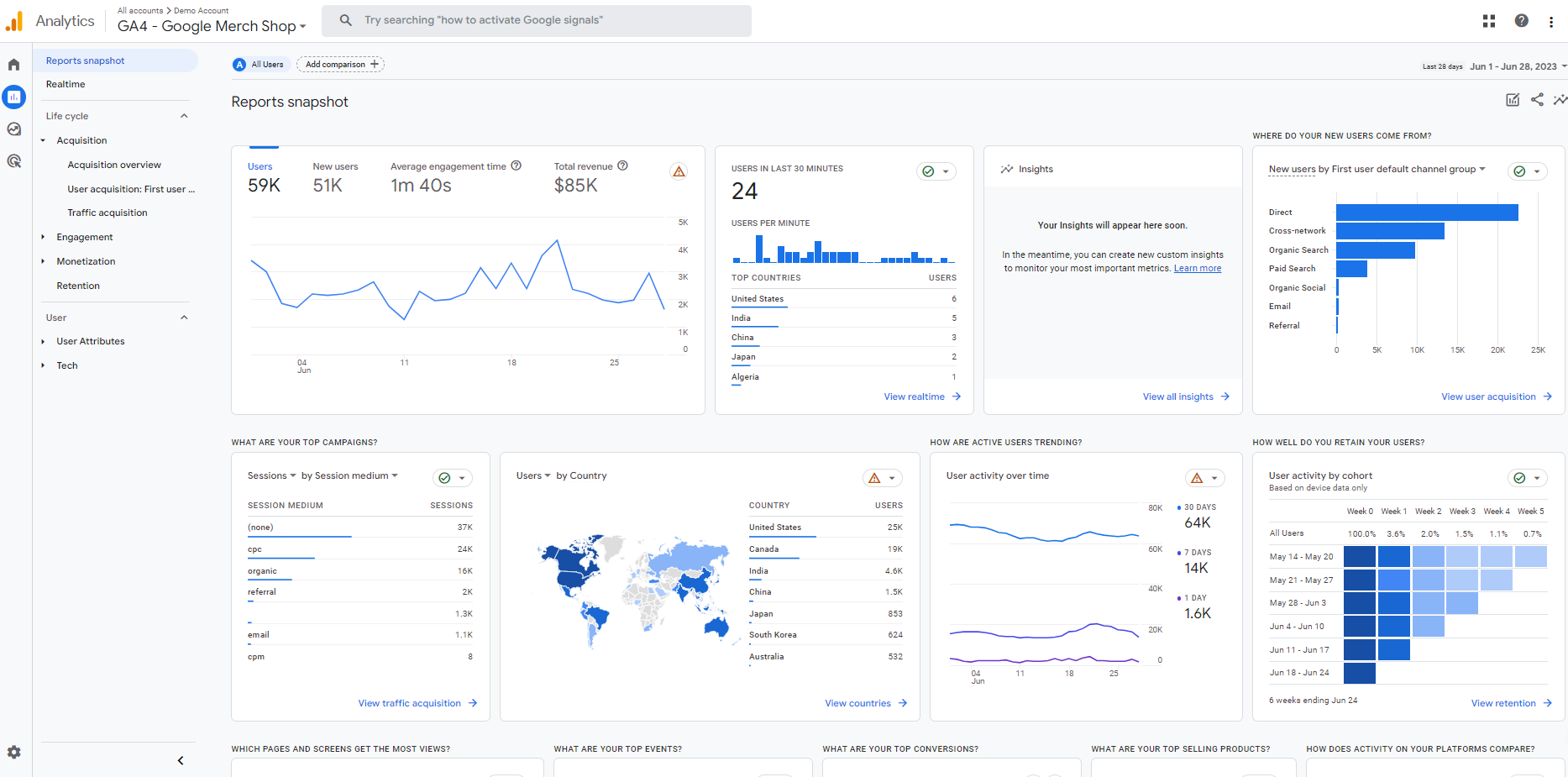
For more advanced reporting, you must create a detailed report in Explorations to investigate your data further.
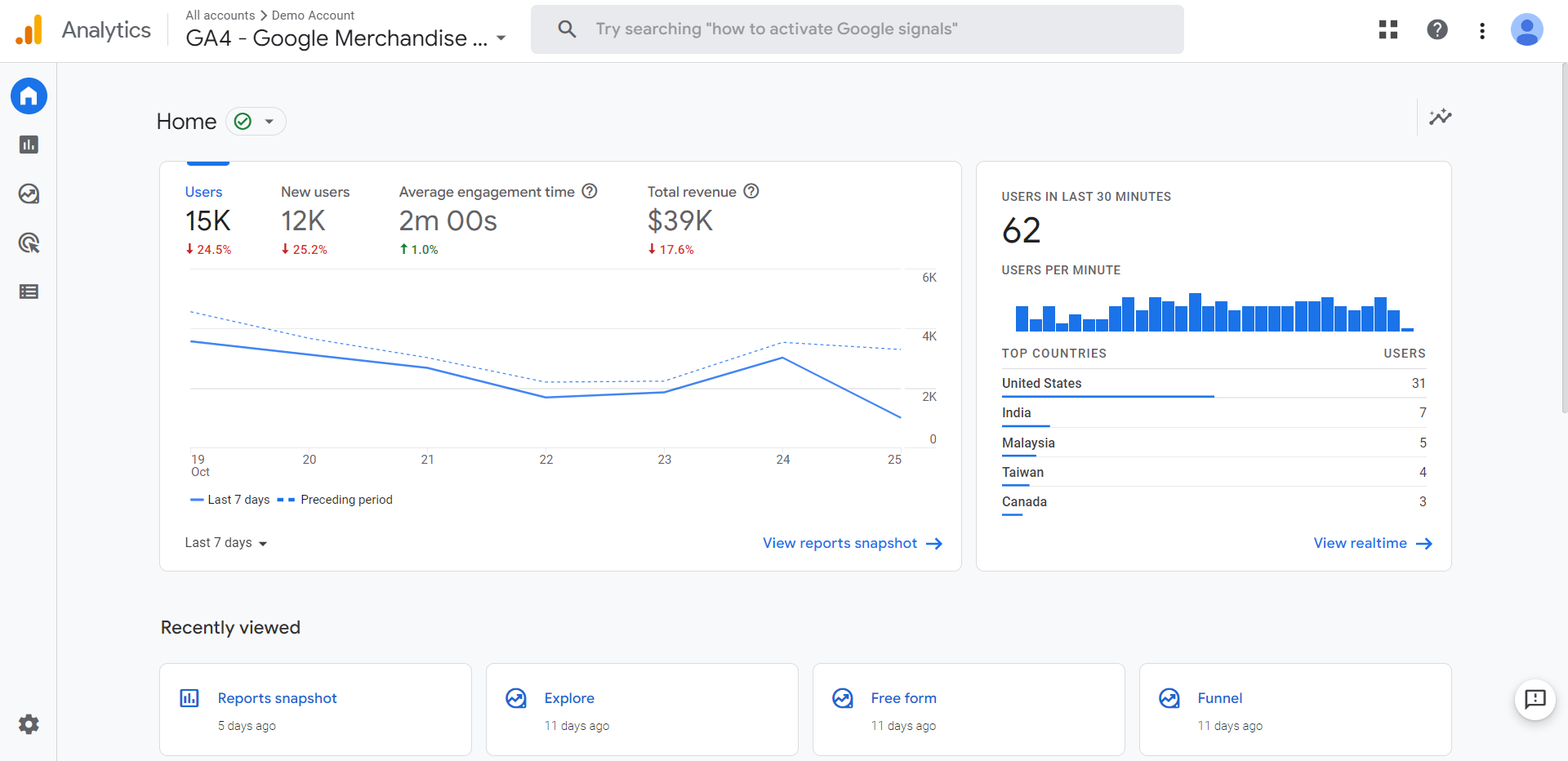
Getting started with Piwik PRO
When getting started with Piwik PRO, you will see a number of built-in reports that are pretty similar to the ones you’d see in Universal Analytics. You will find audience reports, traffic acquisition reports, behavior reports to analyze top pages, and conversion-focused reports.
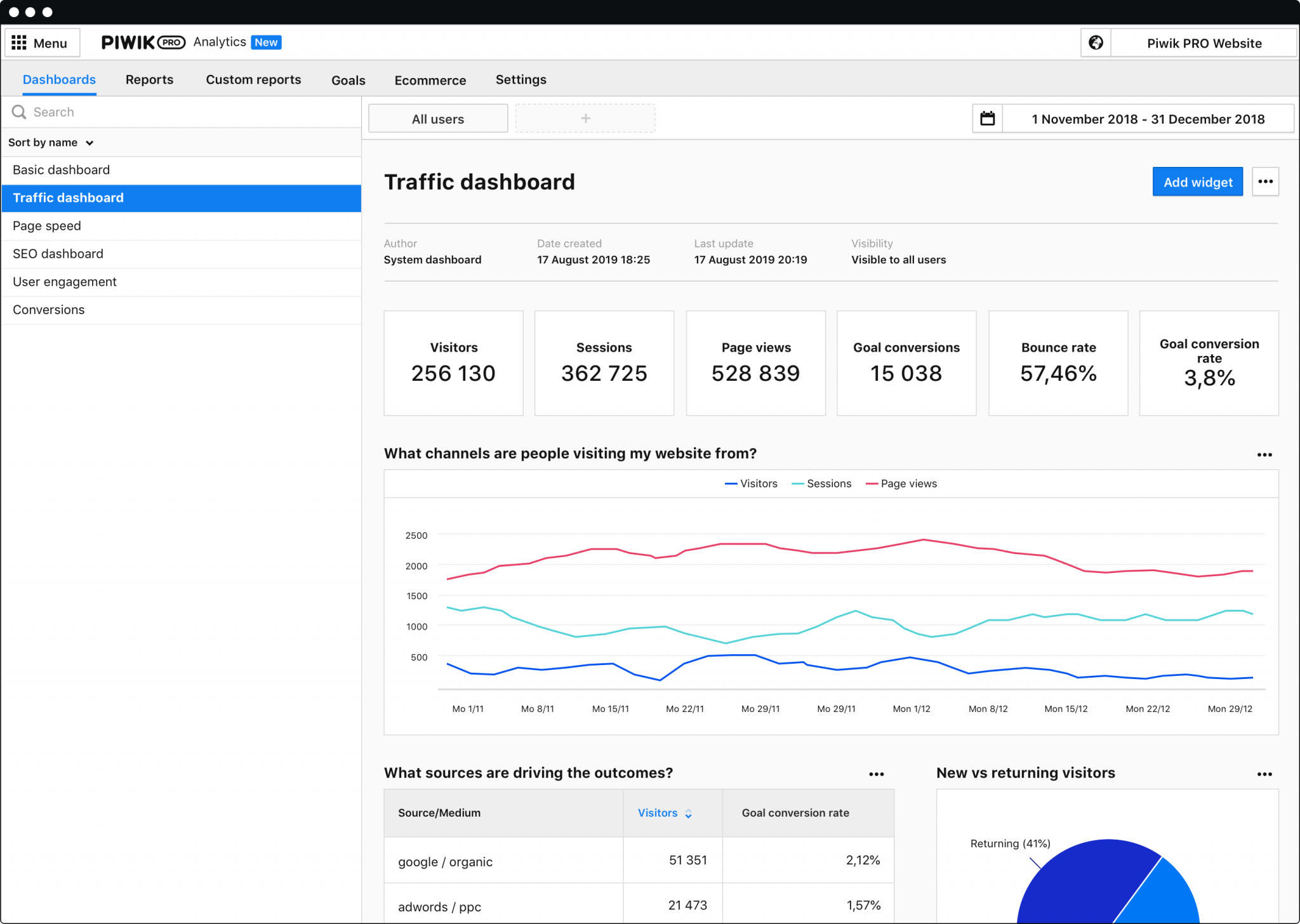
1. Acquisition reporting
The acquisition reports will point you to websites, campaigns, search engines, and social media that bring people to your website. Looking at these reports, you’ll know if your advertising is getting through to people if you’re communicating well on social media, and if your company can easily be found on Google.
In Piwik PRO, you will find several acquisition reports:
- Channel report – a good observation point of all your traffic sources.
- Search engine report – details search platforms used by people who reached your website.
- Website & social report – shows all websites and social media sites via which people reached your website.
- Campaign report – displays data about your online campaigns, including paid search Google Ads, Facebook ads, and newsletters.
- Google Search Console report – combines data from Google searches with information about website visitors.
- Google Ads report – tells you which Google Ads campaigns bring people to your site.
In Google Analytics 4, only three acquisition report sets are readily available. If you want more data on your acquisitions, you have to configure it yourself.
In Google Analytics 4, you can choose how to count conversions with a new counting method setting for conversion events. “Once per event” is recommended, but if you need it to match Universal Analytics, choose “Once per session.”
2. Attribution reports
Using the Attribution report, you can analyze which channels people used to reach your website goal or purchase your product. This report shows various attribution models and conversion paths compared to basic acquisition reports. Using it lets you understand which touchpoints generate the most valuable traffic to your website and better allocate your marketing budget.
Piwik PRO has a multi-channel attribution report with different attribution models, including custom-created models. This is an essential feature for assessing conversions.
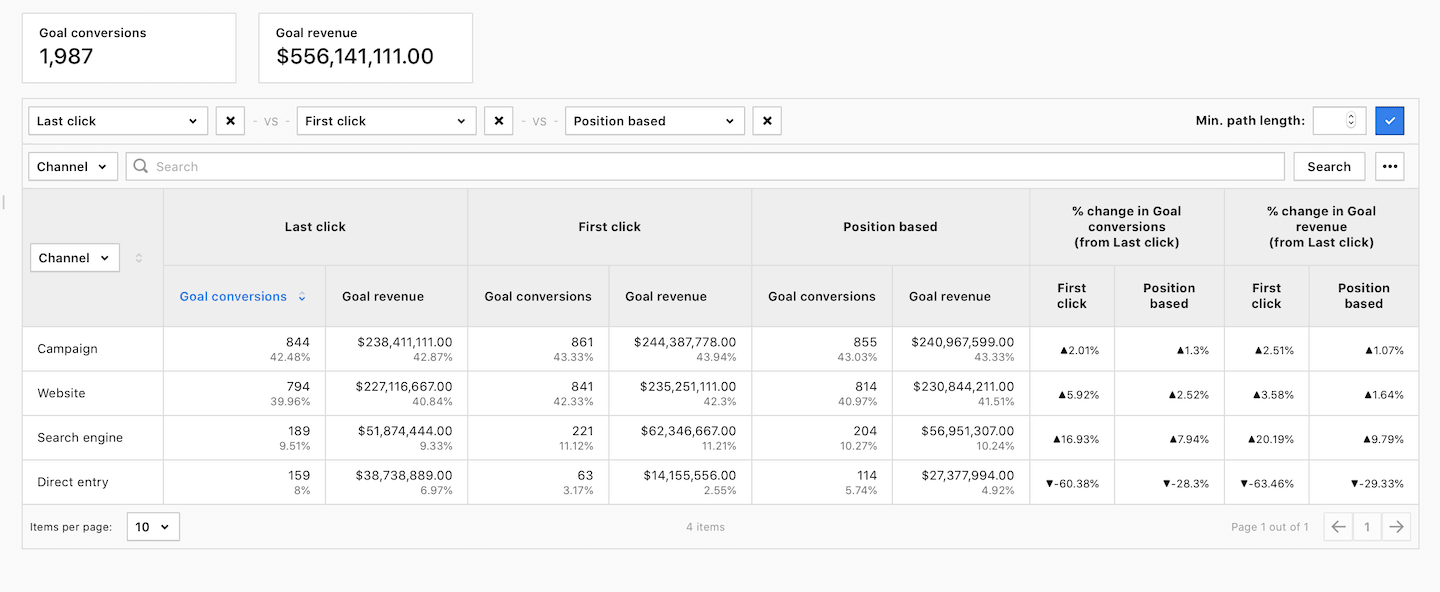
Attribution modeling in GA4 is data-driven by default. Data-driven attribution uses advanced machine learning to analyze data and decide how important each touchpoint is in a customer’s journey. The new platform limited the number of available attribution models. You can use the last-click attribution model, but each conversion action must be manually changed.
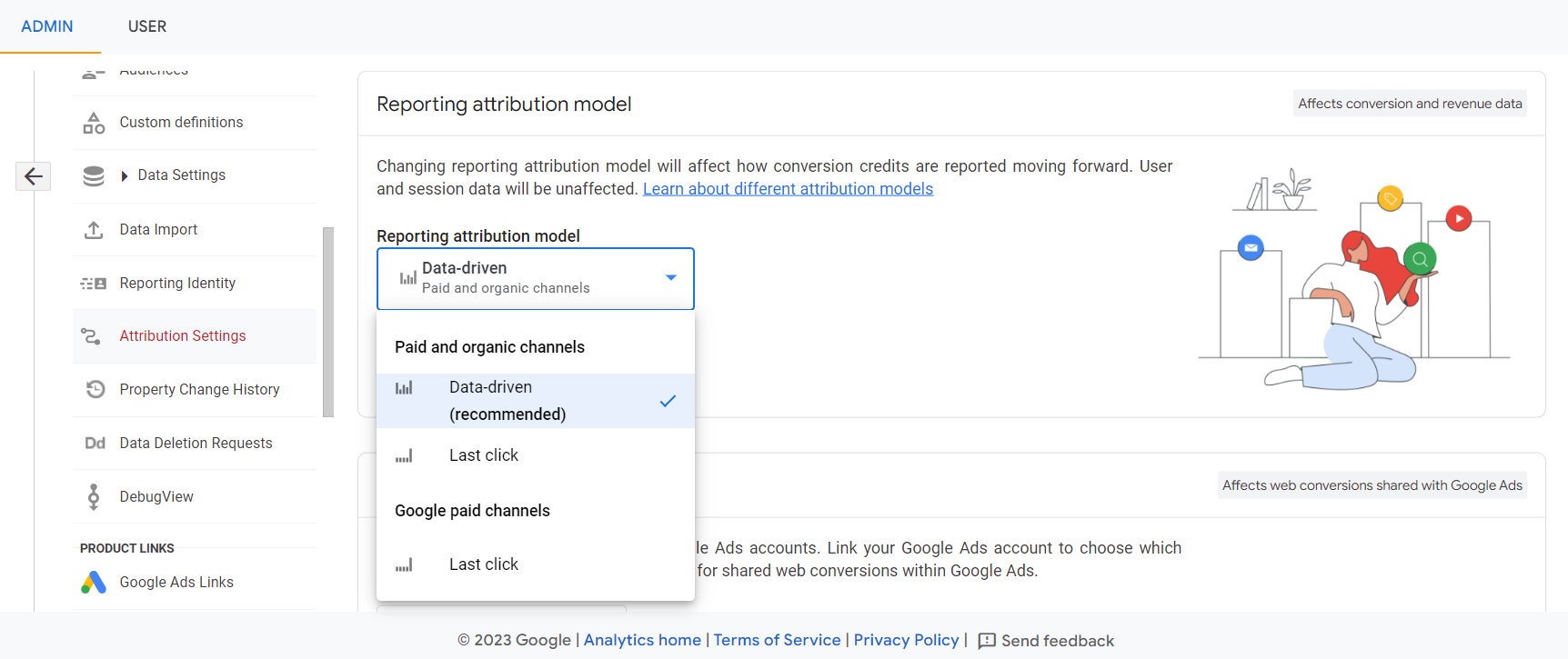
In the April 6 announcement, Google stated that four attribution models would disappear from Google Ads and Google Analytics:
- First click
- Linear
- Time decay
- Position-based
Starting in May, newly created properties will no longer support these models. Beginning in September, Google will sunset the models for all other properties. Cross-channel data-driven attribution, cross-channel last click, and Ads preferred last click will remain available.
3. Ecommerce reporting
Ecommerce reports provide information about your sales and how customers buy. Using ecommerce reporting tools, you can learn more about your customers, products, sales goals, marketing campaigns, and inventory management. This will enable you to make better business decisions.
GA4 includes enhanced ecommerce tracking, enabling you to measure and analyze e-commerce transactions, product performance, and revenue metrics. It provides reports on sales performance, product list performance, and more.
Unfortunately, it lacks some valuable metrics. For example, the cart-to-detail metric was recently removed from GA4. Cart-to-detail rate is a percentage of how many visitors come to your product page and how many buyers add products to their carts. It is a powerful indicator of how well your product page is doing. It also lacks more predefined ecommerce reports.
Piwik PRO also offers e-commerce tracking capabilities. It allows you to track product views, add-to-cart actions, completed purchases, and other relevant e-commerce metrics.
Piwik PRO’S ecommerce module was recently updated with support for product scope in reporting (also including custom reports).
Moreover, Piwik PRO supports reports and metrics you’re probably familiar with, including cart-to-detail and order-to-detail rates removed from GA4. And ecommerce data is now available in the raw data exports like BigQuery.
Features such as product-scoped custom dimensions, product lists, detailed checkout reporting, multiple currencies, and more will be introduced soon.
UA migration tip
Piwik PRO operates on the same data layer as Google Analytics, making the transition of advanced ecommerce setups seamless.
4. Funnel reports
A funnel report helps you understand where people leave your website or app before completing a specific goal. To create a funnel report, you must define the steps (pages or events) a person typically passes through to reach the goal. Then, you can see how many people make it through each step and where they are most likely to drop off.
Piwik PRO allows you to create funnels from any page view or custom event, along with several more benefits of funnels:
- Historical data tracked before the funnel was defined is retroactive.
- Immediately available after creation.
- A goal as the last step isn’t required – it is flexible.
- Filtering allows you to define each step in the funnel at a highly granular level.
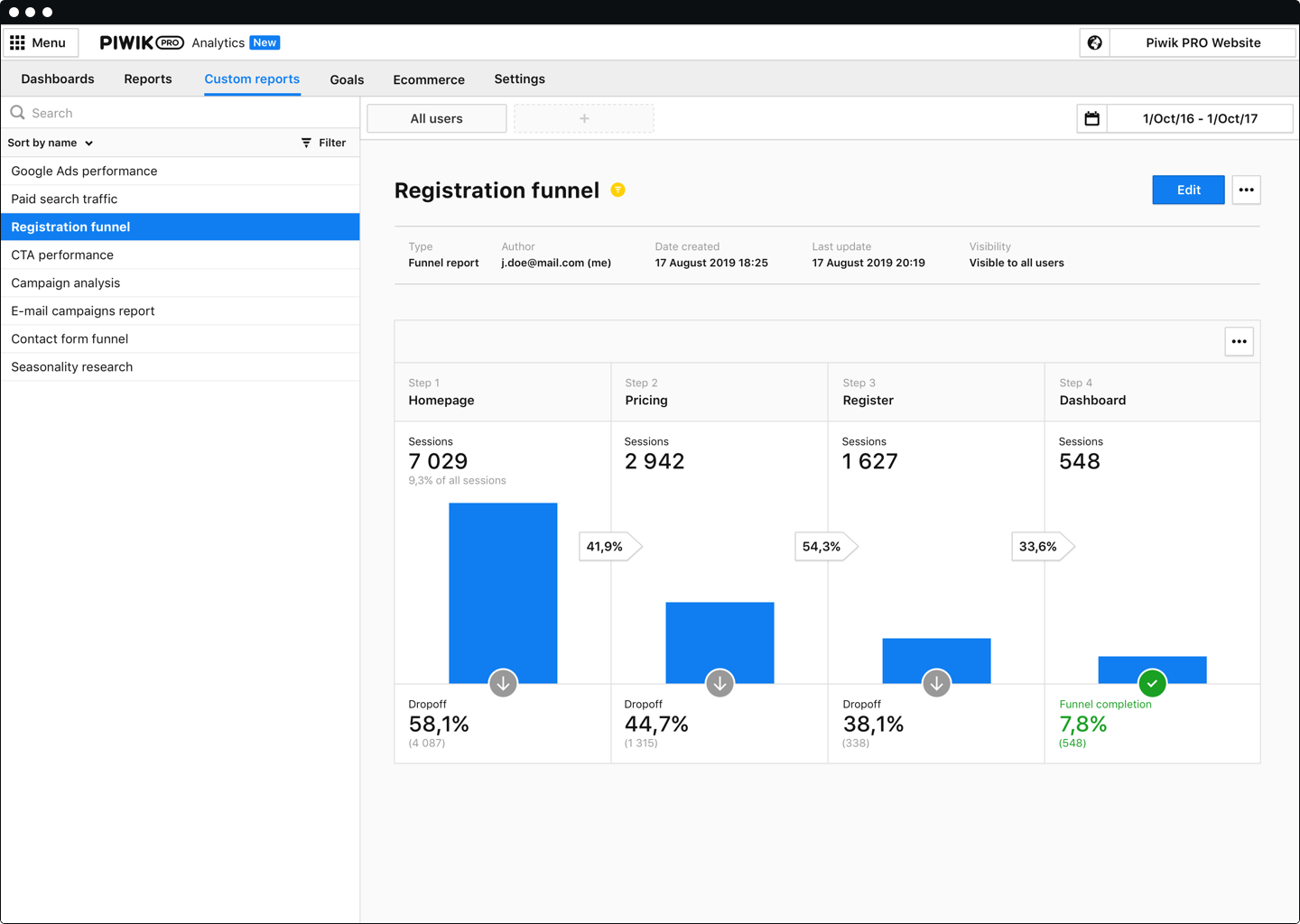
No matter when you configure your funnel, you’ll always have access to the entire dataset of historical and recent user actions.
Google Analytics 4 users have access to funnel exploration features.
In GA4, funnel exploration visualizes already collected data. To compare, in Universal Analytics, you have goal funnels, which means you have to define a goal to start using funnels. The report will only show data collected from that point. If you have a goal, such as purchasing a product or signing up for a newsletter, you can create a funnel to track the steps leading up to it.
While in Universal Analytics, step customization is based only on Page dimension, GA4 is based broadly on events filtered by other dimensions. By adding dimensions, you can further customize your analysis by including attributes that describe something (e.g., an event, user, product, etc.).
Instead of platform- or device-based measurements, GA4 enables customer-centric measurements from multiple touchpoints. Customer-centric insights might give you a fuller picture of the buyer funnel, especially if your conversion funnel involves many steps that can be completed over separate visits.
However, GA4 relies on referral information accuracy, such as the lifetime of capped cookies. The capped lifespan of first-party cookies to 1-7 days means that conversions outside this window will not be attributed to the right source. Since GA4 heavily relies on first-party cookies, analyzing funnels in user scope comes with the risk that the data set might be incomplete.
The GA4 funnel report looks like the following example:
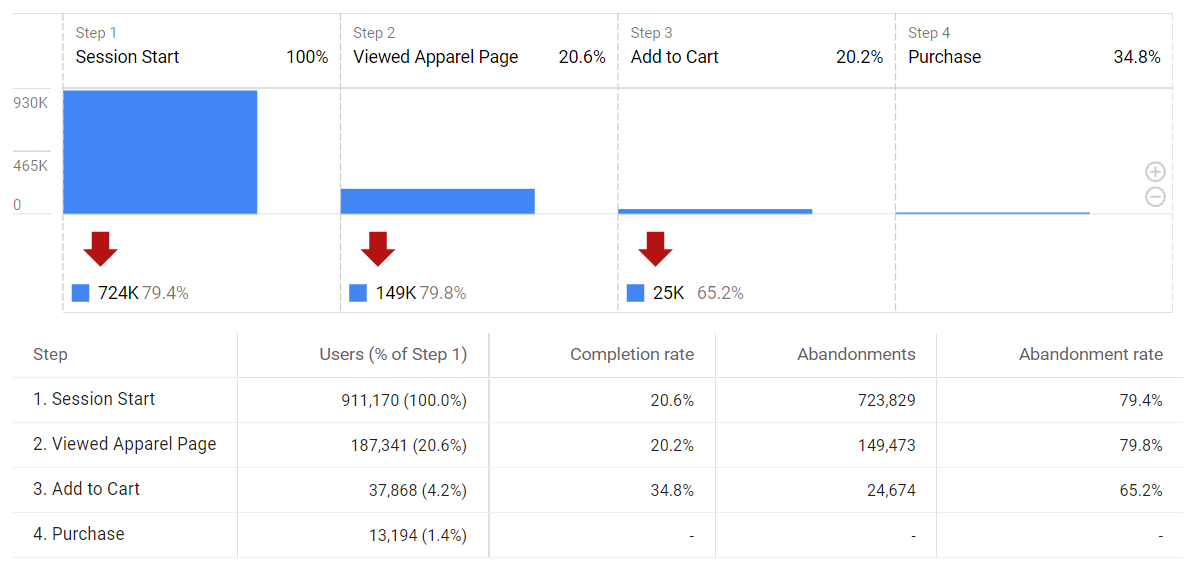
5. User flow reports
A behavior flow report gives you a visual representation of the path a user follows throughout your site. Analytics tracks the user from one page or event to another.
Piwik PRO’s user flow reports offer the following options:
- To set up user flow report interactions such as page view, download, search, custom event, and more.
- To see a breakdown of session dimensions. For example, you can view channels, referrers, or campaigns.
- Add up to ten interactions.
The user flow in Piwik PRO has three settings to analyze visitor paths:
- Standard: shows you the following interactions after the vital interaction.
- Transition: illustrates the interactions before and after the critical interaction.
- Reverse: shows you the interactions preceding the key interaction.
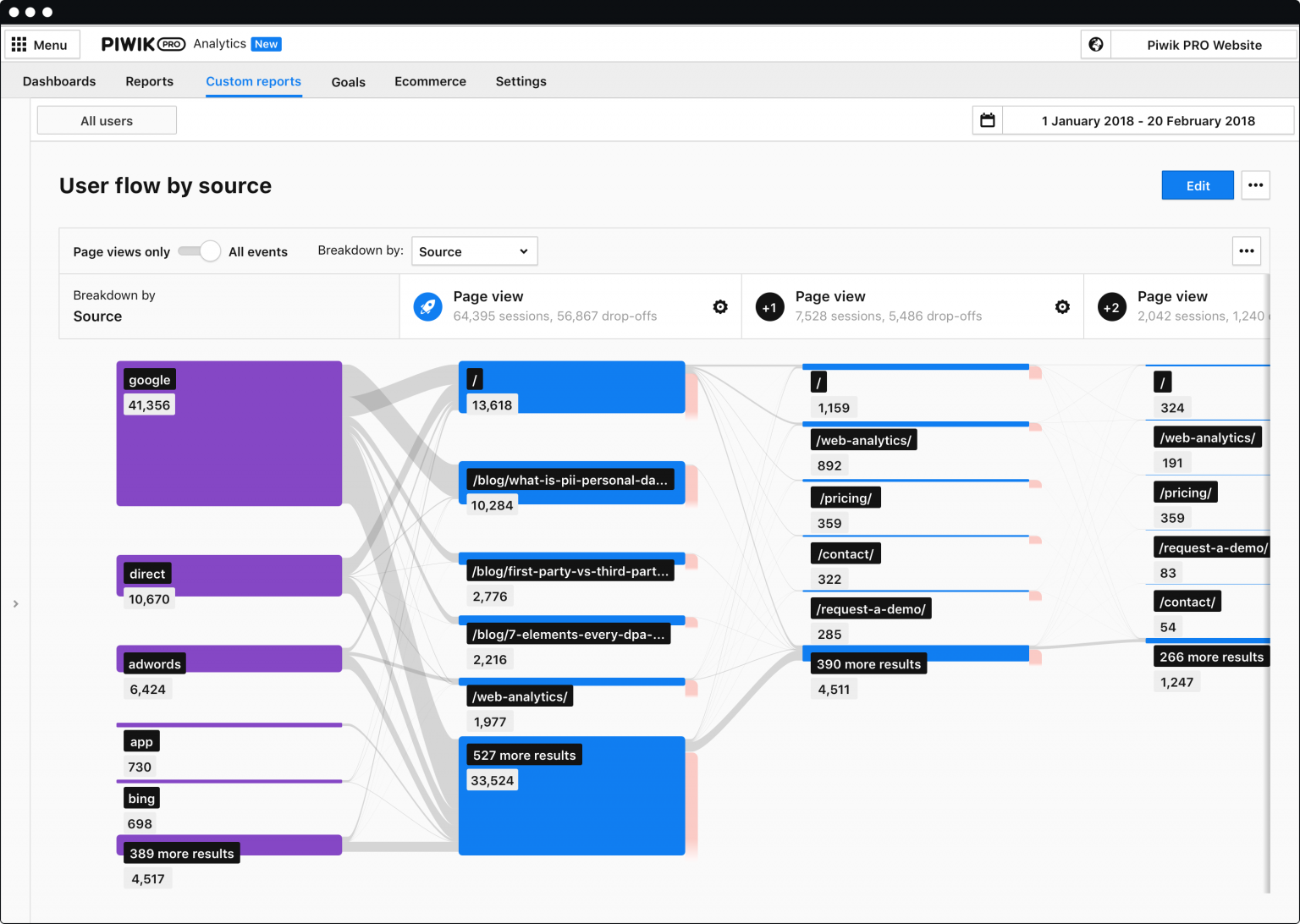
GA4 doesn’t have a behavior flow report. To follow your user’s journey, you can use your exploration templates. If you want to track a predetermined path, use your funnel exploration report. If you want to track a free-form path, use your path exploration report. The reports can provide you with detailed information without limiting your exploration options. However, they need to be customized.
6. Custom reports
Custom reports in Piwik PRO and GA4 offer similar functionalities, but they differ in implementation and flexibility.
Since GA4 has fewer standard reports, you must construct custom reports for many everyday use cases from scratch.
With Piwik PRO, you can customize metrics, dimensions, and reporting settings to align with your business goals and requirements. You can pick a standard report as the starting point, customize it, and save it as your new custom report.
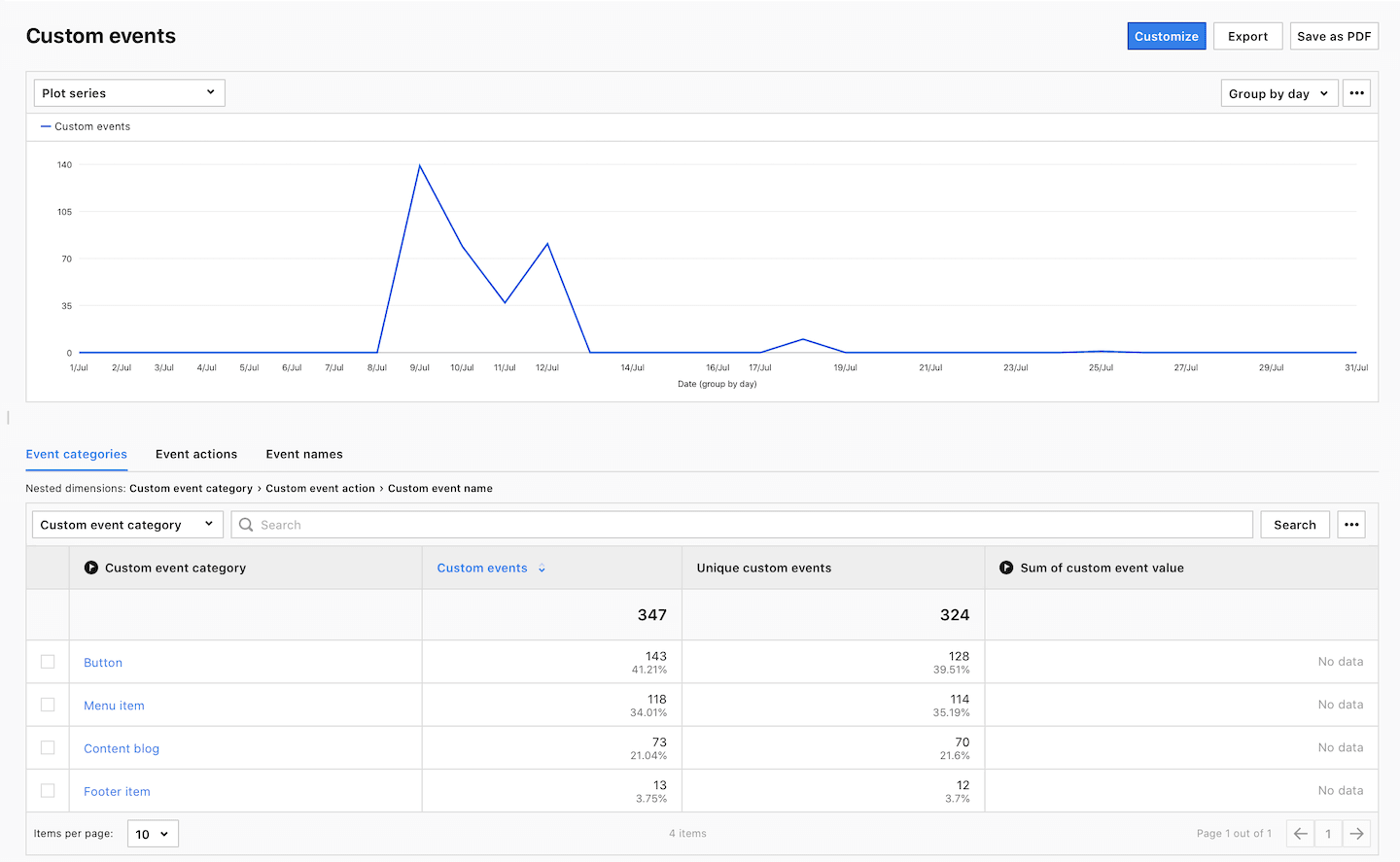
7. Real-time reports
Real-time reporting has become a pivotal feature for businesses that aim to make swift, data-driven decisions. Google Analytics 4 (GA4) and Piwik PRO offer real-time reporting capabilities, each with distinct functionalities tailored to diverse user needs.
Google Analytics 4 real-time reporting: Basic live insights for immediate monitoring
GA4’s real-time report allows users to monitor website or app activity as it occurs. Key features include:
- User monitoring: Displays the number of users active in the last 5 to 30 minutes, providing insights into immediate user engagement.
- Traffic sources: Identifies where users are coming from by detailing metrics such as first user source, medium, source platform, or campaign.
- Content interaction: Shows which pages or screens are being viewed through metrics like page title or screen name.
- Event tracking: Lists events triggered by users, offering a view into user interactions and behaviors.
These real-time insights enable businesses to:
 Monitor the immediate effects of marketing campaigns or site changes.
Verify the correct implementation of measurement codes.
Quickly respond to user behavior trends as they emerge.
For a comprehensive overview, visit Google’s Analytics Help Center.
Piwik PRO real-time reporting: Fully customizable dashboards for actionable insights
Piwik PRO goes beyond basic real-time reporting with fully customizable, high-speed dashboards that refresh every 10 seconds, ensuring you always have the latest data at your fingertips. Unlike GA4’s limited, fixed real-time reports, Piwik PRO lets you build multiple dashboards from scratch, tailoring each one to your unique business needs.
Why Piwik PRO stands out:
- Instant insights, always fresh: Get real-time data updates every 10 seconds, with a flexible viewing window (5-60 minutes) to track live trends as they unfold.
- Truly custom dashboards: Create unlimited real-time dashboards, each with handpicked, tailored widgets that display what matters most to your business.
- Unlimited use cases: Set up dedicated real-time dashboards for specific campaigns, user segments, marketing teams, or customer interactions, ensuring every department gets the insights they need.
- Advanced segmentation and deep analysis: Filter real-time data with rich segmentation options and compare and act on meaningful trends easily.
How it empowers your business:
Monitor and optimize marketing performance in real-time with detailed, campaign-specific dashboards.
Give teams the necessary insights with dashboards built for different stakeholders – performance marketers, content teams, or executives.
Reduce costs and improve ROI by optimizing campaigns, personalizing experiences, and responding to user behavior instantly.
For a full breakdown, check out Introducing real-time dashboards in Piwik PRO.
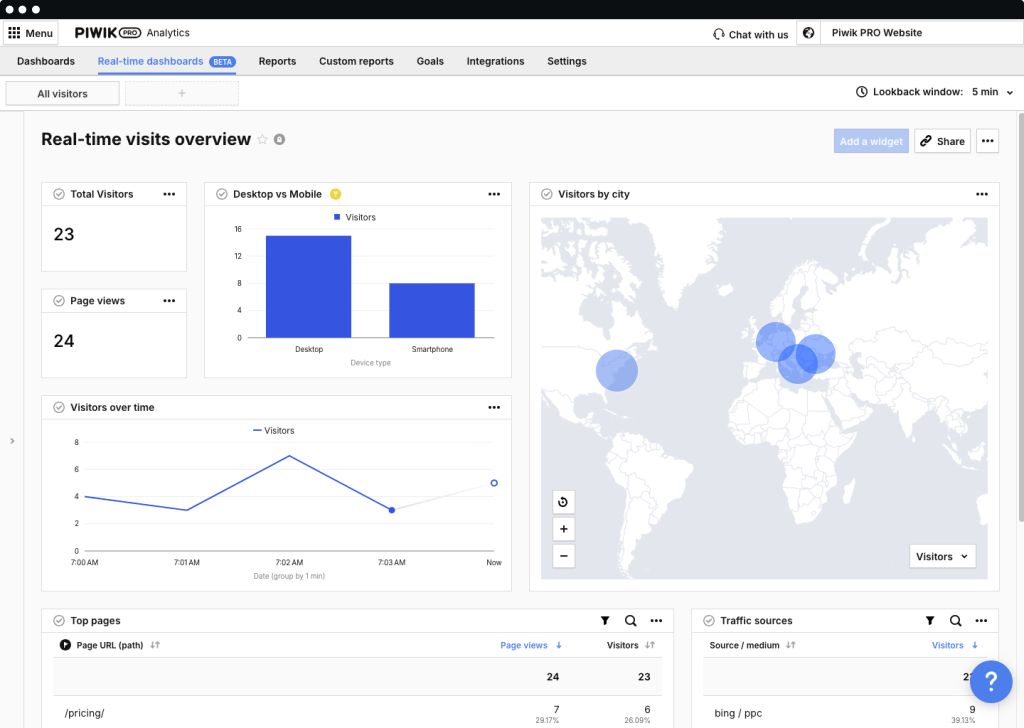
For more details, read:
Both GA4 and Piwik PRO acknowledge the critical role of real-time data in today’s fast-moving digital landscape. However, their approaches differ significantly.
GA4 provides a basic, fixed real-time reporting interface suitable for quick, high-level monitoring but limited in customization and depth. It offers a single dashboard with predefined metrics and minimal flexibility.
Piwik PRO, on the other hand, delivers a fully customizable real-time reporting experience. With dashboards built from scratch, tailored widgets, and unlimited configuration options, businesses can track precisely what matters to them, whether it’s individual campaigns, audience segments, or team-specific insights. Data updates every 10 seconds, ensuring faster, deeper, and more actionable insights than GA4’s static reports.
When choosing between the two, consider how much control and granularity you need in your real-time analytics. If you require precision, flexibility, and instant decision-making, Piwik PRO will be the right choice for you.
Set up a real-time launch dashboard
Launch dashboards enable you to monitor and track your launch metrics in real-time. The results can be compared with your expectations and benchmarks to identify trends, patterns, and anomalies in your data. Furthermore, a launch dashboard assists you in communicating your launch performance to stakeholders and team members, allowing you to adjust your launch strategy and tactics accordingly. Data sources and tools can be integrated with the dashboard through APIs or connectors.
Custom channel grouping
Marketers can check the performance of marketing channels more efficiently by using channel groupings, which are rule-based groupings of marketing channels. You can connect all traffic sources to your website in one defined channel grouping.
For instance, connect similar referrer URLs into one group. Take Facebook traffic and the different subdomains it uses. Rather than having multiple rows on your source/medium report (each for Facebook traffic), you can have one: Facebook organic.
Piwik PRO lets you create unlimited groups, with 10 channels per group, but this limit can be increased for enterprise clients.
Custom channel grouping is available in Google Analytics 4, but there are limits. You can create 2 groups and 25 channels within each group.
Limited options for customizing dashboards
You should know that GA4 is stripped of custom dashboards and widgets that allow you to display your data in different presentation styles. These include simple numeric metrics, tables, and charts. You only have a few options to customize dashboards and widgets, so displaying data in a presentation style that suits your needs will be difficult. You can only add predefined components that can’t be modified. Moreover, GA4 doesn’t offer a drag-and-drop editor.
Here is a quick recap of the GA4* and Piwik PRO reporting capabilities and integrations:
| Google Analytics 4 | Piwik PRO | |
|---|---|---|
| Standard reporting | | rich set of standard reports |
| Regular expressions in filters, segments & groupings | | |
| Live traffic/live map | | |
| Consent reports | | |
| Ability to process personal data and PII (including sensitive data) | only encrypted PII allowed (min. SHA256) | non-encrypted and encrypted PII allowed |
| Views feature | | |
| Custom reports | | |
| Cross-property roll-up reporting (metasites) | | |
| Funnel reporting | advanced | advanced |
| User flow reporting | | |
| User-level reporting | | |
| Site speed reports | | |
| Custom channel grouping | | |
| Ecommerce reporting | limited | |
| Detailed real-time reporting | | |
| BigQuery | | |
| Google Search Console | | |
| Google Ads | | |
| Looker Studio | | |
| Audience activation | limited to Google ecosystem | native integration with Piwik PRO Customer Data Platform |
| Widgets | limited | |
| Custom dashboards | limited | |
| Predefined attribution models | only data-driven and last-click | |
| Custom attribution model | | |
*GA4 free version
Which is best for my business?
Both Google Analytics 4 and Piwik PRO have their strengths.
Piwik PRO gives more control over data collection and processing. Because Piwik PRO meets the needs of both analysts and marketers, it is more universal.
If we consider GA4, it’s harder to use GA4 for less experienced users who are used to default reports, easy-to-use custom reports, and dashboards. It might be a good fit for larger organizations. You need time and resources to rethink, redesign, and rebuild your data pipeline. Tailoring it to your needs requires a much more significant investment in data strategy and configuration.
Evaluating your specific needs and priorities is essential when choosing between GA4 and Piwik PRO. Consider factors such as data privacy, customization requirements, integration needs, costs, and the level of control you want over your analytics data.
See product comparisons that will help you choose the right web analytics software. We present the essential features, explaining in detail their significance from the legal, technical, and practical perspectives:
The post Reports in Google Analytics 4 and Piwik PRO: Everything you should know appeared first on Piwik PRO.
]]>The post Best 10 A/B testing tools for 2023: Google Optimize alternatives appeared first on Piwik PRO.
]]>It was popular for testing small changes and getting results, but it lacked flexibility and had some limitations.
As businesses and individuals prepare for the discontinuation of Google Optimize, many are searching for alternative solutions to fill the gap.
In this article, we’ll look at some of the top Google Optimize alternatives, discussing the differences between each tool and their features, including privacy compliance.
- What is Google Optimize?
- A/B testing in the age of privacy
- The top A/B testing tools
- Optimizely
- Convert
- Visual Website Optimizer (VWO)
- Conductrics
- Adobe Target
- A/B Smartly
- AB Tasty
- Omniconvert
- Apptimize
- Crazy Egg
- A/B testing tools: Conclusion
What is Google Optimize?
The main selling point of Google Optimize was its free version and its native integration with Google Analytics, giving you automatic access to behavioral insights. It also made it easy to target the valuable segments you’ve already discovered using analytics.
Google Optimize is a favorite of beginner testers due to its easy-to-use interface and many essential features. But it is also notorious for its limitations when it comes to running more extensive tests:
- Only five tests at a time.
- Only three goals at a time.
- Only test for 35 days maximum.
- Only test websites, not apps.
It is a basic tool when you want to perform A/B testing without committing significant funds.
Google Optimize is a limited-feature version of Optimize 360, Google’s paid optimization tool, which will also be discontinued in September.
With Google Optimize sunsetting, many companies must seek an alternative to keep their experimentation programs running. In addition, it’s a great time to consider switching to a platform that protects the privacy of your users and helps you comply with data protection laws. These issues have become increasingly significant in digital marketing.
A/B testing in the age of privacy
In 2018, the EU passed the General Data Protection Regulation (GDPR) to tighten data privacy regulations, and California enacted the California Consumer Privacy Act (CCPA) in 2020.
The ePrivacy Directive, informally known as the “EU Cookie Law”, is particularly important to conversion optimization practitioners because it’s focused on cookies, which are widely used in marketing and product technologies like analytics and A/B testing tools.
What are cookies?
Cookies are small text files placed on a site visitor’s computer, which are then read by a browser to determine and enable a host of services for that visitor. But EU law takes a broader approach. According to the ePrivacy Directive, cookies access a site visitor’s or app user’s local device memory.
This definition of cookies means any technology that accesses a visitor’s computer memory infringes on the privacy rights of that user.
The Directive doesn’t prohibit the use of cookies. Publishers and website owners can use cookies if the user provides consent.
These privacy laws give more data transparency to consumers while limiting certain data collection practices. And experimentation is critical for every marketing and product team, but it requires data collection. Data powers the process. This means that if you run A/B tests, you must make data privacy a top priority.
The laws have implications for your experimentation practices and tech stack. Many technologies were designed before these privacy laws, and while some are iterating quickly to comply, others need to catch up.
Here’s a helpful checklist to ensure your experimentation practices and the technologies that power them are privacy compliant:
- Check whether the vendor is focused on the concept of privacy by design
- Check where your technology vendor stores its data.
- Check who owns the data.
- Check if the vendor asks users for consent before adding them to a mailing list, provides easily accessible privacy statements and disclosures, and allows users to access, modify, or delete their personal information.
- Check whether the A/B testing tool allows for anonymized tracking.
- Understand how much user data the technology vendor needs to collect to perform A/B tests.
- Understand how the technology is implemented on your website.

“A/B testing and privacy can play well together, providing you have weighed your risks. Of course, I recommend that you only test on traffic that has consented to the relevant tracking, but sometimes this is not an option. Suppose you need to test all your traffic (to get enough traffic for your test, for example). In that case, you need to consider the risks involved in such processing and the recommendations of your local data protection authorities. Remember that some EU countries like France allow testing under the strictly necessary cookies.“
Siobhan Solberg
Founder & Consultant at Raze
Read more about A/B testing and privacy.
The top A/B testing tools
There are many A/B testing tools on the market, which means finding the right tool requires sifting through dozens of options.
No single A/B testing tool will work well for everyone. An ecommerce business, for example, has far different needs than a SaaS company.
To help you find the right one, we’ve analyzed the top A/B testing tools to compare their pricing, features, ease of use, approach to privacy, and pros and cons.
Here are our recommendations for A/B testing software:
1. Optimizely
Optimizely is a user-experience optimization and testing platform that lets you quickly build, launch and measure experiments. It helps run A/B and multivariate tests, which are used to test the impact of different designs on different audiences.
Pricing
Pricing for Optimizely is available on request. There’s no free trial.
Main features
- A/B testing: simple A/B tests let you put two pages head-to-head to experiment with simple changes.
- Server-side testing: the variations of a test are rendered directly on the web server.
- Multivariate testing: allows you to change multiple page elements and test performance.
- Multipage funnel testing: you can link similar or related variants from different pages with this testing technique.
- Audience-specific messages and personalized offers: you can also create variations for the elements on your webpage and determine which combination works best.
- Visual Editor: Optimizely’s Visual Editor lets you edit text, HTML elements, the elements’ order, their position and style, background, borders, dimensions, etc., with a single click.
- Audience targeting: it lets you target visitors based on their behavior and locations. It also offers adaptive audiences created automatically from personas.
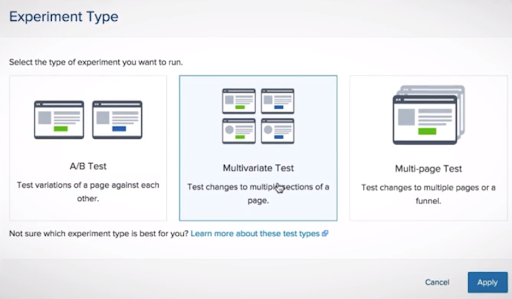
Ease of use
Optimizely’s setup is simple and intuitive. It’s fairly easy to change every element of your experimental page without digging too deeply into your site’s code.
Privacy and security
Optimizely’s Digital Experience Platform, Web & Server-side Experimentation, and Campaign are ISO 27001 and SOC certified. The platform has also implemented features and processes to help you comply with CCPA, GDPR, and Payment card industry (PCI) compliance requirements.
- Data deletion and access requests
Data subjects in certain jurisdictions can request access to or erasure of their personal data. Optimizely has built tools to help its users fulfill these requests.
- Encryption
By default, the web snippet communicates with Optimizely using Transport Layer Security (TLS), which is regularly updated. In addition, all visitor data stored by Optimizely and its third-party service providers is encrypted at rest.
- Cookie compliance
You may want to review the cookies and local storage objects set by your EU websites to ensure compliance with GDPR. Optimizely can be integrated with popular tag management and cookie banner tools to help you customize cookie compliance. It doesn’t have any built-in consent management solution.
- Data transfer and location
GDPR restricts the export or use of personal data to countries in the EU and the European Economic Area (EEA). Optimizely has implemented a geo-fenced process and technical controls to limit the transfer and access of personal data. EU hosting is possible
PROS:
Multipage tests incorporate various pages that give a more comprehensive view of how specific changes can affect your sales funnel.Optimizely offers premium customer service.Many integration tools are available.It’s very easy to make changes visually using the editor.
CONS:
Behavioral analysis tools are missing.
Overall
Optimizely is a very good enterprise tool. It is powerful and targeted at websites with high traffic – in other words, companies that are very serious about testing and personalization.
It is focused on web experimentation and personalization. With its Web Experimentation product, you can safely run multiple experiments on the same page. You can also use Optimizely beyond your website and expand to mobile apps, messaging platforms, and more to optimize your customer experience.
2. Convert
Convert is a competitively priced tool with an intuitive interface and customer support. The platform suits companies doing in-house optimization and small to medium-sized businesses.

Pricing
Convert offers a variety of plans starting from $99/month. The plans that include full-stack features start at $199/month. A free 15-day trial is also available.
Main features
- A/B testing: you can use advanced targeting and post-segmentation in every plan.
- Split testing: Convert’s split testing allows you to run hybrid and multipage split tests.
- Multivariate testing: using the MVT testing setup, you can change a cluster of page elements in each version to find the most effective combination.
- Multipage experiments: you can make different changes across linked pages.
- Full stack experimentation: full-stack testing offers rich aggregation of insights (server side, SDKs, roll outs).
- Visual editor: Convert has an inbuilt drag-and-drop and style sheet editor to create test variations and dynamic pages.
- Code editor: you can switch to the code editor to make more complex changes.
- Personalization targeting: you can target visitors during and after the tests. You can target them by source, cookies, device, location, JS events, and more.
- Reliable and effective testing: SmartInsert
 technology ensures flicker-free and blink-free testing.
 - Integrations: you can integrate a multitude of tools with Convert, including Google Analytics, HubSpot, and many more.
- Sample Ratio Mismatch (SRM) checks: SRM test automatically checks and flags potential issues.
- Data import feature: using the Convert Experiences Tools Chrome Extension that comes with a Google Optimize Data Migration Tool is the fast way to export your data.
- Technology compatibility: client-side, server-side, and mobile testing.
Ease of use
Setting up and using Convert is easy and intuitive, thanks to an intuitive drag-and-drop editor. You can create A/B, multivariate, multipage, and split tests with the provided visual editor. You can also break out the more advanced style sheet editor for dynamic pages. Moreover, anyone who signs up for Convert’s Growth, Expert, and Enterprise plans gets a guided 10-step onboarding.
Privacy and security
Convert uses the principles of the Privacy by Design approach. It allows you to comply with multiple privacy laws, including GDPR, CCPA, and LGPD. It is not HIPAA compliant.
- Data privacy
Convert only processes (collect, use, or store) user data under basis such as consent and contract. The company keeps the minimum information required to provide its services.
- Cookies
Cookie settings allow you to select which categories of cookies you accept or reject. The opt-out option Convert provides is a further measure to set a third-party cookie that tells the Convert Experiences script not to track a user. Non-PII cookie lifetime is 6 months.
- IP addresses collection
Convert tracks users for the test and targeting software but does not store IP addresses. They don’t store sensitive personal data.
- Data transfers and location
The company is registered and based in the US. Convert uses Amazon Web Services (AWS) for the production servers and databases. EU-based servers are in Frankfurt, Germany.
PROS:
Advanced A/B testing tool at a competitive price.Easy to use the visual editor.Code editor allows you to conduct complex experiments.Detailed post-segmentation based on the types of visitors, devices used, and campaigns clicked.Top-notch customer care.
CONS:
No SOC 2 complianceNo HIPAA complianceNo mobile app testing
Overall
Convert is an effective A/B testing platform at a competitive price. Suitable for small and medium businesses. A/B tests can be set up with an intuitive design. And if your team is more advanced, you may use a code editor to develop complex experiments. Customer care may help you with the onboarding process.
3. Visual Website Optimizer (VWO)
Visual Website Optimizer (VWO) is a popular enterprise-level A/B testing tool. Brands worldwide use VWO as an experimentation platform to conduct A/B tests on products, websites, and applications.
Pricing
VWO plans for web-based testing range from $356/month to $1461/month. A free 30-day trial is available.
Main features
- Five categories of tools: Testing, Insights, FullStack, Engage, and Plan.
- A/B tests: let you track visits to specific pages, web page engagement, form submissions, clicks on buttons and links, revenue, and custom events on your website.
- Split-path tests: VWO split testing allows you to run tests for different URLs – single page vs. multipage, big menu vs. dropdown menu, and different themes and flows.
- Multivariate tests: enable you to create multiple variations of web pages and track various conversion goals.
- In-built visitor segments: servers for performing tests for different segments, such as mobile vs. desktop traffic or new vs. old visitors; you can create custom segments as well.
- Personalization targeting: you can also test your personalized experiences by setting up target segments with the VWO Personalize tool.
- Statistical significance analysis of results: allows you to rule out the possibility of obtaining results by random chance
- A built-in heatmap tool: tracks visitor click behavior and tracking habits
- Form Analytics: gives you insights into users’ journey on your form, including metrics like total time spent on the form, interaction time, hesitation time, and the field from which users exited the form.
- Technology compatibility: client-side, server-side, and mobile testing.
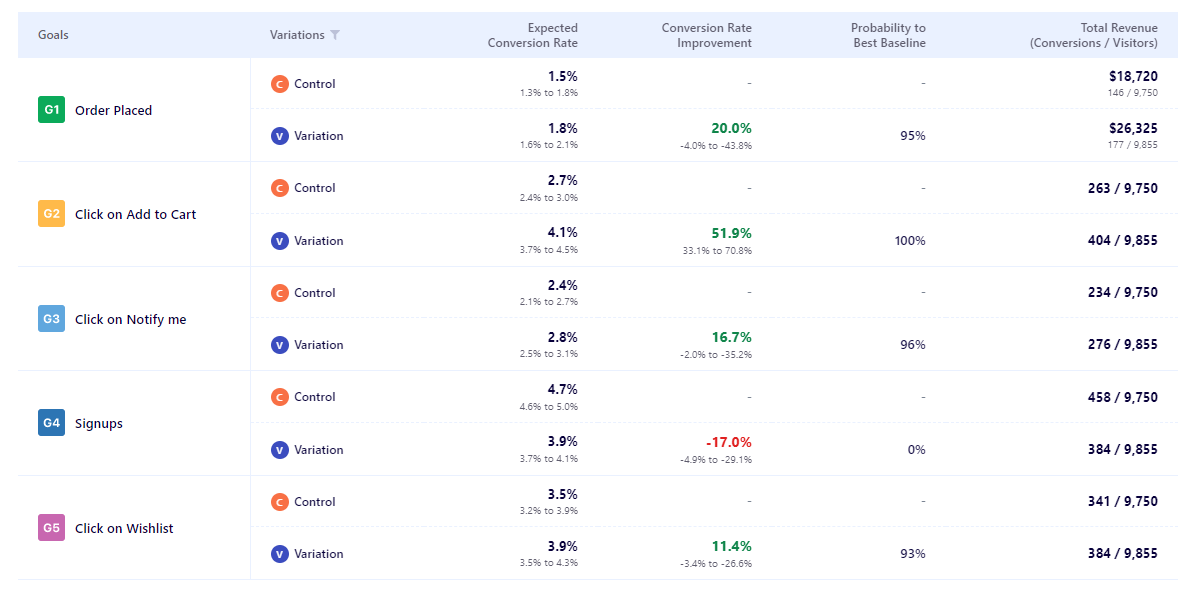
Ease of use
Coding skills are needed to set up VWO. But the tool makes it easy for anyone to walk through creating a new test. It allows users to create and run tests without involving IT or needing coding knowledge. It is a simple step-by-step process that makes more sense, especially for someone new to A/B testing.
Privacy and security
VWO claims to comply with national, regional, and industry best practices governing the collection and use of information in line with acts and regulations across the globe, including GDPR, CCPA, and HIPAA. It is ISO and PCI certified.
Here are some VWO features that allow you to comply with the relevant legislation:
- Anonymization
By default, VWO anonymizes all key presses to avoid storing or transmitting personal or sensitive data on VWO servers.
- Encryption
Users are recommended to encrypt all incoming data.
- Cookies
VWO can be integrated with popular tag management and cookie banner tools to make it easier for you to customize your approach to cookie compliance. You can exercise your cookie rights by setting your preferences in the Cookies Consent Manager. The Cookies Consent Manager allows you to select which categories of cookies you accept or reject.
- Data transfers and location
All VWO customer data resides in US data centers. VWO doesn’t offer data hosting in the EU.
Additionally, VWO is open to signing a BAA with HIPAA-covered companies.
PROS:
User-friendly visual interface. Reports and charts are easy to analyze. The point-and-click visual editor of VWO enables you to edit any component on the website like text, background, images, etc. In addition, you can insert other fundamental or advanced widgets and elements.It comes with surveys and feedback tools.
CONS:
For setting up more advanced A/B tests, coding skills are needed.
Overall
VWO is a basic, easy-to-use A/B testing tool. It is a top choice for businesses with slightly smaller budgets and is popular among marketers. With testing tools, behavior analytics, data retention, and a visual editor, VWO is a great tool for mid-size to large companies.
4. Conductrics
Conductrics is an advanced tool that offers methods from A/B testing blended with machine learning to automatically deliver optimal experiences for users.
Pricing
Pricing for Conductrics is available on request. A demo version is available.
Main features
- A/B testing (client- and server-side): allows for robust reporting like purpose-built reporting for one or two-tailed analysis.
- Multivariate experiments: enable to test if there is any aggregate impact across multiple treatment types.
- Bandit tests: use algorithms to optimize your conversion target while the experiment is still running.
- Visual WYSIWYG editor with Conductrics Express Customization: allows you to customize every element on your site.
- Predictive targeting: AI/machine learning discovers which combinations of visitor traits respond best to each of your content variants automatically.
- Content testing: to determine the most compelling images or stories.
- User interface and UX testing: to check whether visitors respond well to a new design.
- Testing in mobile apps: for example, to check whether users use a new feature you’re looking to roll out.
- Targeting for banners and campaigns: so that the right promotional content reaches the right users.
- Landing page optimization: helps you to lift up conversions.
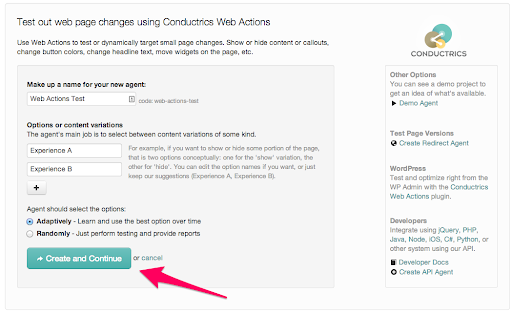
Ease of use
Setting up and using Conductrics is easy. Rich documentation and reliable support make Conductrics easy to use. Also, you don’t need to install a script until you set things live, as you can use the browser extension to edit and preview variants.
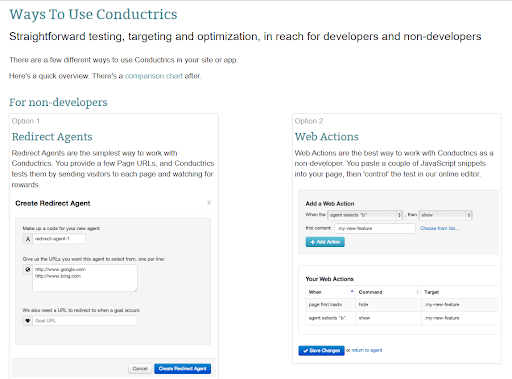
Privacy and security
- Data privacy
Conductrics keeps the minimum information required to provide aggregated counts and other statistics in reporting. No IPs or Customer IDs are exposed to or stored by Conductrics.
- Data control
You can provide your own database to store individual responses for surveys. Records are placed under your control, allowing you to apply internal data governance policies.
- Data transfers and location
Self-hosting makes it easier to comply with data privacy policies and is suitable for companies that don’t trust third-party scripts. You can also self-host the REST API for mobile or server-side use to completely control your Conductrics implementation. Dedicated servers enable you to choose your primary geo-region and your cloud provider.
PROS:
Conductrics offers significant flexibility regarding ways to interact with your systems, from APIs to one-tag solutions. It’s at its best when it is not used for straight A/B testing but as an active decision agent, constantly adapting and creating experiences. Conductrics combines testing, machine learning, and surveys to give you the complete picture and help you to develop compelling visitor experiences.Many testing solutions let you measure customer behavior. Conductrics measures changes in customer attitudes and behavioral measures such as conversions, revenue, and submits. It offers straightforward integration into any site, app, or process anywhere in your stack.Rich documentation and reliable support.Privacy by design solution.
CONS:
Has a steeper learning curve than very basic tools.
Overall
Conductrics is an excellent tool for companies that want to tackle adaptive learning personalization or want a lot of interaction flexibility.
It requires more knowledge and has a higher learning curve than basic tools like VWO, but provides good functionality and flexibility.
5. Adobe Target
Adobe Target is an AI-powered user experience testing and personalization platform that helps you automate the process of delivering personalized content to your users.
Pricing
Contact for custom pricing. Plans vary based on product options, volume, and whether you need omnichannel testing. No free trial available.
Main features
- A/B testing: test images, website copy, UI components.
- Numerous A/B tests: ability to run multiple tests simultaneously.
- Targeting: target audiences from the various platforms of Adobe Experience Cloud.
- Visual composer: allows you to easily create and run tests.
- Multivariate and multiarm bandit testing: to funnel traffic to the most successful experience earlier in the process.
- Technology compatibility: allows client-side and server-side testing or both.
- AI-fueled automated personalization: Target’s self-learning algorithm continually and automatically adjusts itself to make associations between visitor behavior and content to give you the best results possible.
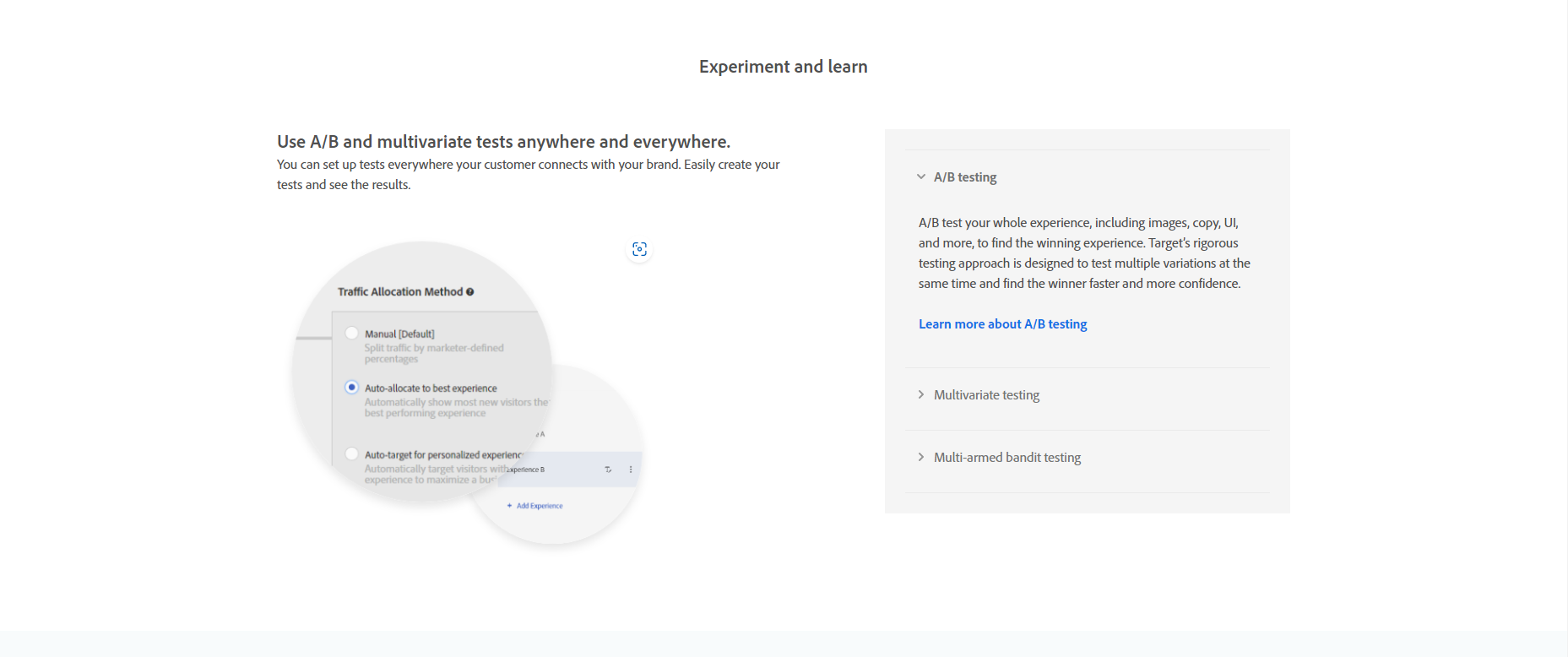
Ease of use
Difficult setup and use – Target is not beginner-friendly. Hence, it’s probably not ideal for those just starting. It requires a lot more knowledge and has a steeper learning curve than very basic tools. Adobe offers plenty of training modules to get you up to speed.
Privacy and security
Adobe Target has enabled processes and settings that allow you to use Target in compliance with applicable data privacy laws. Adobe Target is SOC-2 and ISO 27001.
- Encryption
Adobe deploys Transport Layer Security (TLS) cryptographic protocol for web browsers and other applications that require data to be securely exchanged over a network. Adobe has security compliance standards that require the end-of-life of older protocols and is mandating the use of TLS 1.2 to have the most up-to-date and secure version in use.
- Cookies
Cookie settings allow you to select which categories of cookies you accept or reject. You can add an opt-out link to your sites to enable visitors to opt out of all counting and content delivery.
- Data collection and consent management
Adobe collects individual feature-usage data to identify whether Target features are performing as intended or are underutilized. Personal data is not collected. You can opt out of reporting usage data in the SDKs. You can also support your consent management strategy with Target’s opt-in functionality, which lets you control how and when the tag is fired. However, Adobe doesn’t offer a Consent Management Solution.
- Collection of IP addresses
Target doesn’t store the IP addresses of the user or any personally identifiable information (PII). IP addresses are used only by Target during the session.
- Data storage and location
Adobe Target Edge servers are hosted in data centers from public cloud service providers in US-East (Virginia) US-West (Oregon), Europe (Ireland), and Asia Pacific (Singapore, Tokyo, Mumbai, and Sydney). Visitor profile data is stored on the Edge Cluster closest to the site visitor.
PROS:
Target integrates with other Adobe products in Adobe Experience Cloud. If you’re using Adobe for analytics, insights, and content, this allows for increased insight. For example, you can push segments to be targeted via specific variants and analyze your tests more deeply in Adobe Analytics.It offers a visual composer to create tests.
CONS:
There is a steep learning curve. You need to complete an Adobe training course to use Adobe Target to its full potential. Only a ticketing system is available for support.
Overall
Target is a good enterprise testing tool with many capabilities and customization. More advanced optimization is possible with modules such as personalization and recommendations that come at an additional cost. Suitable for large brands and websites5. .
6. A/B Smartly
A/B Smartly is a knowledge-based and engineering-centric experimentation platform that can run hundreds of simultaneous experiments. It was created by the team that built Booking.com’s experimentation platform.
Pricing
Pricing depends on a few factors, including whether you require custom integrations or advanced support. Contact them for pricing. No free trial is available.
Main features
- Unlimited A/B tests: you can run thousands of simultaneous A/B tests across your entire infrastructure.
- Support for multiple data sinks: Redshift, BigQuery, Snowflake, Hadoop, S3, Apache Druid, ClickHouse and more.
- Advanced segmentation: to segment the data on a variety of dimensions but also to filter any report on any specific audience after the fact.
- Real-time reports: sub-minute dashboard latency.
- Automatic warnings: it automatically warns you about sample ratio mismatches, novelty effects, trigger day effects, deeps or spikes caused by robots/scrappers, etc. You can even add your own custom guardrails.
- Technology compatibility: for apps and web, client-side and server-side.
Ease of use
Setup requires some coding skills. But the ease of implementing experiments from the back and front end allows for reducing development time.
Privacy and security
A/B Smartly’s GDPR and HIPAA Compliance Policy seeks to ensure that A/B Smartly allows you to comply with privacy laws.
- De-identification
A/B Smartly may use or disclose de-identified personal data, personal identifiable information, and personal health information without obtaining an individual’s consent when such data is de-identified under GDPR/HIPAA.
- Data transfer limitations under GDPR/HIPPA
When personal data is transferred outside the EEA, A/B Smartly says it applies special safeguards to protect the data. It only sends data to countries that ensure an adequate level of protection for data subjects’ rights as specified by the EU Commission. A/B Smartly doesn’t offer data hosting in the EU.
PROS:
One of the most significant differences between A/B Smartly and other A/B testing vendors is the level of training and support on offer. A/B Smartly gives access to training led by experts with over 10 years of experience in experimentation programs, and you can even contact them in real-time over Slack or video calls.Rich data deep-dive capabilities. Not only is it possible to segment the data on anything, but you can also filter any report on any specific audience after the fact. This is crucial for debugging results and avoids creating custom reports internally when the tool doesn’t answer all the questions.The user-friendly interface lets you see your results in real-time.
CONS:
A/B Smartly is missing tools to export data.
Overall
A/B Smartly is an experimentation platform for experienced users. Overall, it’s a complete tool for product and data teams that want to optimize the user experience across the whole stack.
7. AB Tasty
AB Tasty is an experimentation platform that offers personalization tools and AI capabilities to optimize your site. AB Tasty is one of the most commonly used A/B testing tools.
Pricing
Pricing for AB Tasty is available on request. The demo version is available.
Main features
- A/B and multivariate testing: low code/no code approach.
- Split URL testing: to host the different versions on distinct URLs.
- Funnel testing: to run funnel testing across multiple pages.
- Audience builder and AI-based segmentation: to enhance personalization.
- Audience activation: pre-configured templates for client-side experiments.
- Editors: code editor and WYSIWYG editor.
- Analytics connectors: Google Analytics, Adobe Analytics and more.
Ease of use
AB Tasty offers pre-configured templates that you can customize, making experimentation easier. Moreover, the drag-and-drop text editor makes it easy to test any feature of your site, from the navigation bar to coding.
Privacy and security
To protect individuals’ privacy, AB Tasty limits the collection of personal data only to that which is essential for the operation of their service. AB Tasty is GDPR, PPDA, and CCPA compliant. AB Testy is ISO 27001 certified.
- Encryption
All the data collected is encrypted in transit (via TLS 1.2) and at rest (in AES-256).
- Data collection
AB Tasty processes personal data only for the sole purpose(s) for which it is outsourced. The IP address is collected but not stored (deleted after the campaign results have been obtained). The visitor ID is also collected and automatically deleted after a maximum of 13 months.
- Consent management
No consent management solution, but you can make AB Tasty execution dependent on your consent management system. Then, if you use cookies, js variables, or an external tool to manage visitor consents, AB Tasty will not be triggered for those visitors who refuse consent.
- Data storage and location
Personal data is hosted in the EU, North America, or the Asia Pacific region. It is not transferred by AB Tasty or its subcontractors.
PROS:
The interface is clear to understand, and launching and monitoring tests is easy. There are many available configuration options. For example, you can add multiple filters such as user IP address, localization, or cookie values.Many integrations are available and helpful in validating test results, such as Google Analytics, Clicktale, or Kissmetrics.The customer service team is very responsive and quick to tackle problems if any arise.
CONS:
There is no trial version. There is no built-in heatmap or recording tool.
Overall
AB Tasty is a very good tool for experiments. However, it lacks behavioral analysis tools such as heatmaps, surveys, session recordings, etc. For marketing teams, it offers basic client-side A/B testing, multivariate experiments, and personalization and social proof notifications for online retailers. For product teams, you get robust server-side experiment delivery, feature flags, and progressive rollout.
Is AB Tasty right for you? It’s not recommended for smaller sites or those just getting started. It’s a full-featured tool with many options and ways to test, so it’s an excellent choice for enterprises, especially those in ecommerce.
8. Omniconvert
Omniconvert is another crucial player in the testing tool market. It’s an all-in-one optimization tool for on-page surveys, A/B testing, personalization, overlays, and segmentation.
Pricing
Omniconvert’s Scale plan starts at $249/month. An enterprise plan is also available, as well as a 30-day free trial.
Main features
- A/B Testing: you can create A/B tests for your visitors regardless of whether they’re on a tablet, mobile, or desktop.
- Split testing: to test different page variations by hosting them on different URLs.
- Multivariate testing: requires more time and traffic than A/B testing but allows you to perform a more detailed test.
- Customer segmentation: you can mix and match any of the 40+ segmentation parameters
- Personalization: to personalize web pages, overlays, and satisfaction surveys.
- Multipage tests: allow you to compare multiple pages that are related and are all part of your sales funnel.
- Website Overlays: customizable templates ready to use and customize, no coding needed.
- Feedback survey tool: on-click, on-load, on-scroll, and on-exit surveys.
Ease of use
The platform is technical. Setup and use are rather difficult, and may require some reasonably extensive CSS/HTML knowledge. You’ll need to be comfortable with coding and setting up reporting on your integrated platforms.
Plenty of ready-made templates require you to manually go to the HTML/CSS editor and edit the code directly. This may not be very friendly for non-technical users.
Privacy and security
- Data collection
Omniconvert processes personal data only for the sole purpose(s) for which it is outsourced. The types of personal data that Omniconvert collects, by itself or through third parties, include cookies, usage data, phone number, first name, last name, gender, date of birth, company name, profession, address, fax number, country, province, email address, city, field of activity, number of employees, geographic position.
- Data storage and location
Data is processed at the Owner’s operating offices and other places where the parties are located.
- Data transfer and location
When personal data is transferred outside the EEA, Omniconvert must ensure the data is protected. Omnivert doesn’t offer data hosting in the EU.
- Consent management
You may obtain the consent using third-party services. But the User privacy settings (GDPR) feature from the Omniconvert platform is available for users who do not have a cookie pop-up consent yet address visitors from the EU.
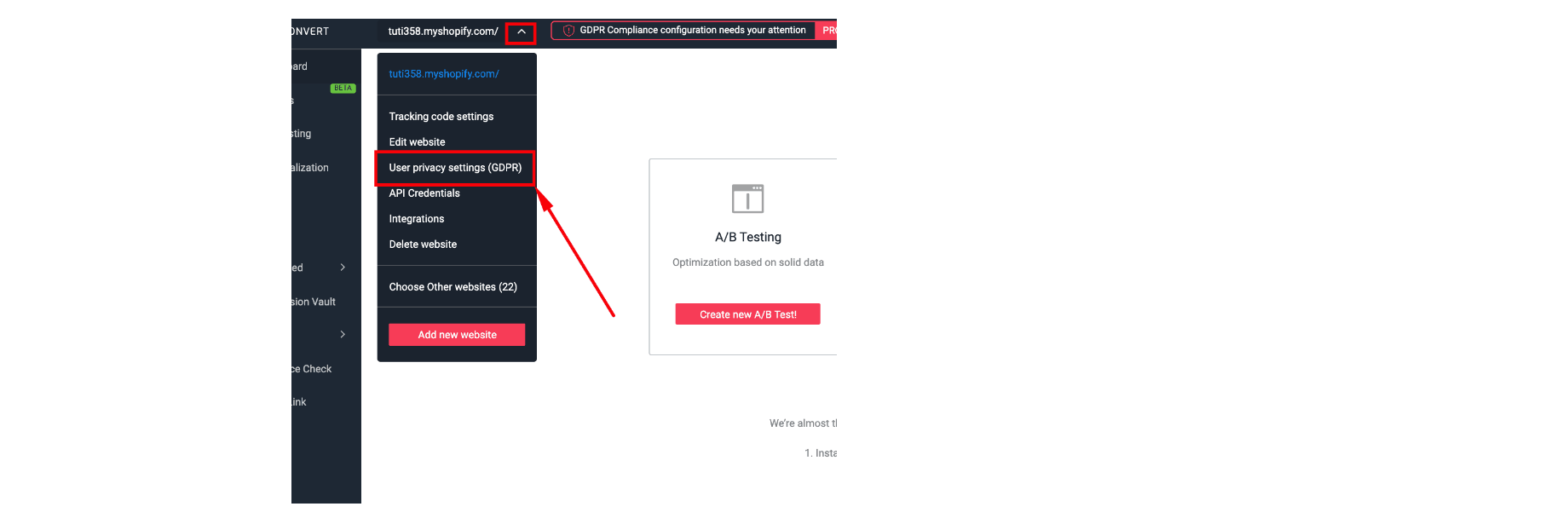
PROS:
Omiconvert is more than an A/B testing tool. It will help you to make strategic design changes with the testing tool and gather user data with the survey functionality. In addition, Omniconvert mixes its segmentation tool with the A/B testing tool so that you can test up to 40 segmentation parameters such as visitor behavior, geolocation, and traffic source.You can count on reliable support and customer service.
CONS:
The user interface is a bit confusing. The UI hinders access to certain elements and the choice of a personalized pre-set for displaying data (main website, website overview, etc.).You can’t run two separate tests on one page simultaneously.
Overall
Omniconvert is affordable and includes lots of features. Moreover, this tool can be used for A/B testing a web page, app, or product – ideal for ecommerce organizations aiming to become more customer-focused. The pricing is reasonable and can be a good fit for small- to medium-size companies.
9. Apptimize
Apptimize is a testing tool focused on mobile optimization.
Pricing
Contact Apptimize for pricing. 30-day full-feature trial. Demo available.
Main features
- A/B and multivariate testing tools: web, mobile, over-the-top (OTT), and in-store.
- Experimentation features: audience targeting, funnel analysis, split testing, campaign segmentation, and visual editing.
- Technology support: the ability to add dynamic variations and code blocks that support Objective-C, Swift, Java, HTML5, Xamarin, and React Native.
- Cross-platform optimization: you can optimize all your customer digital touchpoints while ensuring a consistent user experience across all platforms and tracking the impact of those optimizations everywhere.
- Programmatic tests: you can test anything you code through dynamic variables and code block experiments, i.e., search algorithms or the number of steps in a conversion flow.
Ease of use
It is rather easy to set up and use – with easy-to-deploy SDKs, rich integrations, and a centralized dashboard for all channels, even non-technical users can launch experiments involving copy, CTAs, images, and navigation items through the WYSIWYG visual editor.
Privacy
To help customers comply with applicable data privacy laws, including GDPR and CCPA, Apptimize has introduced enhancements to the platform to provide controls and features.
- Encryption
Data is encrypted during transmission to and from Apptimize. Additionally, all data is encrypted with Whole Disk Encryption using the AES 256 standard.
- Consent management
Apptimize supports opt-in consents and withdrawal of consents for mobile application push notifications, web notifications, email, and SMS. No consent manager solution. You must implement your integration with the platform with the legally appropriate level of notice and consent enabled.
- Data transfer
Apptimize claims to ensure that, as required under GDPR, EU residents’ personal data may only be transferred outside the EU if the country to which the data is transferred has been deemed by the EU Commission to have adequate data protection laws.
- Data location
Depending on the customer’s selection of services at setup, Apptimize uses cloud data centers in the US and the EU.
PROS:
Apptimize offers an easy-to-use WYSIWYG editor. Access controls and permissions limit who can make changes.
CONS:
No behavior tracking.
Overall
If you have an app or a buyer journey that crosses platforms, Apptimize might be a good solution for A/B testing.
Apptimize focuses explicitly on testing for companies with frequent product rollouts, such as software companies.
10. Crazy Egg
Crazy Egg is a tool that lets you track how users interact with your website. It has a built-in A/B testing platform to complement its heatmaps.
Pricing
Crazy Egg plans range from $29/month to $249/month. A 30-day free trial is available.
Main features
- A/B tests: let you run tests of images, website copy, and UI components. You can target traffic from specific mobile, desktop, or tablet devices and set different goals, such as selling more products, getting more registrations or getting more page views, and more.
- Traffic analysis: you can compare your website traffic based on origin. For example, you can see the top 10 sources of traffic and analyze which audience performed several actions on your site.
- Errors tracking: you can see which errors reduce conversions in session replays. You’ll get insights into each error, such as the raw stack trace, device and browser information, and more.
- Surveys: enable you to create multiple-choice, text, and ratings-based surveys. You can also collect feedback on customer experience through NPS scores and ratings.
Ease of use
Very simple setup. Add the unique Crazy Egg snippet to the web page you want to test and you’re ready to go. It is easy to use, and no advanced technical skills are needed.
Privacy and security
Crazy Egg is compliant with various pieces of privacy legislation across the globe, including GDPR, CCPA, HIPAA, and PIPEDA. Crazy Egg is ISO-27001 and SOC2 certified.
- Anonymization
When tracking data from a customer’s website, Crazy Egg does not collect any other Personal Identifiable Information (PII) in Snapshots or AB Testing features, and all IP addresses are anonymized; they are not stored.
- Encryption
All communications from your end users and visitors with the Crazy Egg Service are encrypted using industry-standard communication encryption technology. Crazy Egg currently uses Transport Layer Security (TLS).
- Data storage and location
All data Crazy Egg collects is stored electronically in the US on AWS infrastructure. The application and database servers run inside an Amazon VPC (Virtual Private Cloud). Crazy Egg doesn’t offer data hosting in the EU.
PROS:
Crazy Egg’s A/B testing module was created to keep it simple. No complicated setup here. It offers solutions for both testing and behavioral insights. Each plan includes unlimited surveys, websites, and tests.Works well with Google Tag Manager without complex coding scripts.
CONS:
No advanced reporting features. This is a very basic tool.
Overall
Crazy Egg’s A/B testing module is a basic tool at an approachable price. If you do not need advanced features, don’t do coding, and have no rich analytical skills but want to understand user behavior and identify what users are doing when they visit your website, this might be a suitable choice.
Here’s an overview of the 9 A/B tools we’ve compared:
| Optimizely | Convert | VWO | Conductrics | Adobe Target | A/B Smartly | |
|---|---|---|---|---|---|---|
| Pricing | On request | From $99/m | From $356/m | On request | On request | On request |
| Free trial/demo | | | | | | |
| A/B testing | | | | | | |
| Multivariate testing | | | | | | |
| Client-side | | | | | | |
| Server-side | | | | | | |
| Visitor segmentation | | | | | | |
| Consent Manager solution | | | | | | |
| Privacy | | | | | | |
| EU data hosting available | | | | | | |
| Ease of use | | | | | | |
| AB Tasty | Omniconvert | Apptimize | Crazy Egg | |
|---|---|---|---|---|
| Pricing | On request | From $249/month | On request | From $29/month |
| Free trial/demo | | | | |
| A/B testing | | | | |
| Multivariate testing | | | | |
| Client-side | | | | |
| Server-side | | | | |
| Visitor segmentation | | | | |
| Consent Manager solution | | | | |
| Privacy | | | | |
| EU data hosting available | | | | |
| Ease of use | | | | |
A/B testing tools: Conclusion
Each of the top A/B testing tools has pros and cons. You’ll likely have to do some strategic thinking and exploration to get the right solution for your business and specific use case.
But it’s always a good idea to work with those that support principles such as privacy by design. Following these values will help you abide by privacy laws, fully control your data, and understand what kind of data you collect, store, and transfer. Hopefully, our comparison will help you in the process.
Check out our other comparisons:
The post Best 10 A/B testing tools for 2023: Google Optimize alternatives appeared first on Piwik PRO.
]]>The post 70-point comparison of 7 tag managers appeared first on Piwik PRO.
]]>Tag management solutions track marketing data by embedding tags in websites or apps. They are essential to capture information for web analytics. Digital marketers can use tag managers to track conversions and collect visitor behavior data without the help of developers.
Choosing a tag manager for your organization shouldn’t end with analyzing the extent of features and customization options. Due to the increase in the importance of data governance, your tag manager should also include data privacy and security features.
Learn more about Piwik PRO Tag Manager.
Why do you need a tag management system in the first place?
Tag managers simplify the process of web and mobile tracking for analysts and marketers. They are able to create, edit, and deploy tags in minutes using the available tag, trigger, and variable libraries. Teams get more power and flexibility.
The main benefits of using a tag manager include:
- Saving time and resources by reducing the workload of the IT team.
- The ability to consolidate and standardize the process of updating tags.
- Easily tracking and maintaining large numbers of tags.
- Faster page load times and better site performance.
- Making your marketing activities more efficient.
- Increased data accuracy.
- Being able to easily comply with privacy requirements.
read also
Comparison of 7 tag managers – 70 factors from tag types to privacy
Understand the differences between Piwik PRO Tag Manager, Google Tag Manager, Tealium IQ Tag Management, Segment, TagCommander, Matomo Tag Manager and Ensighten Manage
How to choose the right tag management system
To make your data collection more efficient and secure, you should look for a tag management system with the following characteristics:
Customer Support
Tag managers take care of a lot for you, but at the core, you’re still dealing with complex JavaScript code. It’s helpful if your tag manager has extensive documentation you can use for guidance. Ideally, the tool you choose should have a support team you can reach out to in case of any problems or unknown bugs.
Privacy compliance and data control
Make sure your tag management platform contains advanced privacy-friendly features that will support the collected data’s security and give you enhanced control over it. This can include features like zero-cookie load, safe hosting options, and choosing where your data is stored.
Integrations, libraries, and templates
Extensive libraries, templates, and integrations can save you a lot of time when creating, debugging, and maintaining your tags. Thanks to them, you don’t have to add too many custom tags yourself. Also, it pays to have an easy way to integrate your tag management system with tools such as consent manager or customer data platform.
Read more about how you can use tag managers in web analytics:
A review of tag management vendors
Piwik PRO Tag Manager
Piwik PRO Tag Manager lets you create, set up, debug, and run tags on your website to streamline data collection and activation without the help of developers. You can run online campaigns, integrate with Facebook Ads or Google Ads, and collect additional data. Use a vast library of tag templates, triggers, and variables, or create custom ones. With Piwik PRO, you can also count on complete data control and security – for example, connect Consent Manager to only fire tags with relevant consent.
Google Tag Manager
Google Tag Manager (GTM) is the most widely used tag management system and integrates well with Google’s other tools, such as Google Analytics 4 or Google Ads. GTM is a powerful tool for marketing and analytics teams that facilitates creating, embedding, and updating tags across websites and mobile apps. It offers features like debugging and rules, macros, or automated tag firing, allowing for data standardization and quick deployment.
With Piwik PRO you can use integration with Google Tag Manager to collect data server-side and client-side.
Segment
Segment is predominantly a customer data platform that shares some features and purposes with tag managers. The platform collects and structures the data to be integrated with analytics, advertising, email, marketing automation, CRM tools, and others with minimal effort. Segment can also archive the data, replay historical data into new tools, and send raw data to a data storage solution for later analysis.
Tealium IQ Tag Management
Tealium IQ Tag Management is a system for managing the configuration, testing, and release of third-party vendor tags to digital properties. The platform lets you unify disparate data sources and drive more consistent visitor interactions. Equipped with numerous vendor integrations, you can quickly deploy and manage vendor tags, test new technologies, and take control of your marketing technology stack.
Commanders Act TagCommander
Commanders Act TagCommander is an enterprise tag management solution that simplifies managing and deploying tags. This tool allows you to increase the quality of your implementation, collect data across devices, and use it across channels. Teams can explore unified audiences and send data to other systems for more precise segmentation, targeting, and personalization.
Matomo Tag Manager
Matomo Tag Manager lets you manage and unify all your tracking and marketing tags. You can quickly integrate various features into your site, such as analytics, conversion tracking, newsletter signups, exit pop-ups and surveys, and more. Measure the success of elements of your marketing campaigns and external channels. Matomo’s Tag Manager also makes sure that all snippets are implemented and loaded correctly for faster performance.
Ensighten Manage
Ensighten Manage, recently acquired by CHEQ, is an enterprise tag management solution that focuses on deploying, validating, and updating disparate marketing technologies while unifying customer data across brands, domains, mobile apps, and display advertising tags. All of this exists within a critical layer of security that ensures governance and data privacy. You can also use other Ensighten products, such as Ensighten Mobile, which lets organizations easily tag apps.
Overview of the analyzed features
We divided our comparison into the following sections:
Product overview
We prepared a quick overview of how each tag manager ranks in the most important categories: privacy and security compliance, product capabilities, customer care, hosting options, and customization possibilities. You can see each tool’s strengths and weaknesses and how they compare to each other.
Hosting
This part focuses on the available hosting options. Depending on your technical and legal requirements, cloud hosting may be sufficient, or you might need to choose a more secure solution, such as private cloud or on-premises hosting. It’s also great if your tag management system offers flexible data residency options so you can choose and know precisely where your customers’ data is being stored.
Privacy and compliance
Because tag managers support a range of tag types, they make it much easier to ensure compliance. See what privacy and security functionalities are offered in each tool. Go for a TMS that lets you keep full control over your data and how the tags are used.
Some features we are comparing here include zero-cookie load, firing tags based on the user’s consent, Opt-out or Do Not Track options at the individual tag level, and different privacy modes for session and event tracking.
Integrations
Learn whether the tag managers offer any other modules that can be easily integrated with your system.
A customer data platform adds a ton of value to tag managers. It enables granular, cross-platform data collection, protection of data quality and identity resolution, integration and activation, audience segmentation, and data governance and security.
A consent manager is useful for achieving compliance, especially when managing consents. You can keep track of users’ consent choices and apply them so your tags get fired only after consent is received.
Another crucial aspect is how flexible the TMS is regarding custom integrations and development. Find out if you can add and connect custom integrations to your tool.
Customer support
You should be able to contact customer support for help or onboarding assistance in the way that suits you best. Ensuring your tag management setup works correctly and serves your organization right is essential.
If your company has a simple setup or an internal tech team capable of creating and maintaining your tags, you may do with email or live chat support or access to a help center.
More elaborate tag setups might call for specialized help, such as a dedicated support specialist, personalized implementation, and onboarding or product training.
General tagging features
Various tag features can simplify the process of working with your tag manager. See what the tools offer in terms of tag import and export capabilities, folders for tags, triggers and variables, workspaces for concurrent tagging projects, and changelogs. Other analyzed features include access to API, moderation queue, server-side tagging, test and debug mode, and more.
Tag types
Here we look into the available tag types based on their purposes, as well as tag templates for analytics, remarketing pixels, or A/B testing tools and the option for using tag template libraries. Learn about support for asynchronous and synchronous tags, the ability to add custom tags, pop-ups, and tag templates, content personalization from within the tag manager, and others.
Trigger types
Moving on to triggers, we analyze the options of libraries of triggers and conditions, trigger groups, event trigger templates, and other types of trigger templates. Learn whether the tools include trigger types such as data layer, page view, history change, exit intent, or form submission.
Variable types
In this section, we explore the available types of variables – custom JavaScript, cookie, data layer, DOM element, URL, constant or random number variables, as well as access to built-in variable templates.
Flexibility and limits
Here you can learn if there are any limits to how many tags, custom variables, and user roles and permissions you can add. You can also check whether the tools support two-factor authentication.
Preview of our tag management comparison
Note: We’ve shortened some product names for easier reading. Here are the full names of the products covered:
- Piwik PRO Tag Manager
- Google Tag Manager (360-only features are noted in the table)
- Segment (with Business plan features)
- Tealium IQ Tag Management
- Commanders Act TagCommander
- Matomo Tag Manager
- Ensighten Manage
Product overview
| Piwik PRO | Segment | Tealium | Tag Commander | Matomo | Ensighten Manage | ||
|---|---|---|---|---|---|---|---|
| Privacy and security compliance |  |  | | | | |  |
| Product capabilities | | | | | | | |
| Customer care | | | | | | | |
| Hosting options | | | | | | | |
| Customization | | | | | | | |
Hosting
| On-premises |  | | | | |  | |
| Cloud | | | | | | | |
| Private cloud |  | | | | | | |
| Content delivery network (CDN) | | | | | | | |
| Cloud or private cloud data residency options | | | | | | | |
Privacy and compliance
| Opt-out / Do Not Track option at the individual tag level | | | | | | | |
| Option to enable zero-cookie load | | | | | | | |
| Tags and tag categories fired based on consent status | | | | | | | |
| Several privacy modes for session and event tracking | | | | | | | |
| Option for a built-in consent manager | | | | | | | |
Download the full comparison to see the rest of the features and how the vendors compare to one another:
read also
Comparison of 7 tag managers – 70 factors from tag types to privacy
Understand the differences between Piwik PRO Tag Manager, Google Tag Manager, Tealium IQ Tag Management, Segment, TagCommander, Matomo Tag Manager and Ensighten Manage
The post 70-point comparison of 7 tag managers appeared first on Piwik PRO.
]]>