The post How can healthcare organizations benefit from using a customer data platform (CDP) appeared first on Piwik PRO.
]]>The healthcare industry has been slow to embrace digital transformations. Patient data is extremely sensitive, and privacy regulations compel the industry to scrutinize any new marketing or sales strategy. At the same time, regulations like HIPAA require providers to comply with strict standards when managing protected health information (PHI).
Customer data platforms (CDPs) offer a unique opportunity to unify patient data from disparate sources and act on it to improve communication with patients. CDPs allow companies to activate their data to provide integrated experiences across all channels, including appointments, account management, and telehealth.
In this blog post, we will examine how CDPs and data activation can help healthcare organizations integrate and activate their data while remaining privacy-compliant.
What are customer data platforms (CDPs)
CDPs help integrate and manage information about your future and existing patients from multiple sources and points of contact. In healthcare, these can include electronic health records (EHRs), patient portals, mobile applications, social media, and call center interactions.
A CDP offers a unified view of your patients and allows you to use the gathered data to automate processes leading to improved patient acquisition, engagement and retention.
You can use the data to:
- Send timely reminders or follow-ups to patients based on their recent activity.
- Share relevant health information or recommendations matched to patient interests or needs.
- Re-engage patients who started but didn’t finish online forms or bookings.
- Group patients for targeted health campaigns or outreach.
- Notify care teams when patients show signs of needing urgent attention.

Benefits of using a CDP in healthcare
Using a customer data platform (CDP) by HIPAA-covered entities offers several benefits, particularly enhancing patient experiences while ensuring compliance with regulations.
Here are some key advantages of CDPs:
- Data unification: CDPs help unify patient data from various sources, creating a comprehensive view of each patient. Single customer views (SCVs) enhance the ability to provide personalized care and experiences.
- Data silo elimination: By integrating data across different systems, CDPs eliminate data silos, ensuring that all relevant information is accessible and usable for healthcare providers.
- Real-time data management: CDPs often support real-time data management, providing call centers and telehealth agents with up-to-date patient information. With timely insights and responses to patient interactions, call center agents can immediately focus on finding solutions to their issues.
- Integration: CDPs enable seamless integration between various systems and data sources, which improves operational efficiency and provides access to integrated data in one platform.
- Data activation: Healthcare organizations can transform data into actionable insights, improving patient care and decision-making by identifying care gaps, predicting risks, and personalizing treatment plans.
- Enhanced segmentation and targeting: CDPs offer better segmentation and audience targeting by connecting patient data, allowing healthcare providers to tailor services and communications to individual patient needs.
- Improved marketing effectiveness: Use a CDP to unlock healthcare marketing insights to maximize the effectiveness of your campaigns and create personalized experiences.
Customer data platform (CDP) and HIPAA compliance
HIPAA-compliant CDPs provide technical and physical safeguards to protect the PHI they store and process. Such vendors can help them protect patient data with enhanced security features like encryption, safe data storage, access controls, data management, incident response and others.
When looking for a HIPAA-compliant CDP, focus on evaluating the following key areas:
Data security and encryption
Ensure that all patient data is encrypted and hashed immediately upon collection. This includes using protocols like SSL or TLS for data transmission. CDPs also provide identity resolution and data masking to protect patient data.
Compliant hosting
Keep all customer data on a HIPAA-ready public or private cloud with secure backup storage. Private cloud is more optimal due to granular control over the infrastructure and security features.
Minimum necessary principle
HIPAA restricts the scope of collected and disclosed data to what is strictly needed. A CDP should allow granular role-based access controls and data segmentation.
Data retention and deletion
CDPs can automate the implementation of clear policies for retaining and safely disposing of PHI when it is no longer needed.
Auditing and monitoring
Maintain detailed audit logs of data access and modifications for compliance purposes. This will allow you to track who accessed PHI and when, reducing the risk of unauthorized data exposure.
Consent management platforms (CMP)
Many CDPs offer seamless integrations with CMPs. These tools are designed to streamline obtaining, managing, and tracking patient authorization to guarantee all data exchanges contain relevant consents.
Business associate agreement (BAA)
Signing a business associate agreement (BAA) with the CDP vendor allows you to process PHI in a HIPAA-compliant manner. It helps ensure joint compliance and liability for the provided services and establishes clear responsibilities concerning PHI protection.
Patient authorization and HIPAA compliance
Under the HIPAA Privacy Rule, collecting valid patient consent involves specific requirements to ensure the security of protected health information (PHI).
A covered entity must obtain patient authorization before using or disclosing PHI, except for specific exceptions like treatment, payment, and healthcare operations (TPO).
TPO includes, among others:
- Appointment reminders
- Preventive actions
- Individualized recommendations
- Scheduling optimizations
- Telemedicine prompts
- Medication adherence messages
- Basic health campaigns
Another exception to authorization is verbal consent, which is allowed in limited cases, such as hospital directories or notifying family members. Still, disclosures must be minimal, such as name, condition, or location.
If the organization wants to use PHI for purely commercial or marketing purposes unrelated to care, HIPAA requires formal written authorization from patients before their data is used. Such purposes include promoting external or unrelated services, retargeting ads or sharing data with third parties.
You can manage authorization through a HIPAA-compliant consent management platform (CMP) that tracks and enforces consents. A CMP allows healthcare providers to create electronic forms that patients can sign digitally, ensuring a clear and documented authorization record.
Elements of a valid HIPAA authorization
A valid authorization must include the following elements:
- Clear description: The PHI to be disclosed must be clearly defined.
- Patient identification: The patient’s printed name must be included.
- Recipient details: The individuals or entities authorized to use or disclose the PHI must be specified.
- Purpose of disclosure: The purpose of the use or disclosure must be detailed.
- Expiration date: The authorization must include a date after which it is no longer valid.
- Patient signature: The patient must sign the authorization, and a copy must be provided to them.
Patients can revoke their authorization in writing at any time, and covered entities must respect this revocation.
Data de-identification
HIPAA names two valid de-identification methods: Safe Harbor and Expert Determination.
De-identified data can be used for statistical analyses, predictive modeling, or marketing that doesn’t require identifying specific patients. Once PHI is de-identified, the restrictions of the HIPAA Privacy Rule no longer apply because the data contains no individually identifiable health information.
HIPAA also allows using a limited data set under a data use agreement. A limited data set contains identifiable healthcare information that HIPAA-covered entities can share with certain parties for research purposes, public health activities, and healthcare operations without prior authorization from patients. However, if you want to take advantage of this method, ensure you meet the conditions specified by the HIPAA Privacy Rule.
Learn more about HIPAA compliance in marketing and analytics:
Data activation use cases in healthcare
CDPs can help improve patients’ exposure to providers, including onboarding, finding care, and post-care adherence.
You can create audiences of users matching specific demographic or behavioral conditions, such as their preferences, browsing or treatment history, symptoms, subscription, and more. Then, you can activate the audience by providing them with easy access to relevant information and services. Your activations can include showing on-site banners and sending emails or SMS, push notifications, in-app messages, and more.
You can combine data activation with other platforms, such as tag management systems. You’re also able to enrich data in a CDP with information imported from different sources, like ad platforms or CRMs.
Here are some suggestions for data activation use cases in healthcare:
Personalized treatment plans
- Create audiences of users based on their individual health records, browsing and purchase history, and contact preferences.
- Activate the audience by generating tailored treatment recommendations or medication plans and sharing them with patients via secure portals or apps.
Real-time appointment optimization
- Create audiences of users based on their patient preferences and provider availability. You should integrate the CDP with appointment scheduling systems to make this possible.
- Activate the audience by automating scheduling and sending pre-appointment reminders to reduce no-shows.
Enhanced telemedicine experiences
- Create audiences of new patients before their first appointment or a specific type of test.
- Activate the audience by encouraging them to use self-service tools and provide details of their conditions and preferences before their appointment. With this information, clinicians will have access to patient details that will allow them to personalize telemedicine consultations.
- After the appointment, you can request the audience to leave feedback, which you can use to improve future telehealth sessions.
Medication adherence monitoring
- Create audiences of users based on the available prescription data and patient adherence.
- Activate the audience by sending automated refill reminders or alerts for missed doses.
- You can also provide pharmacists and doctors with adherence reports for follow-ups.
Population health management
- Create audiences using aggregated data from diverse populations based on demographic data and identify care gaps and high-risk groups.
- Activate the audience by implementing targeted interventions for underserved communities, such as preventive care campaigns for different age groups.
Acquiring new patients
- Create audiences of users who haven’t used your services before but have been browsing pages about them.
- Activate the audience by showing on-site banners in real-time to encourage them to learn more about your offer, book an appointment, or test.
Cross-promotion campaigns
- Create audiences of users based on their current usage of your services, such as treatment history, health conditions, or subscription plan.
- Activate the audience by recommending related services they might be interested in or higher treatment plans for frequent users.
Let’s go through two step-by-step examples of data activation using Piwik PRO CDP:
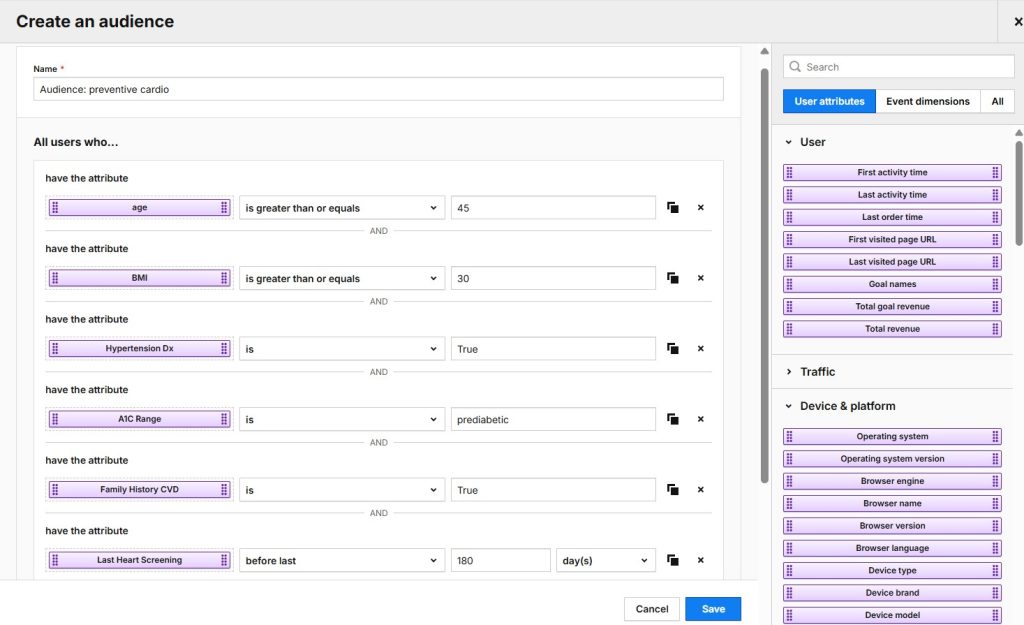
Preventive care
1. In Piwik PRO CDP:
- Create an audience based on user/patient attributes indicating they may be at risk of chronic diseases like diabetes or heart disease, as well as web behavioral data like interaction frequency and recency.
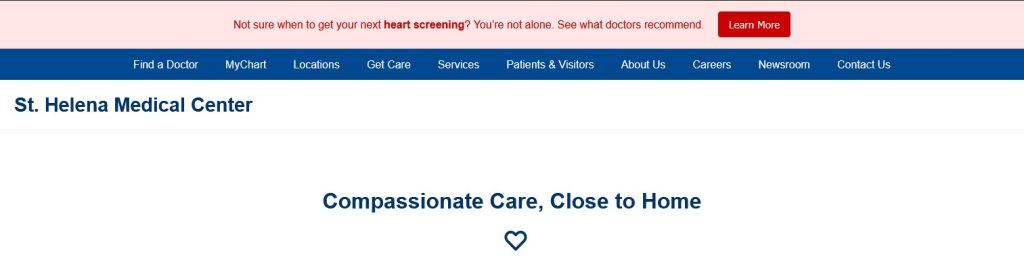
2. In Tag Manager:
- Add a custom tag or content tag with banner styling and text content.
- Add an audience detection trigger.
3. Activate the audience in the CDP by showing an on-site banner with personalized care instructions or recommendations for taking preventive measures.
Patient engagement campaigns
1. In Google Ads:
- Run a campaign promoting cardiovascular disease screenings covered by Medicare Part B.
- Drive users to a landing page with educational content and screening eligibility details.
Note: Such screenings are often covered under government or government-sponsored programs (such as Medicare Part B every 5 years). According to HHS guidance, this type of communication is not considered marketing under HIPAA.
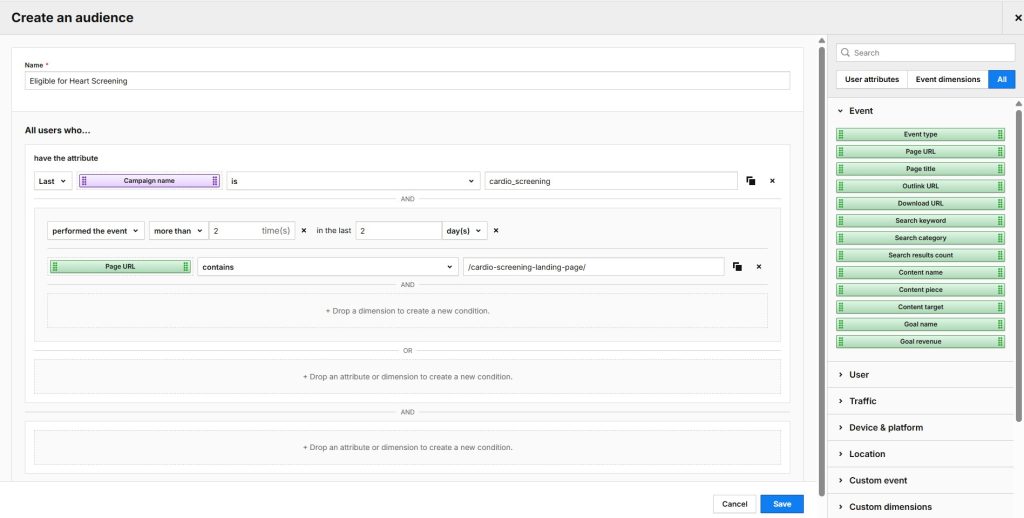
2. In Piwik PRO CDP:
- Create an audience of users who came from the Google Ads campaign and have shown high interest via their web behavior.
3. Activate the audience in the CDP via a webhook or API by sending the attribute indicating the user’s interest in cardiovascular screening to an appointment portal like Phreesia. You must sign a BAA with the platform.
4. In the appointment portal:
- Check if the user already has an appointment.
You can skip this check if you’re feeding data into the CDP from the appointment portal and include a ‘no-appointment-yet’ condition in Step 2.
- If not, send the following text message to the user: “You may be eligible for a free heart screening. View your secure invitation here”.
Piwik PRO and HIPAA compliance
If you want to start activating your data, choose a HIPAA-compliant platform that will let you do it safely yet effectively.
Piwik PRO offers an integrated platform consisting of analytics, tag management, consent management, and a customer data platform.
With an intuitive UI, easy-to-use, customizable reports and dashboards, and seamless integrations with other tools, you can adjust data processes to your needs. Throughout this, we offer personalized support, onboarding and training.
On top of functionality, you can count on a range of features to support your organization in complying with HIPAA. These include:
- Compliant hosting: Piwik PRO offers hosting on HIPAA-compliant Microsoft Azure data centers based in the US, allowing organizations to know how and where their data is being stored.
- Business associate agreement (BAA): Piwik PRO offers a customizable BAA, helping clients ensure sensitive health information is handled following HIPAA standards. If you prefer, you still have the option to de-identify all PHI before sending it to our platform. Either way, you can ensure compliance with HIPAA.
- Encryption: Data is encrypted at rest and in transit using secure protocols like 256-bit AES encryption, ensuring that sensitive health information remains safe.
- Advanced user permissions: Piwik PRO provides granular access controls, allowing organizations to restrict access to sensitive data to authorized personnel only.
- No sharing of ePHI: Piwik PRO does not share electronic protected health information (ePHI) with third parties or reuse it for other purposes, maintaining data privacy.
- Regular security audits: The platform undergoes regular privacy and security audits by external bodies to ensure high-security standards.
- ISO 27001 and SOC 2 Type II certifications: Holding these certifications, including a HIPAA compliance assessment, demonstrates Piwik PRO’s commitment to robust security and compliance standards.
Read more about Piwik PRO and HIPAA compliance.
Final thoughts
Patients expect personalized interactions with their providers, but achieving this on a large scale is challenging. Using customer data platforms (CDPs) in healthcare is a way to provide better experiences at every stage of the patient journey. User expectations are ever-changing, and organizations that are willing to adapt can better meet their needs. Healthcare is personal, and with a strategic application of CDPs and data activation, healthcare organizations can deliver the right message when it matters most.
Reach out to us and learn how your healthcare organization can benefit from data activation with Piwik PRO:
The post How can healthcare organizations benefit from using a customer data platform (CDP) appeared first on Piwik PRO.
]]>The post Customer Data Platform is now available for all Piwik PRO users appeared first on Piwik PRO.
]]>What is a customer data platform?
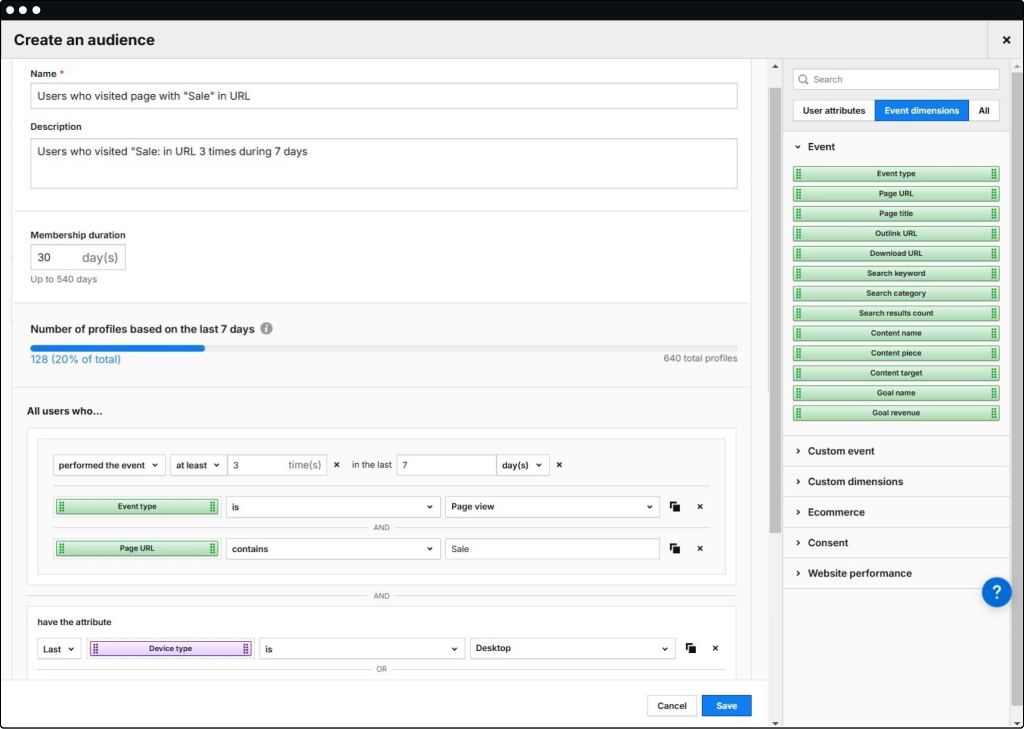
Customer data platforms help you gain a unified, comprehensive view of your customers, improving personalization and marketing campaign effectiveness. With a CDP, you can effortlessly integrate data from different sources to build in-depth customer profiles that include all the data you’ve gathered, such as demographic information, purchase history, behavioral data, etc.
Segmenting customer profiles based on specified criteria creates audiences. The data can then be activated by sending selected, most relevant user data to thousands of destinations. Consequently, marketers can gain a competitive edge by accessing and transforming customer data into action.
Why is data activation important?
While data analysis is key to understanding how users interact with your page or app, data activation represents phenomenal potential to take action based on the data you gather. For example, you can use it to:
- Improve onboarding completion rate with personalized email sequences to guide new users with tailored emails, ensuring they complete critical steps like setting up profiles while addressing friction points early on.
- Enhance engagement and value realization by offering premium users exclusive pre-launch deals to maintain engagement.
- Run a churn prevention campaign to identify users with declining engagement and re-engage them with personalized solutions, product tutorials, or new feature updates.
If you want to learn more about data activation, read Unlock the power of customer data: A Piwik PRO data activation playbook
With its robust data activation and import options, CDPs allow you to turn data into valuable insights and connect various tools from your technology stack. The data can be used to make informed decisions, improve operational efficiency, and enhance customer experiences. Most importantly, CDP is a powerful tool for driving business growth, making it a critical component of any data-driven organization.
If you want to learn more about data activation and customer data platforms, read:
- Activate data for a personalized customer experience with the Piwik PRO Customer Data Platform
- Customer Data Platform: Generate meaningful insights with customer data activation and import
- Free comparison of 7 enterprise-ready customer data platforms
- 8 customer data platform (CDP) use cases that will drive your business growth
Explore our videos:
What you can achieve with Piwik PRO’s CDP
In combination with analytics, CDP adds critical value, allowing you to analyze and report on your marketing performance and act accordingly. Piwik PRO Customer Data Platform enables businesses to organize, analyze, and activate data to improve and fight churn, optimize their ad campaign budgets, increase the average cart value, or whatever action is the most important in your case.
Here is what makes Piwik PRO’s CDP unique:
- It integrates with a web and app analytics platform rather than aiming to replace it like most other CDPs on the market.
- It is flexible and can scale with your business and needs, providing basic and more sophisticated functionalities.
- The native integration with Analytics and Tag Manager ensures a steady supply of crucial user data, facilitating a deeper understanding of insights.
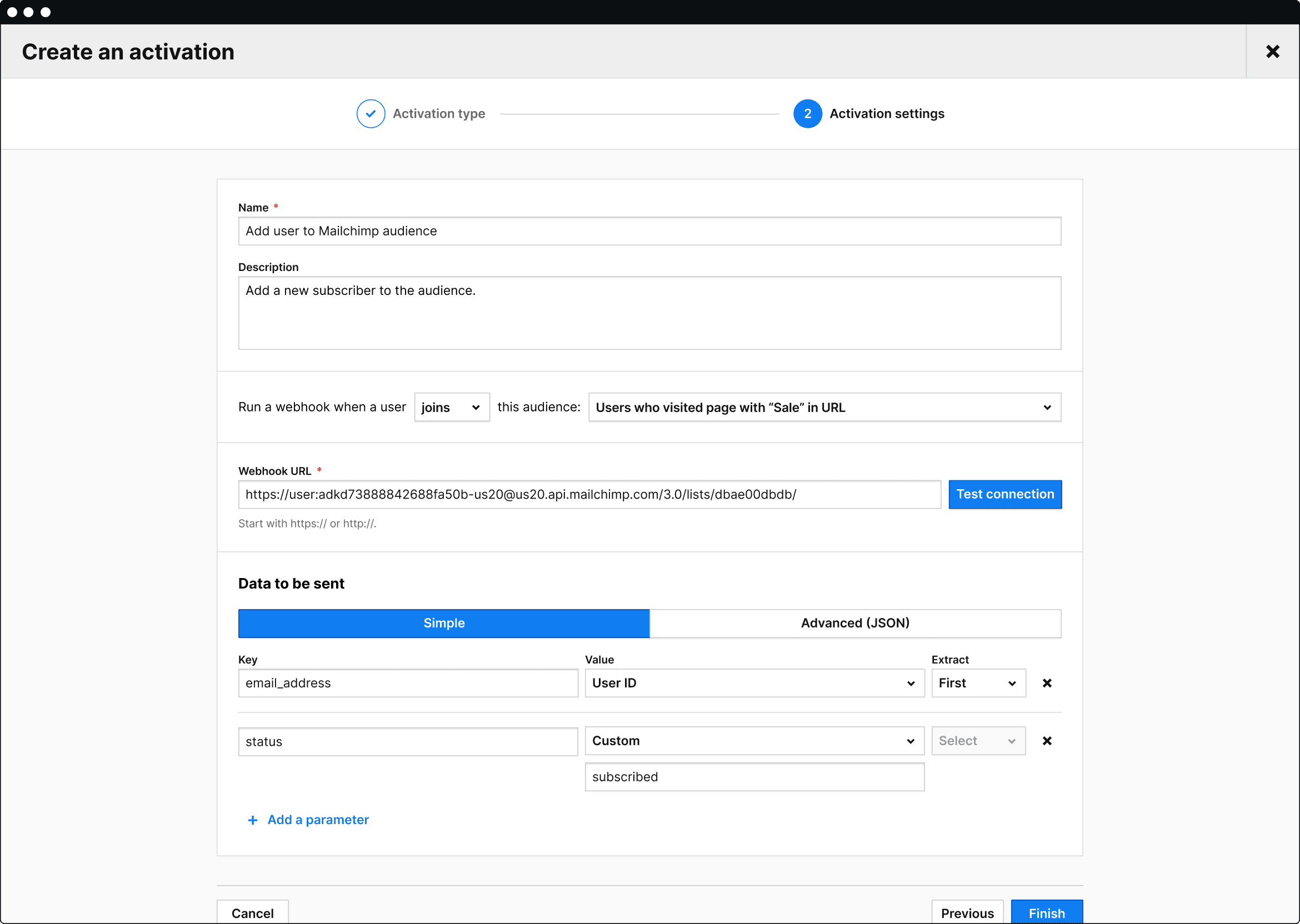
With Piwik PRO’s CDP, you can effortlessly activate data. Utilize webhooks and automation tools to send desired attributes to various destinations, such as CRM, ad platforms, email marketing tools, and internal communication channels. Plus, the intuitive editor and templates allow you to create activations without the help of tech teams, and you can also define advanced integrations if required.
Moreover, Piwik PRO’s CDP prioritizes user privacy and helps you comply with global privacy laws like GDPR, TTDSG/TDDDG, CPPA, CPRA, and LGPD. This includes safe hosting options, data governance, and built-in integration with consent management tools. We are also HIPAA approved.
Interested in integrating and activating your first-party data with a privacy-friendly Customer Data Platform?
The post Customer Data Platform is now available for all Piwik PRO users appeared first on Piwik PRO.
]]>The post Unlock the power of customer data: A Piwik PRO data activation playbook appeared first on Piwik PRO.
]]>The post Unlock the power of customer data: A Piwik PRO data activation playbook appeared first on Piwik PRO.
]]>The post How you can drive growth for your business with an integrated analytics platform appeared first on Piwik PRO.
]]>How can organizations best adjust and grow in the ever-transforming digital world?
This article will explain the importance of data integration and activation in analytics today and how companies can use them by turning to integrated analytics platforms.
What trends do companies need to follow in today’s marketing and analytics
Businesses face significant challenges in navigating the changing digital marketing standards.
Nowadays, they must find ways to recognize and incorporate several approaches:
Focus on personalization
Personalization is no longer just an option. Research by McKinsey shows that 71% of customers expect companies to deliver personalized interactions.
Companies in many industries are increasingly fighting for consumers’ attention. As statistics show, 89% of businesses compete primarily on the basis of customer experience. In a recent study by Qualtrics, over 65% of customers said their experience on the website or app would be at least a very important factor in their willingness to recommend a brand.
With rising competitiveness across industries comes stakeholders’ growing demands for better business results. Companies that utilize personalization generate 40% more revenue from these activities than the average. Additionally, 61% of people are willing to spend more with a company that offers them a customized experience.
Organizations should aim to reach customers with tailored campaigns, offers, and products to increase sales and grow their business. Their best bet to achieve that is by activating their data.
Data activation involves utilizing collected information to target and engage with audiences strategically. Activating customer data helps teams personalize campaigns and messaging across channels.
Through that, businesses can:
- Improve customer experiences.
- Convert prospects into customers more quickly and at higher rates.
- Drive positive business outcomes.
Follow privacy compliance standards
It’s understood that strict privacy and security requirements must be prioritized when handling customer data. Both companies and consumers are aware that data is valuable and must be protected, which is additionally enforced by data protection regulations. Users expect their data to be used responsibly and for their benefit. Acquia’s survey shows that consumers are becoming more comfortable sharing personal data with brands for a better experience.
Companies should use this opportunity to stay transparent about data collection and respect users’ choices concerning their data and its use. Privacy compliance requirements also push companies to analyze what digital data they collect and own and evaluate what tools they use to handle it. Organizations should work with vendors that give them complete control over what data they collect and what happens with it.
Collect first-party data
Since most browsers are moving away from third-party cookies, marketers need to move on from them. According to Acquia, 84% of people say that scrutiny of browser cookies has increased the importance of first-party data obtained through direct interactions between a company and its audience.
Among many others, first-party data lets companies:
- Create more targeted campaigns.
- Enhance customer relationships and trust.
- Improve overall marketing effectiveness.
- Support compliance with relevant privacy regulations.
As a result, to remain competitive, companies must establish a first-party data strategy. It should involve collecting valuable data from users through analytics, social media, contact forms, email, user accounts, and others and strategically activating it. Organizations can also benefit from gathering zero-party data, which is the type of data that customers willingly share with brands.
For more on first-party data, check out our blog post: What is first-party data and how does it benefit your marketing.
Establish a data strategy
Businesses today have access to staggering amounts of data, not to mention the number of tools they use for marketing, sales, customer support, and other purposes. According to a 2017 study, the average enterprise used 91 marketing cloud services, 90 for HR, and 70 for collaboration, to name but a few.
As companies plan their first-party data collection, they need to strategize what information they need and how they want to use it. Instead of randomly collecting every possible piece of data, digital analysts must focus on what’s relevant and ensure the data is high-quality and reflects actual customer behavior. It’s also easier to collect valid user consent if you inform users why you need the data and how you will use it.
Integrate your data
Companies must work on complete data sets in order to gain insights that will help them more effectively target their ideal customers. For this purpose, they need to merge user data from different sources, understand the connections between data points, and determine how customers’ behavior impacts their decisions.
They need to be able to analyze the complete customer funnel, including information relating to marketing, sales, finance, and customer experience interactions. This will help them understand users’ paths from their first interaction with a brand, through their responses to marketing activities and sales communication, to the decision-making process and becoming customers.
Above all, integrating and segmenting data allows teams to better understand their existing customer base and how to reach new ones that match their traits.
Experts opinion
Emanuele Celoria
“For the last few years, marketing and product analytics tools have been launching new modules allowing the import of external data. This is not surprising since companies rely on diverse platforms to collect very different kinds of data. For example, analytics platforms collect behavioral data, CRMs provide customer details, and advertising platforms share marketing budget spend and campaign performance. There is a clear need for data hubs that put together all collected information and act as unique sources of truth.
All these data sources provide complementary information about users and customers. This is why integrating them enables a better business understanding and helps answer complex business questions to deliver real value. A strong prerequisite for obtaining unique insights is to have meaningful join keys across the different input data.”

How to fulfill the demands of modern digital analytics and marketing
Businesses have been looking for tools to help them address the above trends.
MarTech’s 2023 Replacement Survey demonstrates that it’s common for organizations to upgrade their marketing software in favor of solutions with better features that integrate seamlessly with the rest of their marketing technology stacks. The 2022 edition of the MarTech survey showed similar trends. The top two criteria for choosing a replacement tool were integration possibilities and open API, as well as data centralization and data capabilities.
A research report from Pandium shows that 86% of the Top 100 SaaS companies in the world now have a public integration marketplace. Other martech trends involve incorporating products from multiple vendors and having them well-connected with each other.
One solution companies can use today is integrated analytics platforms. These platforms allow businesses to merge all tools into a coherent data system and efficiently collect, analyze, and act on user data. Ultimately, they offer data integration and activation capabilities that let companies maximize the effectiveness of their insights.
What is an integrated analytics platform
An integrated analytics platform combines various data analytics components, such as data collection, processing, storage, and visualization, under a single, unified system. These platforms are characterized by flexibility and connectivity.
Crucially, an integrated analytics platform provides seamless integration with other tools and systems in the stack, consolidating online and offline data from multiple sources in one place.
You can combine analytics with tools such as:
- CRM systems
- Ad platforms
- Email marketing tools
- Data warehouses
- Ecommerce tools
- BI and data visualization tools
- Marketing automation systems
- Social media platforms
- And many others
Teams gain access to consistent data sets and can choose what data they import to the platform, where they send it, and how they activate it in destination tools. They might also define and create their own integrations with third-party tools.
Examples of integrated analytics platforms include:
- Piwik PRO Analytics Suite
- Amplitude
- Piano
- Adobe Experience Platform
Benefits of an integrated analytics platform
Integrated analytics platforms help facilitate a more efficient, cohesive approach to marketing and analytics.
The most important benefits of integrated analytics platforms include:
- Removing data silos – Data from all sources is unified and consistent, creating a comprehensive set and enabling the constant evolution of data models. Organizations work on more accurate and complete customer data.
- Being easy to use and collaborate – The platforms are easy to set up and contain the necessary products within one tool, allowing teams to get their work done faster and collaborate effectively.
- Reducing costs – Your team will spend less time implementing and updating different components of the platform. They don’t need to put as much effort into integrating multiple products.
- Combining data from multiple sources – You can easily integrate data from diverse sources and confidently manage data quality. This allows you to perform advanced analytics, visualization, and other processes in one place.
- Creating complete customer views – You can compile and access all user data in one platform. You’re able to merge customer identities and build a full picture of each customer and their interactions with the brand.
- Allowing insight into all touchpoints – You can collect data from all measurable touchpoints and stitch them together to analyze customer journeys in full detail.
- Offering well-integrated modules – You can swiftly make the data stack more powerful by using the combined powers of all available modules, such as tag managers or consent management platforms.
- Providing integration with external tools – You can enhance the platform’s capabilities by integrating analytics with BI tools, data visualization software, marketing platforms, CRM, etc. For example, you may export data for further analysis or activate it in marketing tools to better reach prospects and customers.
- Enabling data activation – You can fuse data into everyday workflows and applications to make smarter decisions and improve customer communication at all lifecycle stages. For example, you may apply the data to create effective marketing campaigns, optimize revenue, predict trends, and evaluate marketing strategies.
Experts opinion
Celina Belotti
“The fragmentation of digital platforms, particularly due to stronger regulations in Europe, leads to technical limitations. These prevent us from creating a seamless picture of our users’ experience and evaluating the results of our marketing efforts. Bridging data silos and enriching data will help you overcome this fragmentation with increased data quality.
Secondly, with the rise of machine learning applications in digital marketing, advertisers should be aware that the more data they can inject, the better their output will be. Platforms are demanding more data, and advertisers should use their analytics platforms and CDPs to organize and distribute it safely.”
Use cases for integrated analytics platforms
Integrated analytics platforms support a coherent understanding and leveraging of data for a whole scope of functions. They streamline data processes, serving the needs of multiple teams beyond marketers and data analysts. Their possibilities extend to product- and business-related decisions, sales, customer support, and others.
Here are some purposes for using integrated analytics platforms:
Identity resolution
Identity resolution involves merging data from different sources to create customer profiles. Profiles can be merged using matching identifiers. These can include persistent identifiers, such as an e-mail address or user ID, or non-persistent identifiers, like session ID, that work for in-session personalization or activation. This removes the need for manually merging and organizing customer records.
Saving costs and resources
An integrated analytics platform reduces reliance on multiple standalone tools. Companies don’t have to pay for a few subscriptions or create various setups. Once they configure tracking, they have hundreds of data points to use across the platform.
Data integration limits tedious manual work and data manipulation, minimizing the risk of errors. Companies can avoid complicated and time-consuming implementation issues, such as creating custom integrations.
Additionally, integrated analytics platforms also increase productivity and help teams collaborate, exchange user data, and complement each other’s efforts.
Optimizing customer journeys
Brands can segment users based on their shared traits or behaviors to better target them at different customer journey stages. Marketers can analyze how users move around the site, identify where they drop off the funnel and help them complete the intended paths.
For example:
- To encourage a user in the consideration stage to choose your solution, show them product-related content, such as an ad for a product comparison whitepaper.
- To support a user who is ready to buy, create a pop-up on your website with the form to request a free demo.
- To retain a customer, assign a dedicated account manager to provide ongoing customer service and prevent churn.
Improving the customer experience
Marketers get the complete picture of a customer’s interactions with the brand to analyze the content they consume, products they purchase, traffic patterns on the website, and other details. With an in-depth understanding of users, marketers can provide relevant product offers, display messages matching their preferences, or prefill forms with previously input data.
For example, you can:
- Send email campaigns with product recommendations based on a customer’s browsing behavior.
- Request product reviews and referrals from engaged users a few days after purchase.
- Send a text encouraging an existing customer to download and use your mobile app based on their device type.
Through these activities, marketers can provide personalized customer experiences and deliver the information, capabilities, products, and services their audience wants most.
Providing insight for predictive and prescriptive analytics
Brands can leverage historical data on previous purchases, communication preferences, loyalty status and more to forecast trends and prescribe actionable strategies.
For example:
- Identify high-value customers and plan actions to nurture and retain them. For example, you may prepare an exclusive offer and share it with them via email.
- Discover cross-sell and upsell opportunities. For example, you may send users recommendations for related products that complement the other products they have bought in a given category.
- Find customers close to churning and encourage them to stay. For example, you may offer a discount for renewing a customer’s subscription to let them use your service longer and discover more of its value.
Supporting the sales department
Data from support tickets, ecommerce browsing history, previous sales call records, and other information about a prospect all come together. Sales teams may also enrich existing data sets. For example, they can combine intent and CRM data to have more dimensions for segmentation.
This lets sales agents communicate with context and familiarity, enabling a better sales experience.
For example, sales reps can:
- Prepare a more tailored offer for each prospect that addresses their requirements in advance.
- Maximize lead conversions and revenue by prioritizing specific leads based on their scoring rules.
This leads to more sales, increased customer retention, and a higher likelihood of recommending the service to others.
Helping customer support
Customer support agents gain immediate access to detailed customer profiles with data integrated from every system. This includes previous interactions with the sales and customer support teams, the support tickets they have created, any relevant notes from the sales team, and more.
For example, customer support reps can:
- Efficiently answer customers’ questions about their current subscriptions.
- Make recommendations for using the product.
- Steer conversations toward new purchases or brand experiences.
This allows them to meet customers’ needs quickly and form stronger relationships, increasing customer retention.
How can you benefit from Piwik PRO Analytics Suite as an integrated analytics platform
Piwik PRO’s integrated analytics platform gives you connectivity and freedom to integrate and activate your data. Regardless of your industry and business goals, you can benefit from high-level privacy and security features in every aspect of the product.
Below, we break down the top assets of Piwik PRO Analytics Suite.
Flexibility
With Piwik PRO, you can connect various tools and systems, create reports, and perform additional analyses. For example, you’re free to set up dashboards that show you the most vital metrics for your business or complex custom reports for particular scenarios. You also own your data and can decide who has access to it. Through this, you can better adhere to privacy regulations.
Integration
Piwik PRO gives you various options for supplying the platform with data imported from other sources. You can also extend the platform’s analytics capabilities and apply the data to your work processes through different tools and systems.
You’re able to connect ad platforms, A/B tools and others, or integrate BI or visualization tools like Looker Studio or Power BI. You can export raw data to tools like Amazon S3, Azure Blob or BigQuery. Additionally, you get to activate data in other tools to reach your customers better and get practical benefits from your data.
In 2023, Piwik PRO merged with Cookie Information, a leading consent management platform (CMP) vendor. You can also benefit from a seamless integration between Piwik PRO Analytics Suite and Cookie Information CMP.

Using some integrated analytics solutions can lead to vendor lock-in. For example, you are limited to integrating GA4 with Google’s products, such as BigQuery and Looker Studio. However, Piwik PRO doesn’t lock you in its ecosystem – you have possibilities for integration with external tools.
Data activation
Our customer data platform (CDP) allows you to unify, segment and act on your customer data.
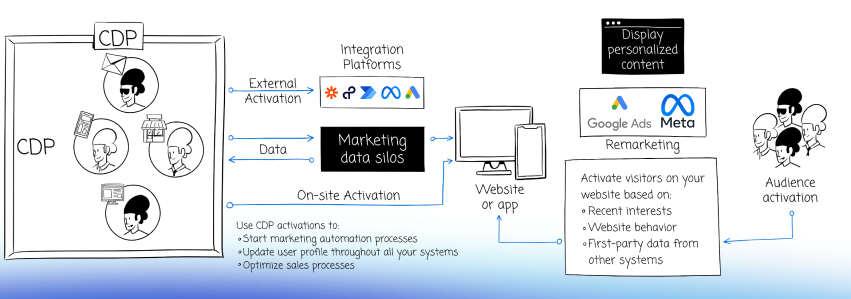
Some of the most important capabilities of the CDP include:
- Connecting visitor data scattered across channels and touchpoints and enhancing insights with data imports from any tool in your tech stack. You can now also import data into the CDP through the API.
- Gaining a detailed overview of user characteristics and interactions with your brand in single customer views (SCV). This lets you view all data gathered about a user in one place to ensure consistent and up-to-date information across systems.
- Triggering audiences across multiple touchpoints, including real-time customer interactions. Create audience segments based on demographic and behavioral data to define audiences more precisely and target them with relevant ads, content, or messaging.
- Activating user data with webhooks and automation tools to send desired attributes to various destinations, such as CRM, ad platforms, email marketing tools, internal communication channels, etc. You can also define advanced integrations if needed.
Connecting multiple touchpoints
Piwik PRO allows you to map out full digital experiences across channels and touchpoints and analyze every step of the customer journey. Your team can swiftly explore and analyze user behavior to inform sales or marketing optimizations. To get insight into customer journeys, you can use the available reporting features, such as multi-channel attribution reports, user flows and funnels.
Tightly integrated modules
Piwik PRO offers much more than Analytics. You can combine other tightly integrated Piwik PRO modules – Tag Manager, Customer Data Platform and Consent Manager – to expand on the features from Analytics and leverage the combined powers of all modules.
- Tag Manager lets you control all aspects of data collection and activation. This saves time and ensures that your tag setup is consistent and effective across different tools.
- Consent Manager helps you maintain transparent consent processes. You can streamline the collection of valid user consent and manage records of user preferences.
- Customer Data Platform offers the ability to integrate user data from multiple sources and segment them into relevant audiences. You can gain detailed insights into customer behavior and act on the data.
Conclusion
Despite the wealth of information at every marketer’s and analyst’s fingertips, many organizations struggle to make sense of their data. The vast technological landscape complicates the process of choosing and combining different tools to create a comprehensive data setup. Not to mention establishing cooperation between teams and making the data usable and applicable to improving business processes and results.
An integrated analytics platform can address these challenges. It’s an effective solution for promoting a culture of data-driven decision-making and supporting continuous development across the organization.
Reach out to us to discover the full potential of Piwik PRO as an integrated analytics platform:
The post How you can drive growth for your business with an integrated analytics platform appeared first on Piwik PRO.
]]>The post Activate data for a personalized customer experience with the Piwik PRO Customer Data Platform appeared first on Piwik PRO.
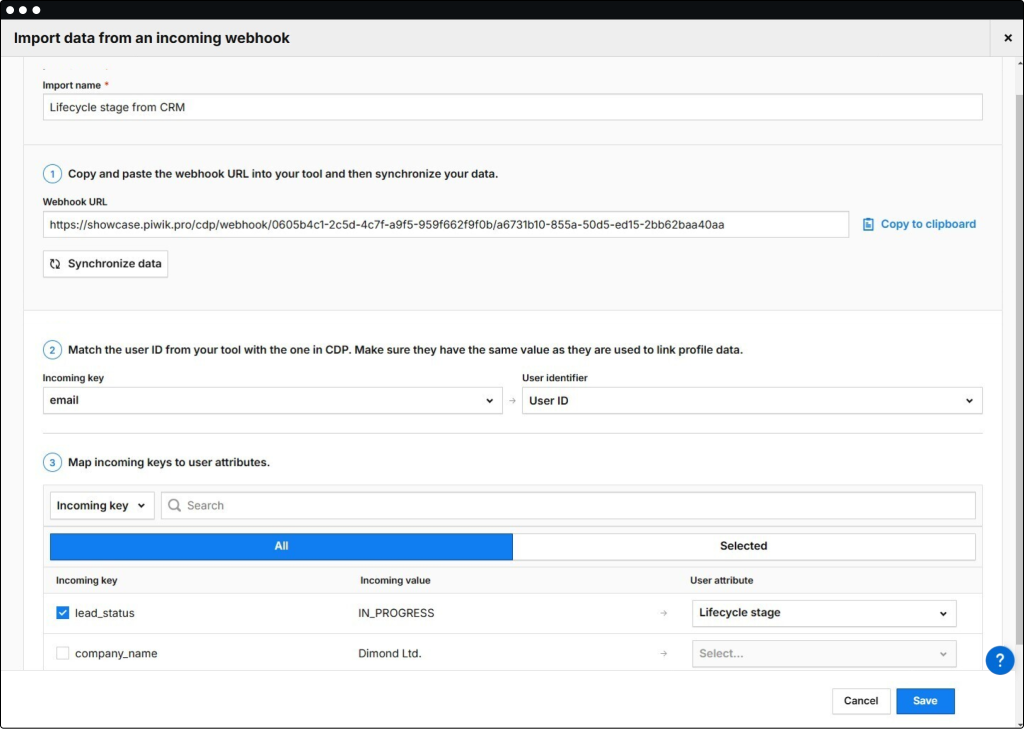
]]>Arpit Choudhury, data strategy expert and CEO at databeats and Glenn Vanderlinden, co-founder at Human37, explain how to activate data with the Piwik PRO customer data platform (CDP) to drive actions and campaigns that lead to meaningful insights, improved experiences, and business growth. Their advice proves that data activation is an essential component of data-driven decision-making in organizations.
Let’s discover the key tips our experts recommend to build personalized customer experiences.
What is data activation
Data activation refers to leveraging collected data to generate actionable insights and drive specific outcomes within an organization. This process involves transforming raw data into valuable insights and using them to make informed decisions, improve operational efficiency, enhance customer experiences, or drive business growth. It is a critical component of a data-driven organization, enabling it to unlock the full potential of its data assets and drive meaningful business outcomes.
Activation is not just about moving data – it’s about running experiments with it or doing anything else where you’re personalizing user experience. But also, it’s not just about personalization. You’re using the data to offer a better experience to the user. And that’s what data activation is.
Arpit Choudhury, data strategy expert and CEO at databeats
Data activation entails:
- Running tests or campaigns: Activation involves using data to conduct real-time experiments or campaigns, leveraging data analysis insights to inform decision-making and drive actions.
- Building audiences: It can also involve building audience segments based on data properties and events – an initial step for targeted activations or personalized experiences.
- Improving customer experience: Data activation aims to improve customer experiences by implementing changes, such as optimizing a website’s elements, adjusting product filters, or personalizing user experience.
- Deriving insights: Activation is also about deriving more insights from data. By activating data through experiments or campaigns, organizations can gain deeper insights into user behavior, preferences, and the effectiveness of different strategies.
- Repetitive processes: Data activation is an iterative process where insights gained from previous activations inform future actions and experiments, creating a continuous improvement cycle.
- Holistic approach: Activation encompasses various stages, including data collection, analysis, insight generation, experiments, and measurement of outcomes. It involves cross-functional collaboration processes to leverage data for organizational growth and improvement.
What are the main obstacles to data activation
There are a few obstacles that may occur while activating data. Addressing them requires strategic planning, investment in resources and infrastructure, cross-team collaboration, and a clear understanding of the goals and outcomes of data activation efforts.
One of the challenges is the perception of the value of data analytics and the difficulty in quantifying the return on investment (ROI). Some organizations may struggle to allocate a budget for analytics, preferring to invest in other areas where ROI is more immediately apparent.
Also, many organizations need to invest more in building a solid foundation for data, which includes collecting the right data, ensuring its quality, and making it available for activation. There may be a misunderstanding of what activation entails. It’s not just about moving data, but also about running experiments or campaigns using it to provide a better customer experience.
Measuring the outcomes of data activation efforts is crucial to determine if they have improved customer experience or led to growth. This requires cross-team collaboration and a solid setup for measuring outcomes. Teams may need more support, including resources, tools, and expertise. Effective data activation and measuring its impact can be challenging without adequate assets.
While revenue growth is significant, it’s also essential to consider other outcomes of data activation, such as increased efficiency or higher customer satisfaction. Focusing only on revenue may overlook other valuable aspects of your business.
Finally, it’s important to remember that data activation isn’t just about acquiring new users – it’s also about ensuring that existing customers continue to use and derive value from the product or service. This requires ongoing engagement strategies informed by data.
Activate your data with the customer data platform from Piwik PRO
Our experts gave a step-by-step guide on how to activate data with Piwik PRO. By following these rules, you can make the most out of the collected data, which means targeting specific audiences and customizing their experiences based on their behavior and preferences.
Piwik PRO allows you to create an audience and use it as a trigger – it’s a powerful feature. In other platforms, you have to do a lot of work to configure the specific data layer. Here, a UI lets you do it, which is a mega plus.
Glenn Vanderlinden, co-founder at Human37
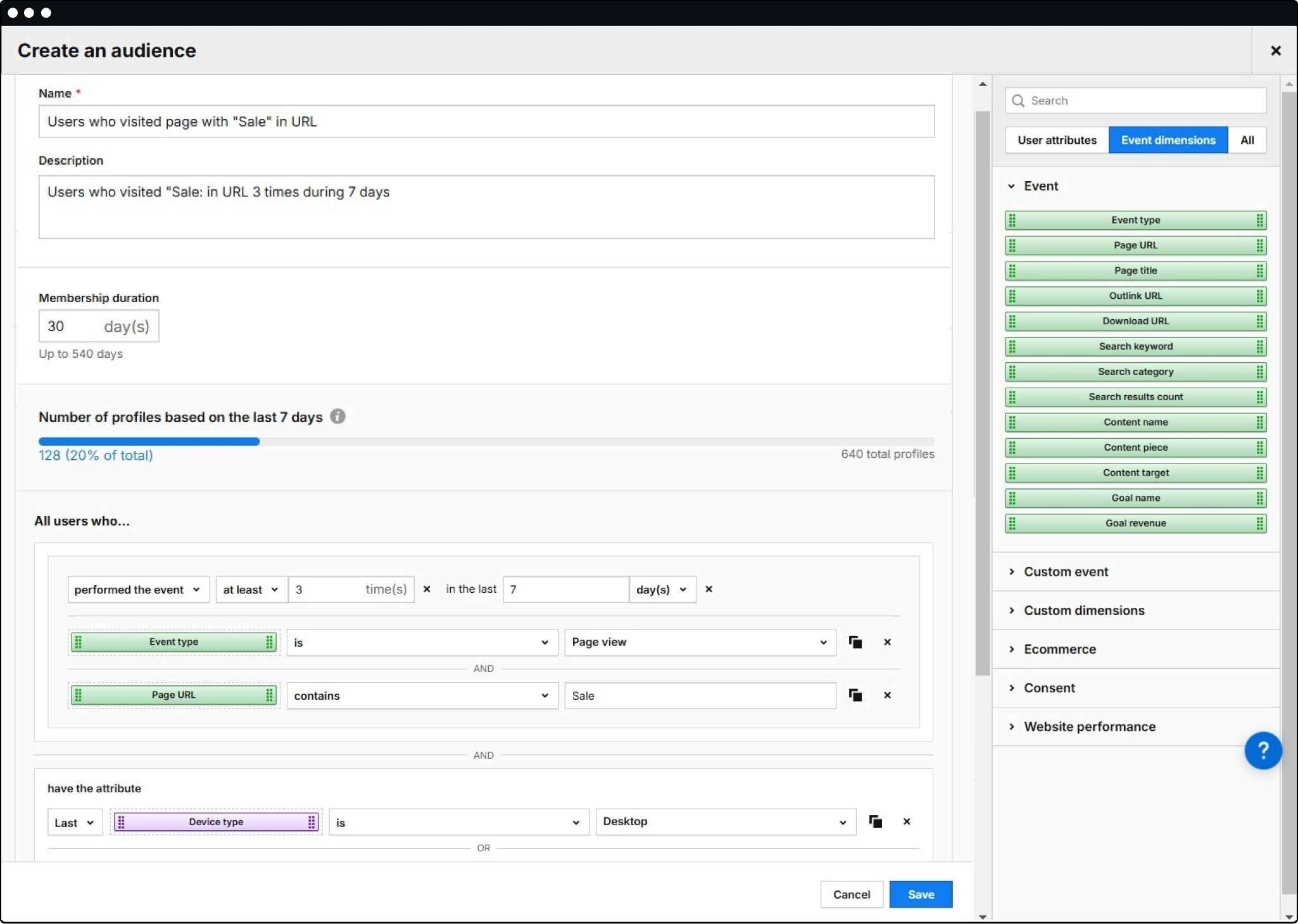
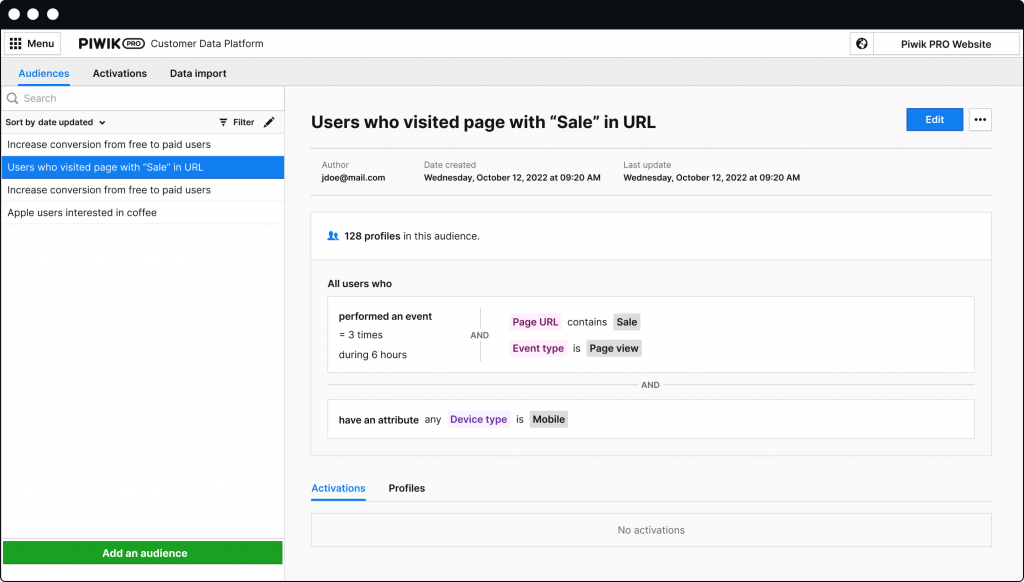
Define the audience
Start by defining the audience you want to target for activation and define the needed criteria. Create rules to filter users based on their behavior, such as page titles containing specific keywords. Optionally, you can set up exclusion criteria to exclude particular users.
Implement triggers
Set up triggers to detect when users meet the criteria defined for the audience. Triggers can be based on user behavior, such as visiting specific pages or engaging with certain content.
Manage consent
Ensure that data collection and activation processes comply with relevant privacy regulations by incorporating consent management. Associate data collection and activation with appropriate consent categories, such as personalization or marketing automation, depending on how the data will be used.
Customize user experience
Use JavaScript code to customize the user experience based on the defined audience. For example, add a navigation item for users who meet the audience criteria.
Track performance
Implement tracking mechanisms to monitor the performance of the activation strategy. This could include tracking impressions and click-through rates (CTR) for the customized user experience elements.
Test and iterate
Test the implementation in a controlled environment to ensure everything works as expected. Continuously monitor and analyze the data to refine audience definitions and activation strategies based on insights gathered from performance metrics.
Enrich your audience data with Piwik PRO
Enriching your audience with Piwik PRO involves a strategic approach that integrates various components to optimize data activation while prioritizing privacy and compliance. You can extend data activation possibilities to numerous destinations through webhooks and automation tools, such as CRM platforms, email marketing tools, and ad platforms.
For more details about activating data, read our articles:
- What is data activation and how does it fit into your data analytics stack
- Customer Data Platform: Generate meaningful insights with customer data activation and import
- 8 customer data platform (CDP) use cases that will drive your business growth
Watch the full episode and learn how to activate data with Piwik PRO CDP
The post Activate data for a personalized customer experience with the Piwik PRO Customer Data Platform appeared first on Piwik PRO.
]]>The post Customer Data Platform: Generate meaningful insights with customer data activation and import appeared first on Piwik PRO.
]]>There is no place for limited data access and integration. With its robust data activation and import options, CDPs allow you to use a variety of tools from your technology stack, such as CRMs, email marketing tools, ecommerce tools, and ad management software, to gain deeper insights.
This blog post will discuss the benefits of a CDP. Specifically, we will dive into data activation and import in a CDP and give practical examples of how it can help your company.
Why do you need a customer data platform?
Customer data platforms (CDPs) enable businesses to organize, analyze, and activate their customers’ data to improve customer relationships. This alone should make CDPs mandatory for most companies. However, there’s more to it.
Here are a few ways a CDP can help your business:
1. Optimizing customer experience
CDPs let businesses provide a seamless customer experience across all channels. Since all customer data is collected in one place, data-sharing between sales, marketing, customer service, and other teams functions in real-time.
2. Elimination of data silos
CDPs centralize customer information by aggregating data from multiple sources, giving businesses effortless access to online and offline data from every touchpoint. This empowers them to decide which experiences will impact their customers most. Most importantly, it allows for improved decision-making through enhanced and automated data accessibility.
3. Data integration
CDPs offer a distinct edge by seamlessly combining data from multiple sources and tools. You can enrich customer profiles with a wide range of information beyond standard attributes such as location, browser, device, and traffic sources. For example, you may add attributes from external sources such as gender, email, and profession or data about recent web behavior to see users’ interests or activities. This gives you far more insights to drive customer acquisition and retention.
4. Access to complete customer profiles and segmentation
With the help of a CDP, you can effortlessly build in-depth customer profiles that include all the data you’ve gathered, like demographic information, purchase history, behavioral data, etc.
Audiences can be created by segmenting customer profiles based on specified criteria. Additionally, streamlining audience segmentation with a CDP reduces the time spent creating target groups and guarantees that the segments remain uniform and current across all systems.
5. Using first-party data
When most browsers abandoned third-party cookies, first-party data became the future of digital marketing. First-party data allows marketers to rely solely on the data they collect and have consent for. With CDPs, marketers can collect and unify first-party data.
You can keep your clients’ data safe as the customer data platform helps you respect users’ right to privacy because you are more likely to obtain valid consent by asking users directly. As a result, CDP can help you meet the demands of GDPR, TTDSG/TDDDG, CPPA, CPRA, LGDP, and other privacy laws worldwide. Moreover, first-party data is more relevant and reliable than second- or third-party data.
What can you achieve with a customer data platform
CDPs offer more than data collection – they are essential for effectively acting on data. This information lets you make wiser business decisions and maintain a competitive edge.
Discover why a CDP is integral to a successful digital strategy and what you can gain.
1. Understand your customers better
A CDP helps you gather and use customer data from various channels and devices, revealing valuable patterns and trends in customer behavior.
Moreover, with a CDP, you can use web behavioral data before you connect it to other systems and platforms, which is powerful on its own. It allows you to look at a visitor’s behavior over time rather than just during one visit.
Finally, you can use a CDP to monitor how often customers visit your website, how much time they spend on different pages, and what actions they take. By employing a CDP, you can quickly make use of the information and act upon it. For example, demographic information enables you to adapt messaging for users from different countries.
2. Predict customer needs and build personalized experiences
Segmenting customers based on their profile characteristics, behaviors, and interests allows you to customize your marketing strategies to match their preferences, ensuring they receive personalized product recommendations and messages.
For example, after creating audience segments in your CDP, you can pass them on to other tools in your growth stack for data activation. Then, you can choose specific audience members that match certain conditions and send them a special discount on a product they searched for.
3. Develop targeted marketing campaigns
With complete customer profiles and segmentation, you can implement highly personalized marketing campaigns across all customer engagement areas. CDP marketing can enhance strategies like social media promotions, targeted ads, and SEO efforts.
4. Use performance metrics to enhance customer lifetime value
A CDP allows you to boost customer retention and lifetime value. As an illustration, suppose your faithful customer has not visited your website in a while. In that case, you can reach out to them (via email, app, or phone) and motivate them to return and browse your website again.
5. Automate processes to save time and money
A CDP enables defining audiences and segments and automating the process of activating them. To ensure efficient data management with a CDP, some setup is necessary initially, but it will require minimal maintenance afterward. Automation is a cost-effective, time-saving solution that streamlines processes and decreases the likelihood of mistakes.
6. Integrate data from disparate sources to activate your target audiences
A CDP allows for a unified and comprehensive view of the data, enabling you to activate it. This is especially crucial in the face of third-party cookies’ deprecation. Moreover, it strongly supports data management processes. Without a customer data platform, your data will be scattered and divided, significantly reducing its usefulness for customer analytics.
7. Enhance customer support
A CDP can help you improve customer support. You could create audiences based on specific website behavior and tailor support team activities accordingly. For example, you can create a backlog for the customer success team to collect user feedback. In communication with customers, account managers can reference:
- What product the customer purchased.
- The channel it was purchased through.
- Previous interactions with the company.
This approach enables them to respond to customers in a personalized manner, leading to faster ticket closures and a boost in customer retention.
8. Strengthen data privacy
Simplify managing customer consents and increase data privacy and GDPR adherence without the burden of manual work. Each activation can rely on customer consent to ensure that data is always used within its limits.
A CDP may not fulfill all regulatory demands by default, but having a centralized approach to customer data is critical to maintaining compliance.
Data activation and import
Data in and data out involves working on customer data to convert it into insights and actions, and it’s vital to unlocking all of a CDP’s benefits. Thanks to data activation and import, you may send customer data from any source and forward it to any other tool in your tech stack using webhooks.
Easy data import and activation from numerous sources allows you to create rich audiences and single customer views (SCV). The SCV may include personal details, communication methods, buying patterns and loyalty program participation, online interactions, and past interactions.
An SCV provides a panoramic view of your customer interactions, equipping you with valuable knowledge to shape marketing plans based on their identity, preferences, and potential for deeper engagement with your brand.
Get more details in our blog post: Single customer view (SCV): what is it and how does it work?
Thanks to data in and data out, you can find further uses for the stored information. For example, you can send the data to sales tools to improve your interactions with current and prospective customers, or it can be imported to enrich CDP user profiles. With data import, you can quickly and automatically bring in data from various sources, such as your CRM, ecommerce platform, data warehouse, and more.
Designed with privacy in mind, Piwik PRO’s CDP enables marketers to unlock the full potential of their activities. You can create complete customer profiles and segment your data into audiences. Activate and import them to provide a personalized experience and run effective campaigns across channels. Piwik PRO’s CDP capabilities serve multiple use cases.
Data activation use cases
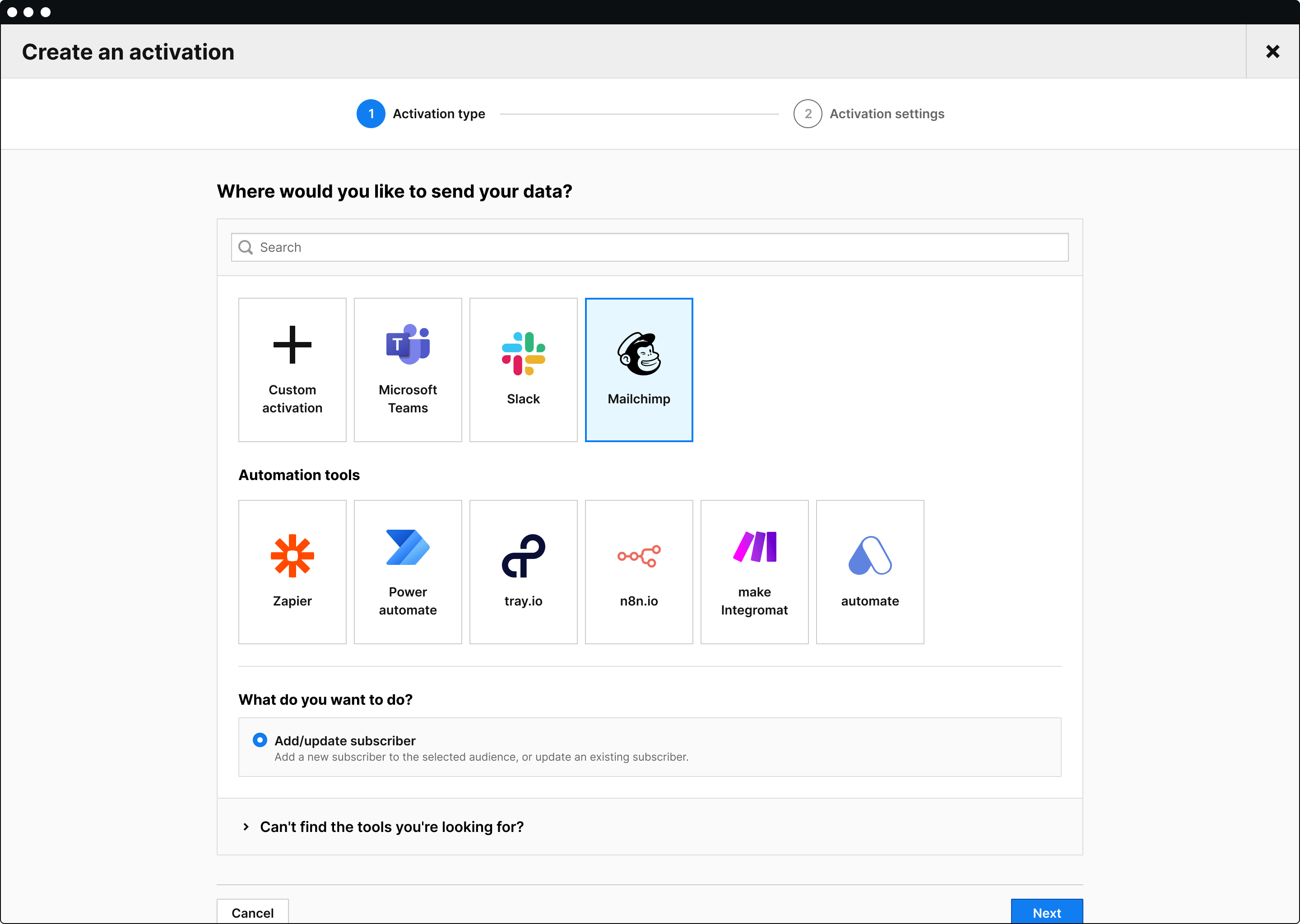
A CDP lets you activate data by sending selected, most relevant user data to thousands of destinations. Audience activation can be automated on almost any platform using webhooks. If not available, you can easily link any platform through intermediary workflow automation tools such as Power Automate or Zapier. Examples of other platforms you may use for data activation include Hubspot, Slack, Mailchimp, Google Ads, Shopify, and Marketo.
Data activation allows for unlocking valuable insights and applying them to your company’s processes.
Example use cases:
- Encourage undecided shoppers to buy from you. For this purpose, you can add your audience members to any marketing automation tool you like and send them a discount coupon or information about your fast delivery. This can bring in more customers and increase your sales.
- Improve operational efficiency by assigning account managers to high-value customers. Activate data and send a notification to the sales team to contact the customer. For example, they may receive automated messages via Slack or Microsoft Teams when prospects visit key pages like pricing, unfinished checkouts, or warranty pages. It ensures your sales team is instantly informed, seizing the perfect moment to connect with hot prospects.
This can increase customer satisfaction and trust. It’ll also save you time otherwise spent manually inputting your audience’s information and verifying its correctness.
- Develop targeted marketing campaigns by displaying banners to customers with the propensity to buy (hot leads), excluding people who have already bought your product to prevent wasting ad budget. For instance, you can target customers who visited the site for the first time through a campaign and browsed product pages or visited a pricing page. The activation involves adding the customer’s email to Custom audiences on Facebook Ads and Google Ads.
This can optimize remarketing spending and help focus your resources on prospects most likely to purchase from you.
Data import use cases
You can import data from your CRM, ecommerce platform, data warehouse, and other tools into the CDP and use it to enrich and update profile data in real-time. This helps ensure that your CDP profiles have relevant information and are up to date. You can apply the customer data to audiences and activations to combine the data gathered across touchpoints.
Furthermore, if you integrate your CDP with analytics and a tag manager, you can benefit from a steady stream of valuable user data. You can also connect siloed data sources into clear records that map all user traits and behaviors.
Example use cases:
- Send data on offline purchases from retail stores or points of sale. Importing offline conversions is integral in analyzing customer journeys, sales sources, and ROI, and effectively reporting on multiple touchpoints within numerous funnels.
- Import customer lifetime value (CLV) and customer scoring from CRM. It’s one thing to measure customer profit, but game-changing companies take customer lifetime value a step further. With CLV import, you get to tap into the power of CDPs to unlock advanced analysis, actionable insights, and predictive capabilities that allow you to understand customer desires.
- Ingest data from your email campaigns into the CDP and merge the data into existing customer profiles. For example, you can send information about opened emails to Piwik PRO CDP from email automation software. By incorporating data from email automation tools, you can better understand customer engagement, enabling well-defined audience segmentation.
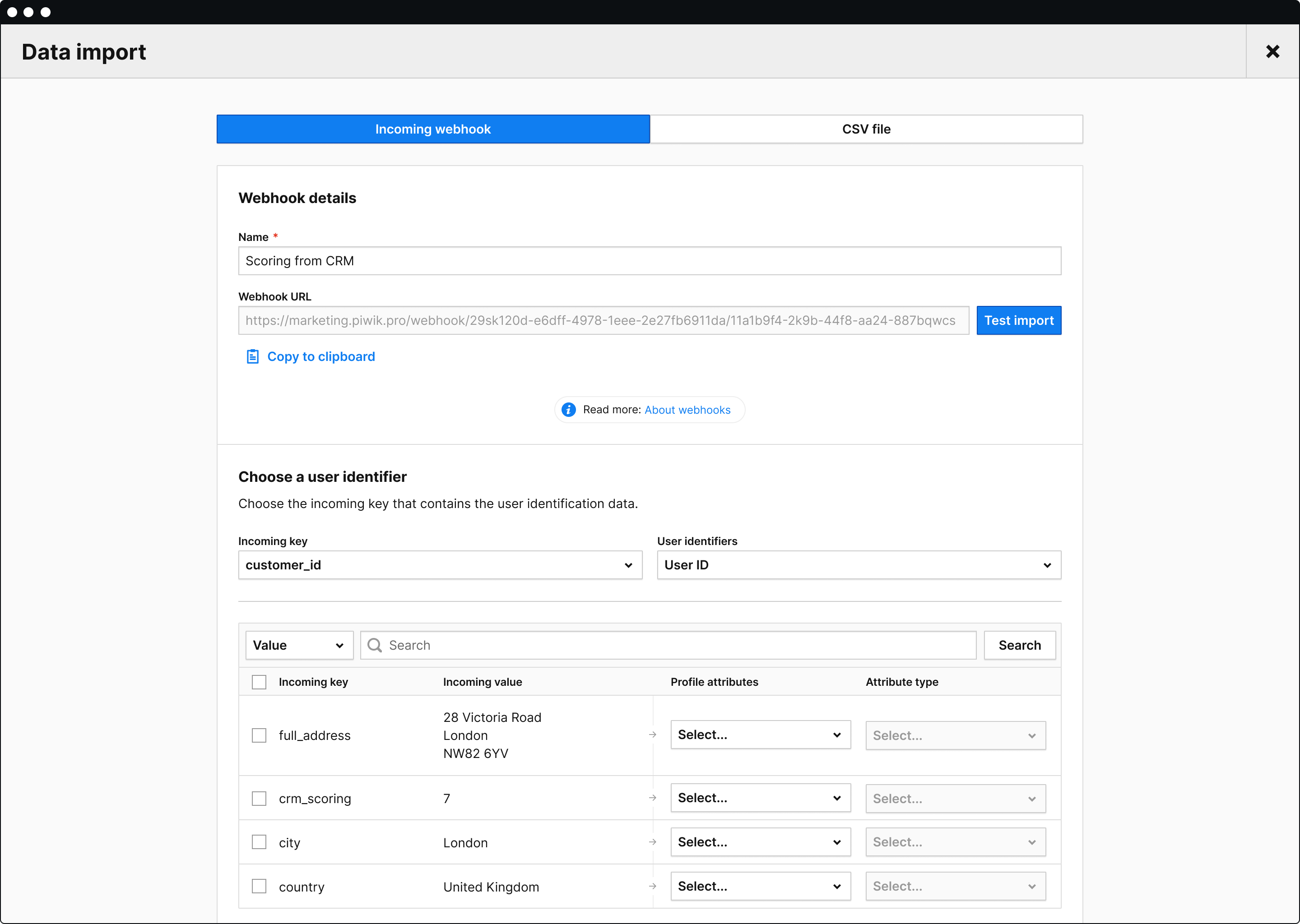
If you are a more advanced user, Piwik PRO also allows you to import data from other tools using the API. This option lets you improve your customer profiles by accessing critical information from external sources and better understanding their preferences and behaviors.
Additionally, you can create custom attributes through the user interface and API.
If you want to learn more, visit our developer docs and guides.
What should you look for in a customer data platform?
To get the most benefit from it, your CDP should have such features as:
- Data integration: An optimal CDP should be able to integrate data from various sources. Examples include web analytics, CRM systems, email marketing tools, social media platforms, and other sources. Review what tools you need to integrate with the CDP and whether your chosen CDP allows you to do it.
- Integrated analytics and tag manager: A CDP that natively offers analytics and tag management provides even more comprehensive insights. Native integrations offer seamless connections between tools and lower entry barriers for end users.
- Data activation and personalization: Make sure CDPs can deliver a personalized experience across channels and activate data to reach the right people at the right time. This involves enriching user profiles with attributes specific to your business and customers.
- Powerful analytics capabilities like behavioral segmentation and audience building: Select a CDP to trigger audiences across multiple touchpoints, including real-time customer interactions. Platforms should allow segmentation using demographic and behavioral data to define audiences more precisely.
- Scalable and secure data storage: The system needs to manage increasing amounts of data and support a growing user base as the business expands. It should also be able to seamlessly and securely integrate with new data sources and systems.
- Flexibility and easy setup: All stakeholders in the company should have access to the information, from marketing and sales to customer service and product development. Non-technical team members can navigate and understand it easily with a user-friendly interface.
- Support: Leading CDP vendors offer comprehensive professional services and customer support, including implementation, onboarding, product training, analytics consulting, and custom integrations.
CDP that suits your needs
A unique feature of Piwik PRO’s CDP is that it integrates with a web and app analytics platform rather than aiming to replace it like most other CDPs on the market. The native integration with Analytics and Tag Manager ensures a steady supply of crucial user data, facilitating a deeper understanding of insights.
With Piwik PRO’s CDP, you can effortlessly activate data by utilizing webhooks and automation tools to send desired attributes to various destinations, such as CRM, ad platforms, email marketing tools, internal communication channels, etc. Plus, the intuitive editor and templates allow you to create activations without needing the help of tech teams, and you can also define advanced integrations if required. Our CDP allows you to further enhance your insights with secure data imports from any tool from your tech stack.
Moreover, Piwik PRO’s CDP prioritizes user privacy and helps you comply with global privacy laws like GDPR, TTDSG/TDDDG, CPPA, CPRA, and LGPD. This includes safe hosting options, data governance, and built-in integration with consent management tools.
Learn more about the capabilities of the Piwik PRO CDP:
If you want to see our CDP in action, contact us for a personalized product demo.
The post Customer Data Platform: Generate meaningful insights with customer data activation and import appeared first on Piwik PRO.
]]>The post What is behavioral data and how can it help you better understand your customers appeared first on Piwik PRO.
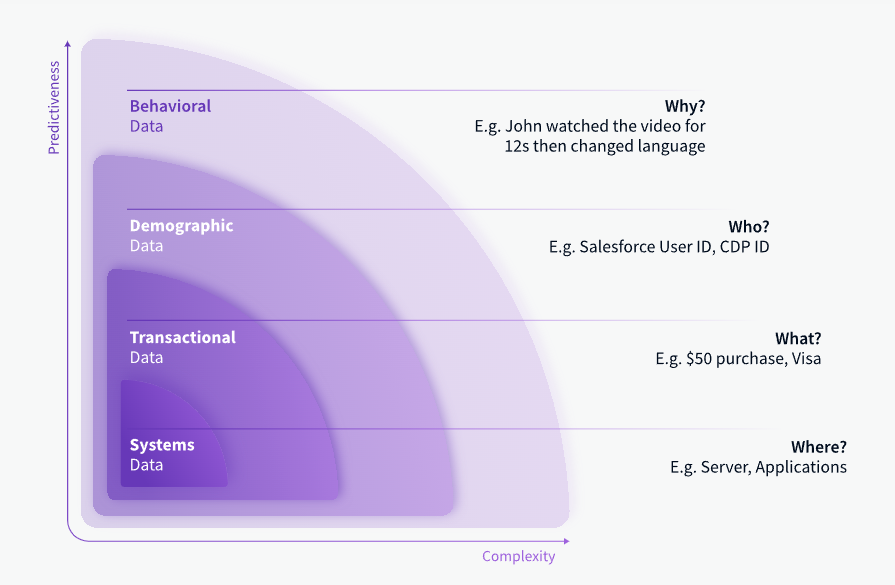
]]>What differentiates behavioral data from other types of data is that it reveals why users behave the way they do rather than just what they are doing. This powers data-driven decision-making across your organization regarding optimizing product offerings, website experiences, marketing campaigns, and more. Ultimately, behavioral data enables you to grasp what customers expect from your product and deliver more personalized, relevant experiences.
Examples and sources of behavioral data
Behavioral data represents real, observable actions customers take across both digital and physical environments. This information directly signals what customers do and eliminates the guesswork around their intentions.
Behavioral data can be obtained from both online and offline sources.
Examples of online behavioral data
- Website interactions: clicks, searches, page visits and video views.
- Mobile and web app usage data and metrics.
- Ecommerce store interactions: adding an item to a cart, abandoning a cart, creating an account and canceling an order.
- Form submissions.
- File or app downloads.
- Email metrics: open, click-through and unsubscribe rates.
- Customer service interactions across channels.
- Point-of-sale (POS) and transactional data.
- Social media interactions: likes, reactions and comments.
- Product reviews.
Examples of offline behavioral data
- In-store purchases and returns.
- Foot traffic patterns and in-store interactions.
- Call center conversation topics.
- Event participation and engagement.
- Loyalty program activity.
- Service and consultation appointments.
The first-party nature of most behavioral data makes it useful for brands looking to better understand their customers. Because first-party data comes from direct customer interactions, it is highly actionable for optimization and inherently compliant with privacy laws if managed responsibly.
Compared to third-party data, the use of which has been a growing ethical and regulatory concern, transparent first-party behavioral data collection minimizes various errors and misuse risks.
How behavioral data can help you better understand your customers
Businesses gain invaluable insights into customer preferences, needs, pain points, and expectations by analyzing the myriad of their interactions – from browsing patterns on a website to purchase histories. This data allows companies to tailor their products, services, and marketing efforts to better align with customer behavior. Such alignment not only enhances the customer experience but also drives business growth through increased loyalty and sales. In essence, behavioral data acts as a compass guiding businesses toward more customer-centric strategies.
Here are a few areas where behavioral data proves useful:
- Targeted marketing campaigns: Businesses can use customer data insights in other systems, such as CRM or marketing tools, to target customers with personalized content and offers.
- Cross-sell and upsell opportunities: Understanding past purchases and preferences allows for targeted cross-selling and upselling, enhancing customer value.
- Optimizing sales processes: You can boost your customer acquisition and retention efforts, reduce churn, and improve customer LTV.
- Personalized customer experiences: User behavior will tell you what content people read, which pages are most popular, how people navigate between pages, and what they look for using site search. With this data, you’ll know how to structure information for easy navigation.
- Insights for product development: Behavioral data is a trove of information on ways to make your products better.
- Improved customer conversion and retention: Tracking the customer journey enables targeted interventions at different stages, enhancing conversion and retention strategies. This is especially important for product teams trying to better understand users and improve their experience.
- Enhanced customer support: Behavioral data aids customer support teams in identifying friction-heavy touchpoints and providing tailored and effective support where needed.
- Identifying high-value customers to sell more: By analyzing purchasing habits and engagement, ecommerce businesses can segment users to target and nurture the most valuable ones.
- Churn prevention: Behavioral data about product usage can help identify customers at risk of churning, allowing for proactive engagement and retention strategies.
Behavioral data analytics
Companies can use behavioral data analytics to understand what people do on a website, from when they first visit to when they buy a product. This helps businesses identify what makes customers go through with a purchase and what stops them from buying. Equipped with this information, they can make their websites more appealing to what customers want, increasing their satisfaction and loyalty and making them more likely to spend money.
Behavioral analytics is also great for spotting the most valuable customers. This allows companies to apply their marketing resources where they offer the best return. Also, by understanding what customers like, companies can personalize their content to each customer. This helps grab their attention and encourage them to return in the future.
Lastly, behavioral data is useful for maintaining customers. By learning what customers buy and what they like, companies can devise smart ways to keep them interested and stop them from going to other brands. This is crucial for maintaining a steady group of loyal customers to nurture.
The challenges of collecting and using behavioral data
Using first-party behavioral data for customer insights entails specific governance, analytical, and ethical challenges. With the growing variety and volume of data gathered across platforms and environments comes complexity – and without careful management, missteps occur.
Failing to mindfully collect, resolve, store, analyze, and activate behavioral data can undermine analytics accuracy, regulatory compliance, and customer trust. Here is how organizations can address the challenges of collecting and using behavioral data:
| Challenge | Solution |
|---|---|
| Compliance with privacy laws (GDPR, CCPA and others) | Implement a comprehensive data management platform that ensures compliance with privacy laws. This could include features for consent management, data access, and permission control. |
| Respecting consumer advertising preferences | Utilize preference management tools to track and honor consumer choices, aligning with “Do Not Sell” and “Do Not Track” lists. |
| Data retention schedules | Deploy automated data lifecycle management systems that enforce retention policies and schedules, ensuring timely deletion of data. |
| Right-to-access policies | Implement user-friendly data access portals that allow consumers to view, transfer, and delete their personal data easily. |
| Integrating data from various sources | Use advanced customer data platforms (CDPs) for centralizing and reconciling data from disparate sources into accurate customer profiles. |
| Maintaining scalable data infrastructure | Develop or adopt scalable cloud-based infrastructure solutions with robust data processing capabilities, such as Apache Kafka for streaming data. |
| Filling in specialized data roles | Focus on talent acquisition and training programs to fill specialized roles like data or AI ethicists and Data Protection Officers. |
| Cross-departmental collaboration | Implement collaboration platforms and inter-departmental workflows. For example, use tools like Slack for communication and Trello for project management. |
| Dealing with reputational risks connected with unlawful data practices | Adopt a transparent approach to data usage, with clear consumer communication strategies and open disclosure policies. |
| Cybersecurity | Strengthen cybersecurity measures by using advanced security solutions, such as firewalls, intrusion detection systems, and regular security audits. |
Best practices for working with behavioral data
You can leverage behavioral data responsibly and effectively if you:
- Collect explicit consent and be transparent. Communicate how the collected data will be used and obtain opt-in consent from customers when required.
- Prioritize privacy and security. Follow regulations like GDPR to honor user privacy rights. Implement relevant measures, such as data anonymization and appropriate security measures.
- Maintain data integrity. Carefully process and structure behavioral data to correct errors. Record metadata like timestamps and sources.
- Develop strong data governance. Document policies for behavioral data collection, storage procedures, access controls, and oversight procedures aligned with regulations.
- Prioritize data minimization. Treat data as a liability, not an asset. Continuously evaluate ways to collect less data while preserving analytical value.
- Use homegrown identity resolution. Avoid buying third-party data for identity resolution. Develop compliant strategies like zero-party data collection.
- Build an ethical data culture. Foster awareness and shared responsibility for using data ethically across teams via training and leadership.
These best practices form the foundation for maintaining customer trust by putting their well-being first. While an investment initially, this pays long term dividends across both ethical and performance metrics.
Behavioral analytics
Collecting and interpreting behavioral data constitutes the basis for all analytical endeavors. The effectiveness of behavioral analytics depends on the quality and comprehensiveness of the behavioral data collected.
Organizations collecting relevant, high-quality behavioral data can extract more meaningful insights through analytics. This leads to more informed decision-making across fields like marketing and product development.
Behavioral analytics for marketing teams
Behavioral analytics in marketing involves analyzing customer data to understand purchasing patterns, content preferences, and activity on different marketing channels. This approach enables marketers to create targeted campaigns, personalized content, and strategic product placements that resonate with the audience. For instance, by analyzing website visit patterns, a marketer can tailor email campaigns to specific user interests, increasing engagement and conversion rates.
Behavioral analytics for product teams
In product management, behavioral analytics focuses on how users interact with a product. This data helps product teams make informed decisions about design, features, and user experience. For example, by tracking how users navigate an app or website, product teams can identify pain points, optimize user flow, and enhance overall usability. This directly contributes to improved customer satisfaction and retention.
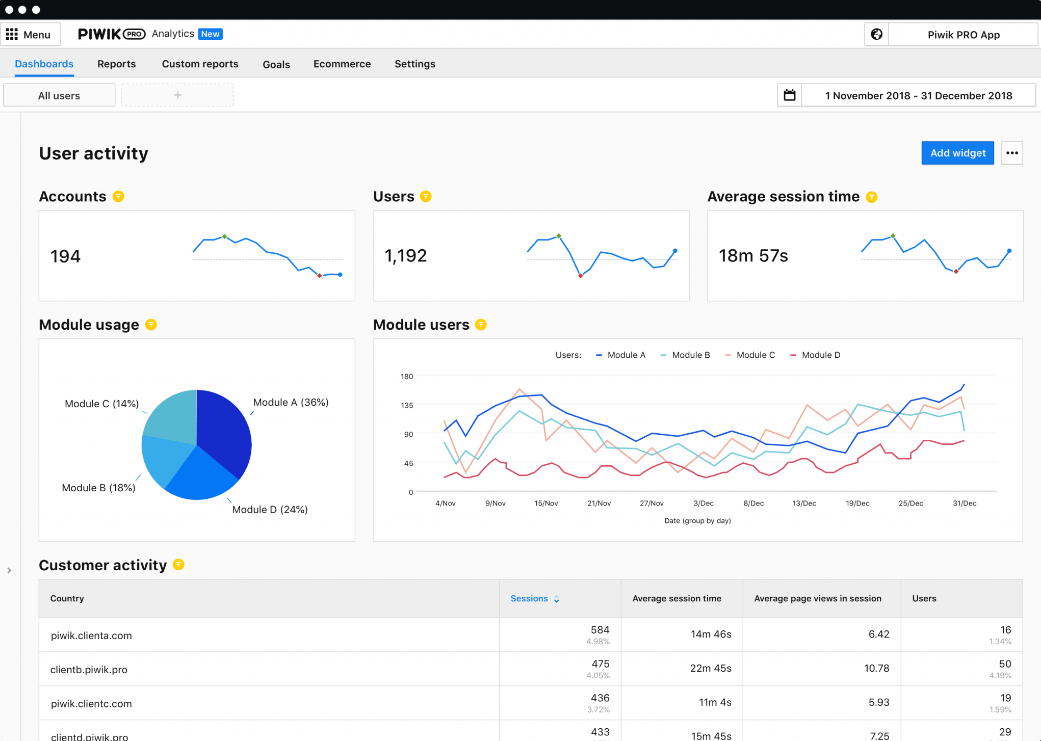
Tools and platforms that handle behavioral data
Managing behavioral data effectively requires specialized tools and platforms that can handle large volumes of data, integrate various data sources, and provide actionable insights. Here are some of the key types of tools and platforms for managing behavioral data:
| Tool | Function | Examples |
|---|---|---|
| Customer data platforms (CDPs) | Centralizing customer data from multiple sources into a unified database for a 360-degree customer view, segmentation and data activation. | Segment, Tealium, Adobe Real-time CDP, Piwik PRO CDP |
| Data management platforms (DMPs) | Managing data from third-party sources for advertising, aiding in audience segmentation and targeting. | Oracle BlueKai, Lotame |
| Web analytics tools | Tracking and reporting web traffic and user behavior, providing insights into user navigation and conversions. | Google Analytics, Adobe Analytics, Piwik PRO Analytics Suite |
| Behavioral analytics software | Analyzing complex user behaviors and patterns, identifying trends and predicting user actions. | Mixpanel, Amplitude, Piwik PRO Analytics Suite |
| Marketing automation platforms | Marketing automation based on behavioral triggers across various channels. | HubSpot, Marketo |
| CRM systems | Managing customer data for sales and marketing, tracking interactions throughout the customer lifecycle. | Salesforce, Zoho CRM |
| Business Intelligence (BI) tools | Data analysis, reporting, and visualization for strategic decision-making. | Tableau, Microsoft Power BI |
| Consent management platforms | Managing user consent and ensuring compliance with data privacy regulations. | OneTrust, Quantcast, Piwik PRO Consent Manager |
Choosing a customer data platform (CDP)
A CDP is a key element in any data stack handling behavioral data. It helps businesses align with their strategic goals, compliance requirements, and operational needs. Organizations should consider several criteria when selecting a CDP to ensure the platform meets their specific needs.
Data integration and import
Look for a CDP that can easily connect siloed data sources into clear records, mapping all user traits and behaviors. This includes integration with CRM, ecommerce platforms, and data warehouses without coding.
Behavioral segmentation and audience building
Choose a CDP that allows you to trigger audiences based on various conditions, including real-time customer interactions. The platform should offer flexibility in defining audiences, allowing segmentation based on demographic and behavioral data.
Data activation and personalization
Ensure the CDP can personalize customer experiences across channels and activate data to reach the right people at the right time. This involves customizing user profiles with attributes specific to your business and customers.
Privacy and compliance
The CDP should prioritize user privacy and help you comply with global privacy laws like GDPR, TTDSG/TDDDG, CPPA, CPRA, LGDP, etc. This includes safe hosting options, data governance, and built-in integration with consent management tools.
Integrated analytics and tag manager
A CDP that natively offers analytics and tag management provides a steady stream of valuable user data for more comprehensive insights.
Flexibility and customization
The platform should offer custom connectors and an intuitive editor for activations, catering to unique business needs without involving technical teams.
Support
Leading CDP vendors offer comprehensive professional services and customer support, including implementation, onboarding, product training, analytics consulting, and custom integrations.
Creating behavioral audiences in Piwik PRO CDP
Piwik PRO CDP lets you divide your customer base into smaller groups based on user attributes or behavioral data.
Behavioral audiences are based on the idea that customers who exhibit similar behaviors are more likely to have similar needs and preferences. By focusing marketing efforts on these groups, businesses can increase their effectiveness.
Behavioral audiences can be centered around various interactions with your organization’s website or app. Below are a few examples of behavioral audiences you can create in Piwik PRO CDP and goals you can achieve by targeting them with relevant activations:
| Goal | Audience |
|---|---|
| Increase conversion from free to paid users | Customers who visited the Pricing page three times in the last seven days and are on a free plan. |
| Personalize customer experience for visitors that came from a given campaign | Visitors whose first touchpoint with the brand was the Spring campaign. |
| Increase form completion rate | Users who visited a page with loan-form in the URL in the last two hours, didn’t visit a page with request-thank-you in the URL in the last two hours, and have been inactive for 30 minutes. |
| Increase sales through cross-selling | Users who visited pages with laptop and charger in the URL and didn’t visit pages with headphones in the URL and made no purchase. |
| Re-engage inactive big spenders | Customers who spent at least $5,000 in the store but haven’t performed any actions in 14 days. |
| Encourage people to collect packages from the parcel locker sooner | Customers whose package was placed in a parcel locker in the last 24h and taken out out of the locker in the last 24h. |
Learn about other ways you can benefit from using a CDP: 8 customer data platform (CDP) use cases that will drive your business growth.
Conclusion
Behavioral data shows how well you connect with your customers. When you group them correctly and reach them with the right content, they’ll feel like you’re talking just to them. And, like transactional data, you can make behavioral information work for you using a customer data platform, such as the one offered by Piwik PRO.
If you want to learn more about how Piwik PRO CDP can help you make the most of your users’ behavioral data, reach out to us:
The post What is behavioral data and how can it help you better understand your customers appeared first on Piwik PRO.
]]>The post Free comparison of 7 enterprise-ready customer data platforms appeared first on Piwik PRO.
]]>CDPs assist marketers in generating a better customer experience driven by precise information on user behaviors across every touchpoint. In short, a CDP can support the following:
- Data analysis
- Online advertising
- Campaign automation
- Cross-channel customer journey mapping
- Personalization
- Customer support
- Cross-sell and upsell efforts
Marketing teams can manage tasks independently with CDPs without the time-consuming assistance of costly IT specialists.
A CDP creates single customer views by stitching together sources of fragmented data and building an overview of all user information and behavioral details. User profiles can be segmented into audiences that can then be activated on other platforms.
Campaigns and actions based on first-party data that the CDP helps you collect can be more business-specific, effective, and personalized to each user. This type of data is most valuable and relevant to a business, making the insights gathered from it particularly useful for effective marketing and growth. Your marketing strategy gets supercharged faster with real-time data and in-depth insights.
Since the data in a CDP comes directly from users, it makes a great asset for ensuring compliance with GDPR and other privacy requirements.

If you want to learn more about the ways your company can benefit from a CDP, read these posts:
You need to clearly define your expectations to find the CDP that fits you best. Aligning them with features and capabilities from each vendor lets you find the right implementation for your business. That’s why we’ve extensively researched key features of CDPs available on the market.
Below we’ve prepared a thorough comparison of seven enterprise-ready customer data platform vendors. If you’re debating which CDP will work best for you and looking for guidance, you’ve come to the right place.
Customer data platform vendor overview
As you make up your mind about a particular CDP, let’s start by giving you a little peek at the vendors.
Piwik PRO
Piwik PRO combines a data-driven approach with a focus on satisfying the strictest privacy standards worldwide. This makes it the first privacy-oriented alternative to Google Analytics with an integrated CDP. It enables organizations handling sensitive data to analyze and optimize the customer journey and improve their cross-channel marketing efforts.
Tealium
Tealium’s primary focus is the tag management system Tealium iQ and the customer data platform Tealium AudienceStream. The CDP provides data enrichment capabilities that help create unified user profiles and automate actions across all channels. It lets you connect data and deliver it in real-time to make it easier to connect with your customers.
Exponea
Exponea gives marketers complete control over all aspects of the customer experience, especially within the ecommerce industry. Its Customer Data and Experience Platform (CDXP) lets marketers use AI-enriched data to understand customer behavior and run omnichannel campaigns across multiple channels.
Mapp
Mapp’s customer data platform centralizes all data through segmentation, unification of customer profiles, and activation of those in priority channels. With Mapp’s CDP at its core, organizations can connect entire marketing ecosystems to enhance the customer experience.
Segment
Segment is a CDP that helps companies organize, connect, and control their first-party data from multiple cross-device sources. It offers a complete data toolkit to standardize reliable data collection, unify user information, and send customer data into any system. The whole company can use trusted data to accelerate its growth.
mParticle
mParticle provides real-time data that combines quality and governance protections with AI-powered insights and predictions. Focused on mobile and desktop applications, it builds cross-platform user profiles to help marketers drive better marketing and improve conversion and retention for various industries.
Amplitude
Amplitude is a digital analytics platform that focuses on product analytics. It consists of several integrated products, including an insights-driven customer data platform. The CDP lets you un-silo data and connect it across teams, discover new audiences, and unite customer behavioral data across your stack.
Comparing 7 enterprise-ready customer data platforms
In our comparison, we’ve highlighted key differences concerning each CDP vendor’s essential functionalities and qualities.
General characteristics
First, we outlined some general characteristics of the reviewed CDPs to give you quick insights into what you can expect from these platforms. For example, see whether the vendors can be easily integrated with analytics or tag management systems and what hosting options are available.
Data collection and processing
Then, we compared how the CDP vendors approach data collection and processing. Learn how the platforms collect and organize data and what forms of information you can access, including raw or historical data. Find out if they process cookies or allow SDK. See the data types you can import into user profiles to expand and enrich them.
You need access to real-time, adequately normalized data and follow the whole customer journey to ensure your data is accurate and up-to-date. Your marketing strategy should be unified and match data from multiple sources. You should be able to use your stack to its full potential.
Audiences and profiles
We also reviewed the details and possibilities of audiences and profiles in each CDP. Find out how user information is matched to create separate profiles, what attributes are available, and how to segment users who match given traits. You need to be able to merge user profiles over all channels and devices and display the information in single customer views. A well-chosen platform should enable you to continuously update and easily access these profiles and create audiences based on relevant shared attributes or behaviors.
Data activation
Each CDP’s value is connected to how it lets you apply the data in personalization, ad campaigns, emails, remarketing, and other actions you can take to improve customer acquisition and retention and drive more sales. That’s why we couldn’t skip a section comparing the data activation features of each vendor. Learn how to integrate the CDP with other platforms and make it useful.
Privacy and security
On top of that, we’ve evaluated the CDPs in terms of their privacy and security obligations. We have checked which platforms provide privacy-dedicated Opt-out/Do Not Track options, an integrated consent manager, and the ability to onboard sensitive data.
We couldn’t overlook the legal landscape of storing and processing users’ information. We’ve investigated if these platforms adhere to international privacy legislation such as GDPR and whether they boast valid security certifications. Customer data is in your hands. Your company should be able to rely on a vendor that ensures proper compliance with all applicable regulations.
Customer care
Last, we’ve checked what kinds of technical support and customer care services each vendor provides. As an enterprise customer, you may benefit from enhanced guidance through dedicated support and onboarding, personalized training, and custom development & integrations.
Comparison
Free comparison of 7 enterprise-ready customer data platforms
Get to know over 50 key differences to determine which platform fits your business needs best: Tealium, Amplitude, Exponea, mapp, Segment, mParticle or Piwik PRO.
The post Free comparison of 7 enterprise-ready customer data platforms appeared first on Piwik PRO.
]]>The post 8 customer data platform (CDP) use cases that will drive your business growth appeared first on Piwik PRO.
]]>This blog post will explore the concept of a customer data platform (CDP) and demonstrate how it can benefit modern companies. You will learn how to apply a CDP to your company’s operations to help it achieve its goals.
What is a customer data platform (CDP)
A CDP is a single platform that facilitates customer data collection, management, transformation and activation.
The traditional definition of a CDP states that “a customer data platform is packaged software that creates a persistent, unified customer database that is accessible to other systems.”
Here is how we can unpack it:
- “Packaged software” means that a CDP is a prebuilt system whose setup and management don’t require high technical skills as many other types of tools, such as data warehouses, and is associated with less risk, cost and implementation time.
- A CDP “creates a persistent, unified customer database” containing individual customer and visitor profiles. The platform captures and links information related to each user and stores it, expanding the database over time.
- Data in a CDP is also “accessible to other systems,” meaning you can find further uses for the stored information. For example, you could send the data to sales tools to improve how you manage interactions with current and prospective customers.
Advanced CDPs can also store machine-learning-powered predictions, such as the likelihood to purchase.
Piwik PRO’s CDP represents a unique type of software. The CDP is integrated with a web and app analytics platform, rather than seeking to replace it, which is the case with many other CDPs available on the market.
Key functionalities of a customer data platform
Let’s walk through a few specific aspects of a CDP and how Piwik PRO’s CDP benefits you.
Collecting first-party data
A CDP consists of individual-level data from the organization’s online and offline sources. This data reflects a company’s current and prospective customers and their behaviors. It is also more precise than second- or third-party data collected by another entity.
Operating on first-party data can help you comply with international data protection laws. You are more likely to obtain valid consent to the collection of first-party data by asking users directly.
Data import won’t be available in Piwik PRO CDP Beta. In future versions we plan to enable data imports from your CRM, ecommerce platform, data warehouse and other tools using incoming webhooks and no-code automation platforms. A built-in integration with web and app Analytics and Tag Manager will enable you to benefit from a steady stream of valuable user data.
Read more about the benefits of first-party data: Why first-party data is the most valuable to marketers [Updated]
Data privacy and management
The CDP enables you to address data quality at the point of collection, so you’re able to retain its integrity throughout the data pipeline. You have governance over the data you collect and maintain in a CDP and control the sources of information.
It provides a single source of truth regarding a customer’s data and the data processing purposes users have agreed to. It lets you quickly modify or delete specific user data if requested.
With Piwik PRO CDP, you can:
- Integrate Consent Manager and make actions related to activation dependent on whether users grant consent. You can keep the latest consent information in the visitor profile. Moreover, webhooks can be fired based on the consent category in the profile.
- Handle sensitive data. For example, you can add an extra layer of privacy by replacing identifiable data with custom scoring values.
In the future, we have plans to enable an activation log.
Single customer view
Because the collected information gets unified and attributed to the same user, you are able to access it in single customer views. Customer profiles include all the information you’ve gathered, like demographics, purchase history, behavioral data, etc.
Knowing all touchpoints of the customer journey provides insights into their interests, what they’re likely to buy next, or if they need a personal discount to re-engage after some time of inactivity.
Piwik PRO CDP allows you to explore single customer views.
Find out more about single customer views: Single customer view (SCV): what is it and how does it work?
Identity resolution
A CDP can attribute all disparate data from multiple channels to the same customer profile. User profiles are created by merging the data using matching identifiers, such as e-mail address, user ID or cookie ID.
The ability to use multiple identifiers differs from options in analytics tracking tools – these often rely on cookies that tie the data to a browser, not a user. Connecting cookie-based user data to other tools and systems can lead to downstream data quality issues. For example, you will have no way of differentiating between individuals using the same device within the same cookie. Plus, privacy-focused legal and technological solutions make relying on cookies a short-term solution.
The Piwik PRO CDP works on both:
- Persistent identifiers (like user ID), which is how most CDPs on the market work already.
- Non-persistent identifiers (like session ID) for in-session personalization or activations. If there is no other data on a visitor, the session ID will be dropped and the profile will become unusable after the session ends.
Non-persistent, short-term identifiers enable you to perform the following actions:
- Open a chat window during the session for visitors that have bumped on the pricing page twice within the last 5 minutes.
- Alter the look-and-feel of the site to allow more contextual ad slots on it for those who have opted out of targeted advertising.
- Send warnings to your company Slack in case of rage clicks on your most important contact form.
Audience segmentation
Segmentation allows you to create audiences that group customer profiles matching certain conditions.
Once audience segments are built in your CDP, they can be forwarded to downstream tools in your growth stack for data activation. Centralizing audience segmentation saves time on audience building and ensures the segments are consistent and up-to-date across systems.
Piwik PRO’s CDP lets you build audiences based on attributes, such as data relating to:
- Traffic, e.g. source, medium, keyword, channel, and campaign details
- Device and platform
- Location
- Consent
- Other details, like last order time or total revenue
This information is gathered through analytics events and matched with the user profile with first-party identifiers, such as e-mail or user ID.
Another option is to set up audiences based on user behavior (event dimensions). In this case, behavioral conditions are based on the number of occurrences of events over a period of time. For example, you may segment profiles of users who visited specific product pages a few times in a specified period.
By combining the CDP with Tag Manager, you’re able to fire tags based on audience conditions.
Data activation
Data activation involves putting customer data insights into action in other systems and tools. For example, you can add users from a given audience to an email list and send them a discount code for a product. Or you can show an ad banner on the website with a complementary product based on a customer’s previous purchases.
All of this is possible through integrations offered directly from the CDP, enabling businesses to access the data where and when they need it and relieving engineers of managing third-party code.
Piwik PRO’s CDP lets you activate data by sending selected attributes to thousands of destinations through webhooks and automation tools – CRM, ad platforms, email marketing tools, internal communication channels and more. Example platforms include Hubspot, Slack, Mailchimp, Google Ads, Shopify, Marketo and others.
You can also create activations through templates and an intuitive editor without involving tech teams. If needed, this allows you to define more advanced integrations.
Learn more about data activation: What is data activation and how does it fit into your data analytics stack.
Work in real-time
CDPs let marketers work in real-time, which improves the process of preparing audience segments or targeting users with relevant content.
Customer information is also reflected in real-time in the updated profiles. As a result, the data sets expand, and you can constantly access up-to-date customer details.
Now that we’ve defined what a CDP is and how you can use it, it’s equally important to understand the functionalities of similar types of data management software and learn the nuances that determine the best applications of them.
CDP vs. DMP
A DMP predominantly influences advertising to better target ads and reach audiences. DMPs mostly rely on third-party data and reflect anonymous customer identifiers (like cookies, etc.), making them systems with less accurate data. Due to the rise of GDPR-friendly solutions, DMPs are far from optimal for managing and utilizing user data.
Read about 4 key differences between data management platforms and customer data platforms.
CDP vs. CRM
A CRM reports on current or potential customers, so it will primarily help you with analyzing the sales pipeline and forecasting. CRMs cannot register offline data unless it’s manually entered, so you would mainly use them with online data sources.
8 customer data platform (CDP) use cases
The capabilities of CDPs allow you to achieve several things that can positively influence business growth. Below, we elaborate on eight of them.
1. Improving operational efficiency
A fundamental aspect of any enterprise-grade CDP is its ability to unify data from various data-producing channels and platforms.
A CDP resolves the issue of data silos – situations when an assortment of data is available to one department but isolated from the rest of the organization. Data silos make the working environment less collaborative, slow the pace and productivity of the company, and threaten the accuracy of customer profile data.
Removing data silos improves efficiency and productivity and makes it easier for teams like marketing, sales, support, customer success, product and others to collaborate, exchange user data and complement each other’s efforts.
With a CDP, the organization works on more accurate and complete customer profile data and is able to automate many of its operations. For example, since a CDP creates individualized profiles for your customers and prospects, you won’t have to spend hours manually inputting your audience’s information and verifying its correctness.
2. Developing targeted marketing campaigns
A CDP enables real-time campaign activation, allowing marketers to deliver highly-personalized marketing campaigns across all areas of customer engagement. You can effectively use a CDP with a marketing automation platform, simplifying time-consuming activities like lead qualification and campaign creation.
With a CDP, you can quickly decide what content to target visitors with and what channel will be the most effective. At the same time, you can measure and track the performance of the campaigns and channels to refine and improve the assets or messaging in the next campaign.
For example, you could segment users who often open your marketing emails and have browsed products on your website but abandoned their shopping carts. Then, you can send reminders about viewed products to re-engage your audience.
Similarly, a CDP can tell you what message not to send to a customer. You can combine online data from your digital channels with offline customer data from a POS system. A complete view of the customer could prompt you to pinpoint those who have recently purchased an item in your physical store. Then, you can remove them from your next social media ad campaign for that exact item, letting you focus resources on those who are more likely to buy it.
3. Personalizing the customer experience
More than 77% of people choose, recommend and pay more for brands that provide personalized experiences tailored to their interests. Personalized messaging and interactions are more relevant, timely and effective in moving users toward engagement, conversion and customer loyalty.
From the data collected through your sources and stored in a CDP, you will know how users move around your website, what actions they take and whether they complete the funnels. Personalization can involve content recommendations and offers that are contextually added to the site based on a visitor’s past behavior. It can also consist of displaying messages matching the user’s industry, appealing to them with relevant visuals or colors, referring to the user by their company or personal name or prefilling forms with previously input data.
For example, imagine a potential customer browsing your sports website. They have viewed several pages for products in the same category – tennis equipment. Then, the user left your site without making a purchase. The next time they are on your website, you can set your homepage to display tennis equipment offers rather than a generic assortment of sports items.
4. Optimizing customer journeys
A CDP allows you to track a customer’s entire journey and assemble every interaction a prospect has had with your business. But the role of a CDP is far from over after a user makes their first purchase. It helps you optimize every stage of the customer journey, including retention and advocacy.
Your sales team can view where your leads are in the sales funnel to reach out with the right information at the most suitable time. Similarly, marketers can analyze where users are in their journeys, how they move throughout your site, and where they drop off.
To acquire more customers for your business, you must understand which interactions encouraged them to convert into paying clients. You can see which content is not as effective and requires improvement along with what resonates with users the most and should be replicated. This way, you can focus your resources on the strategies that drive the best results for your company.
5. Enhancing customer support
According to research from Zendesk, 66% of B2B customers will stop buying from a brand after a bad customer service interaction.
A CDP offers valuable insights for anyone who contributes to the customer experience in their everyday work, including customer success teams and customer support representatives. They are at the front of customer interactions daily, and they significantly impact overall business performance and long-term customer loyalty.
Agents that interact with customers have immediate access to their detailed customer profiles. The agent can efficiently and effectively answer customers’ questions, make recommendations, or steer conversations toward new purchases or brand experiences. This can lead to meeting their needs quickly and forming better customer relationships.
When agents understand details such as how users are engaging with the brand or what their customer status is, they can easily tailor the conversation to them. There is no need to dig for information, figure out the most accurate details or put customers on hold for long periods to find relevant data.
For example, agents can now reference what product the customer purchased and the channel it was purchased through and get an idea of what topics on your site interest them. They can also see when and what previous interactions occurred with the company, such as opened tickets and their status, issues or requests discussed in conversations to date. This way, they can refer and respond to them and close the tickets faster.
6. Identifying high-value customers
Having all your customer data housed in one spot will help you identify the customers who bring your company the most value. You can do this by analyzing the users’ purchasing habits and history. It’s no secret that a customer who is either spending a lot with you or purchasing regularly is one of your most valuable customers.
Your best customers are also those who, on top of buying from you, frequently interact with your brand, whether through social media or email or by leaving positive reviews on third-party pages. Nurturing and retaining those segments should be a priority for you.
You can also identify shared characteristics of your best customers, such as demographic details (age, location, occupation or industry they operate in) or behavioral data (most visited pages, common user flows on your site or app, most purchased products or services, etc.).
This information allows you to create specific campaigns and customer journeys to target lookalike audiences. It’s worth nudging the users currently in your database who share these traits and approaching them with relevant content that will encourage them to get your product.
7. Preventing churn
A CDP can be useful in pinpointing customers who might be close to churning.
A declining number of interactions with your brand, like fewer email opens, social media or blog engagements, or a decrease in product adoption, may indicate a weaker bond between your business and a customer.
With a CDP, you can identify such individuals and get a step ahead by improving the messaging or experience. For example, you can help show customers the features of your product, or send a time-limited promo code to apply to their subscription and give them more time to try your product for less.
8. Identifying cross-sell and upsell opportunities
Apart from retaining customers, a CDP allows you to discover cross-sell or upsell opportunities among your existing clients. You can hone in on what the customer may need next with information on products or services purchased in the past, the timing of previous purchases, communication preferences and loyalty status.
A CDP solves major issues that often impede a brand’s ability to convert cross-sell and upsell opportunities. These include data silos, problematic identity resolution and the lack of real-time access to data.
For example, you can use a CDP to look at the current customers who use your email software and have been browsing pages on your other products. They may have recently started consuming more of your content on product use cases and features, and visiting pricing and contact pages. Consider targeting these users with a promo code for your other product or start a dedicated campaign with content on using your products together.
How to choose the right CDP for your business
Before deciding what CDP to use, you need to think carefully about your specific use cases and identify a CDP that most closely addresses your needs.
Ask yourself the following questions:
- How often do you interact with your customers and visitors?
- What platforms do you use to reach and communicate with them?
- What are their needs and behavior patterns?
- What tools currently handle your customer data?
- How are these tools connected to each other?
Examine the scale of your customer outreach, the depth of integration with your existing systems and your budget. Discuss the needs and expectations of the key stakeholders, especially those who regularly interact with customer data. Address their concerns and plan out a smooth transition, guaranteeing the CDP works with your current tools.
We are reinventing the Piwik PRO CDP, equipping it with extensive functionalities that will make it an essential component of any enterprise-level analytics stack.
The module will allow you to:
- Collect and integrate customer data from multiple sources, including web/mobile SDKs (soon also: online forms, CRM systems, e-commerce platforms, and social media).
- Segment customers based on their behavior and demographics.
- Trigger personalized marketing campaigns based on real-time customer activity, such as abandoned cart recovery emails or personalized recommendations.
- Monitor and measure the performance of the CDP.
Read more about our CDP’s features and learn why it could be the right fit for your company.
Free comparison of 7 enterprise-ready customer data platforms
Get a detailed overview of their characteristics and choose the right CDP for your company.
Final points on customer data platforms
We hope you now have some idea of how your organization can apply the features of a CDP to its processes and drive business results.
Your company has a shot at bridging potential information gaps, enhancing data integrity across departments and stitching together channels, touchpoints and devices.
We’ve published a few other blog posts related to Customer Data Platforms that may help you get more familiar with these systems:
- Customer data platforms: The best choice in the post-GDPR landscape
- How Analytics & Customer Data Platform Can Help You Track the Full Customer Journey
- What is Data Activation and How Does it Work?
If you have any remaining questions about the use cases of Piwik PRO’s CDP, reach out to us:
The post 8 customer data platform (CDP) use cases that will drive your business growth appeared first on Piwik PRO.
]]>The post Data flow in an analytics platform: How to set up your data collection and analysis process appeared first on Piwik PRO.
]]>Data can stream in different directions and back and forth between systems. It may take a lot of work to figure out how data moves around, how it’s transformed at every stage, and what ways your company can benefit from these processes. If you collect personal information, things become even trickier because you need to ensure privacy and security levels at all times.
In today’s post, we’ll walk you through the ins and outs of a data flow based on an example in Piwik PRO. You’ll see that even with consent collection and management, there are simple ways to design and describe data flow.
pro tip
We’re presenting the most popular setups of analytics platforms. There are many ways you can configure Piwik PRO to adhere to local data protection guidelines. For more details, review our help center article on how you can collect data in a privacy-friendly way.
A basic data flow
In most cases, the first step in a data flow is asking the visitor for consent to collect their data. If they grant consent, you gather their personal information and use it in your analysis. However, if the user declines consent or ignores the consent banner, at most, you will be able to collect and use anonymous data.
After this is settled, you should proceed with analyzing the data. For that purpose, you use the web or app data and import data from other sources, such as a CRM or marketing automation platform. You can also export data to other tools or platforms for further analysis or visualization.
Data flow step-by-step
Data analytics flow depends on consent, which sets the direction of the whole process.
Let’s look into a scenario in healthcare. Imagine a user visits your website, mygoodhealth.com. After they enter the site, they are served with a consent form.
Use a system like Piwik PRO Consent Manager to facilitate the process of collecting consents from users. It will save user decisions and send the information about them to the rest of the analytics platform.
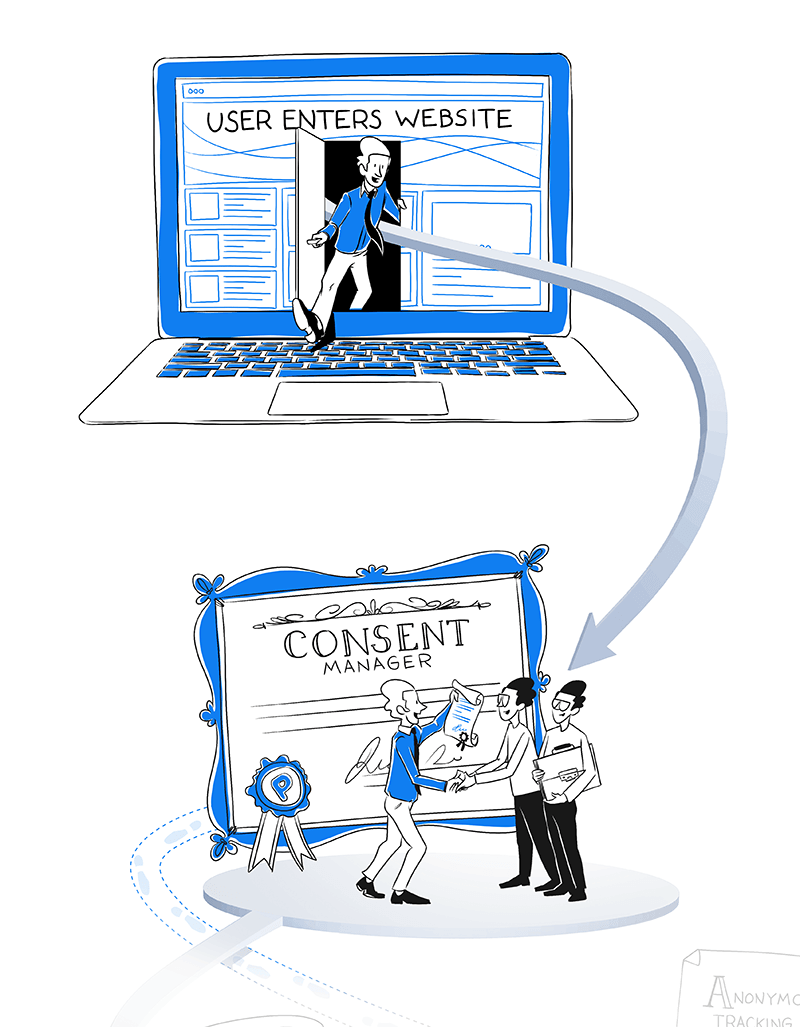
Users decide if they agree, don’t agree, or partially agree to the processing of their data, or they ignore the consent prompt and browse the website without making a decision.
Now is a good time to introduce two more modules of Piwik PRO Analytics Suite and explain their role in the data collection process:
- Analytics – Gathers both personal and anonymous data depending on the received consent. You can set the parameters for the tracker so it collects data in a way that matches your privacy and security requirements.
- Tag Manager – Manages tags – all those little pieces of code that fire based on conditions you define, often sending data to Analytics. If a user consents, tags are fired. Without consent, you still collect anonymous data with the Analytics module but without tags.
Tags won’t fire without user consent – this constitutes a so-called zero-cookie load. As a result, no user can be tracked by default. This setup allows for compliance with strict regulations, such as GDPR and local European guidelines, like those outlined by the French CNIL.
New laws that impose similar restrictions appear all the time, like the California Consumer Privacy Act (CCPA) in the US and the Personal Information Protection and Electronic Documents Act (PIPEDA) in Canada.
Whether a visitor agrees or not, you still get valuable insights, but the process will look different. Let’s analyze the possible scenarios.
A user doesn’t consent or ignores the banner
When a user doesn’t consent or ignores the consent banner, you can activate anonymous data tracking and collect some data using the Analytics module.
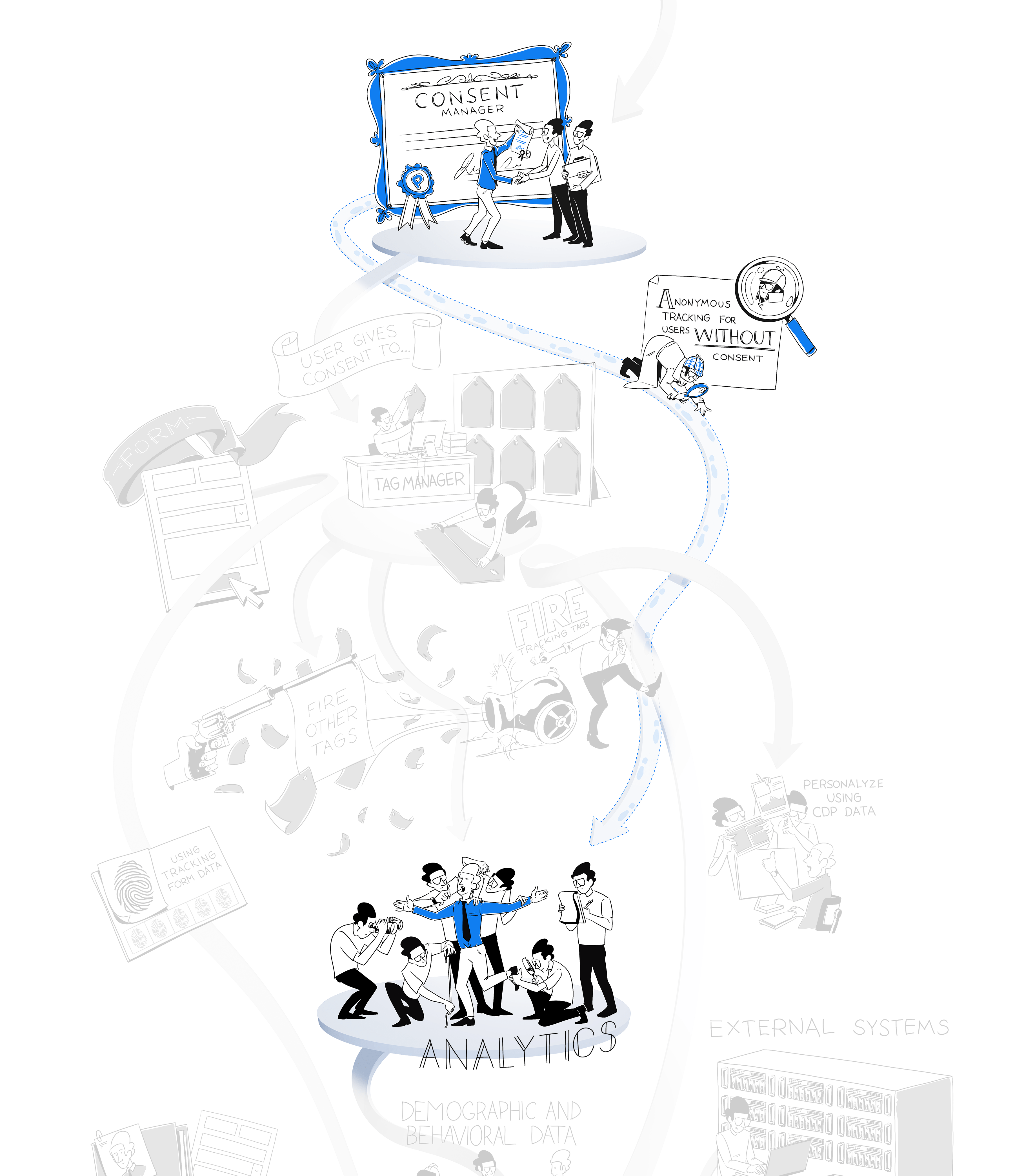
There are a few options available in Piwik PRO for when you don’t get user consent. They differ based on the technology used for data collection.
Here are the methods:
- Collect data using a 30-minute cookie: This method uses a first-party session cookie to collect data. After 30 minutes, the cookie is removed from the browser. The major advantage of this approach is that there are no duplicate sessions. This is also the most reliable anonymous data collection method.
- Collect data without cookies: This method uses a session fingerprint deployed on the device. The analytics platform won’t create or store any cookies in visitors’ browsers. The major advantage of this method is that it’s permissible under several regulations, such as the German TTDSG/TDDDG. The downside is that it creates duplicate sessions, which results in less accurate data. Both of the options mentioned so far let you capture all the traffic, as well as session and event metrics. The tracker collects the information and binds it into a session of a non-returning visitor. Visitor metrics will only be collected after a user consents. There is also a third option…
- Don’t collect data: The tracking code won’t be fired for visitors. If you disable tracking completely, there won’t be a trace of data about visitors that don’t consent to data collection. You won’t even see a page view for that user.
Naturally, anonymous tracking has limitations. It won’t let you collect and store personal data unless you have explicit consent. You also won’t be able to recognize new and returning visitors or identify visitors across sessions. Anonymous tracking will only work if browser fingerprinting is deactivated and geolocation is based on anonymized IP addresses or is deactivated.
If you’d like more details on what data you can collect anonymously, we recommend reading our post on anonymous tracking: how to do useful analytics without personal data.
A user gives consent
You have more opportunities if you receive explicit consent from users.
When a user gives their consent, you can use their information for different purposes depending on what they agree to. These include analytics, A/B testing and personalization, marketing automation and remarketing.
Once consent is registered, Tag Manager fires an analytics tracker. As the visitor interacts with your site, the Analytics module jumps into action by gathering basic information about the visitor’s:
- Device
- Operating system
- Browser name
- Browser language
- Country
It also gathers information about the content the visitor interacts with, such as:
- Pages viewed
- Videos played
- Forms filled
- Files downloaded
- Clicks on elements of the website or app
- Impressions of content
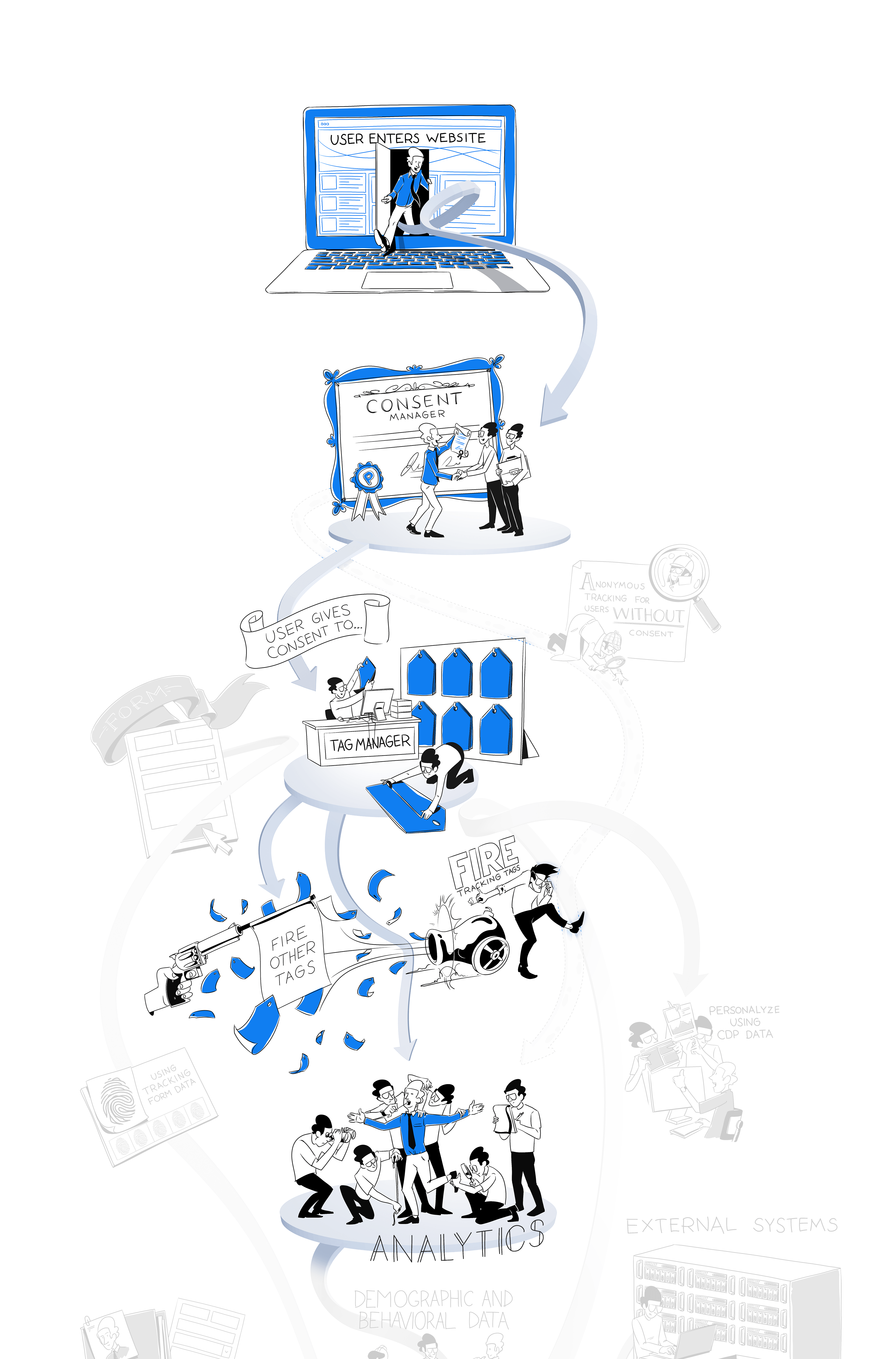
Making more out of data with a CDP
Collecting user data is not the end of the process.
Your web and app analytics data can be integrated along with data from other sources using Customer Data Platform (CDP), the final module of Piwik PRO Analytics Suite.
CDP helps you connect data scattered across different systems into complete customer profiles that map all user characteristics and behaviors.
Your visitor may browse through your site mygoodhealth.com, click on Information for patients, Our facilities, and finally, Specializations. From that page, they can navigate to Contact and fill out the form where they share their name, email address and phone number.
All this behavioral data – visited pages, completed events, clicks, scroll percentages, filled out forms – as well as other acquired information, such as demographics, order history, consent records, sales interactions, data from other sources, and more, will appear in the single customer views. You can enrich user profiles with custom attributes – such as personas that specific users represent or support tickets they’ve created – by integrating CDP with other tools using webhooks and automation tools.

As the user returns to your website or app, performs more actions and lets you collect more data, their profiles will expand over time.
Combining all these sources helps you speed up specific processes as you fill in gaps in the customer journey. With more data at your fingertips, you can better adjust your products and services to the needs of your visitors.
An essential aspect of creating user profiles is deterministic identity resolution, which consists of comparing and matching first-party identifiers such as email addresses, login data, device ID, cookie ID, to recognize that pieces of information refer to the same customer.
To learn more about how customer profiles are built and ways to use them in a CDP, check out our blog post: Single customer view (SCV): what is it and how does it work?
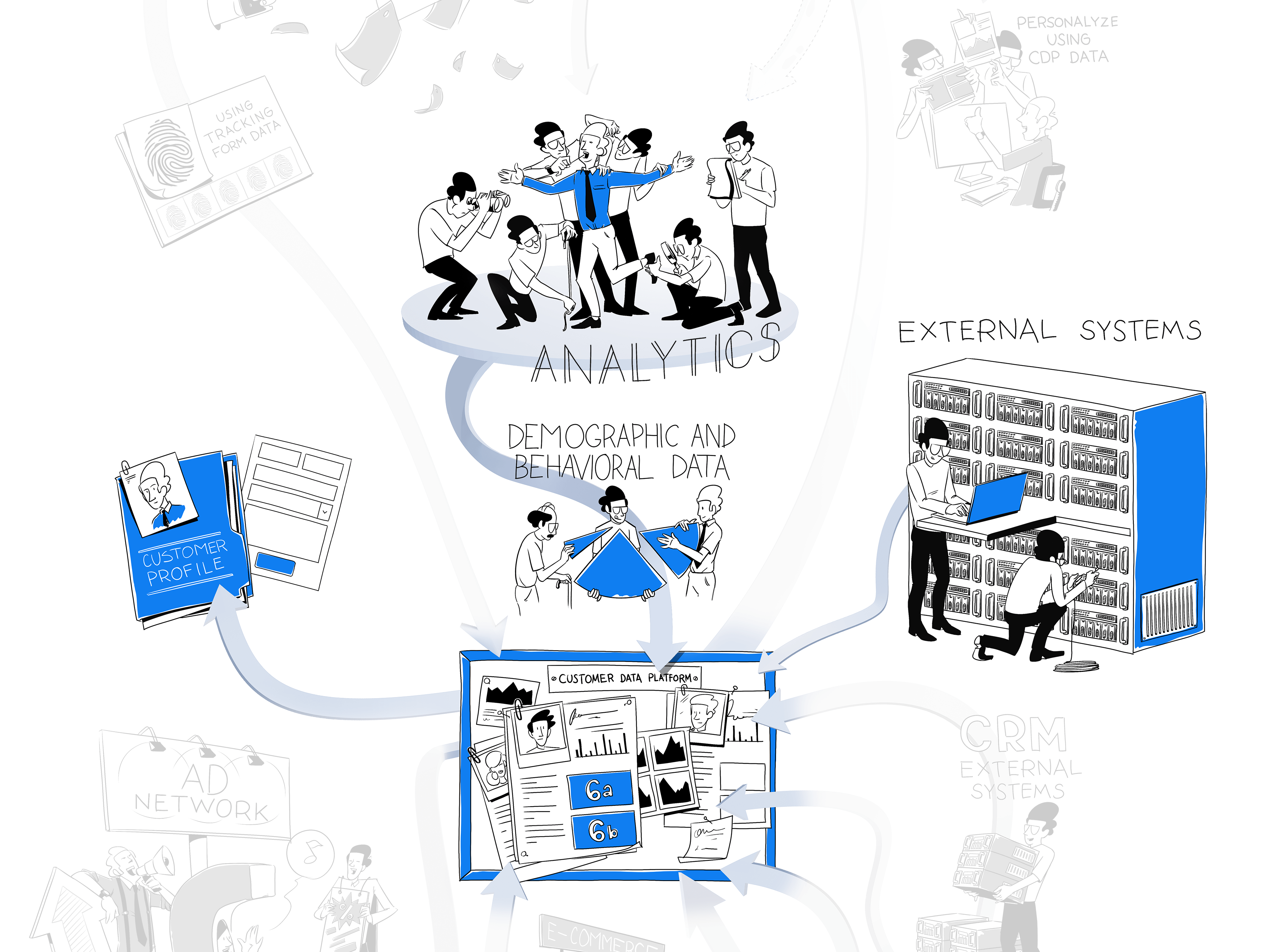
Unified customer profiles come with many new opportunities.
You can trigger personalized marketing campaigns based on customer activity and demographics.
Piwik PRO’s CDP allows you to segment audiences based on user attributes such as source, country, first visited URL or total revenue. Customer attributes are collected by the CDP automatically from analytics events and are matched with the given user’s profile through first-party identifiers.
You can also create audiences with behavioral conditions according to the frequency of events over time. For example, you can create an audience of people who visited a page “store” 3 times in the last 7 days.
If you plan and set up your audiences correctly, you end up with highly specific user segments that allow you to better target clients and visitors and help them convert.
Read our article on Audience targeting: how to successfully use a CDP to find out how you can segment users to improve the effectiveness of your audience targeting efforts.
Once your data is assembled into profiles and segmented, you can easily put it into action in other systems and platforms.
The Piwik PRO CDP lets you send selected attributes to numerous destinations through webhooks and automation tools, such as ad platforms, email marketing tools, CRM and others. Activation sends the customer profile attributes to the webhook’s endpoint. The webhook is triggered when the customer profile becomes a member of the audience.
Keep data protection regulations like the GDPR in mind. Privacy laws are updated frequently, so teams should stay on top to ensure they are gathering, processing, and storing data in a compliant way. Make sure the data you connect from other tools is collected with explicit consent where applicable.
Apart from using the available tools, you have the option to create custom activations and define more advanced integrations.
To get more detailed knowledge on the possibilities of data activation, read our blog post on What is data activation and how does it fit into your data analytics stack.
By combining Tag Manager, Analytics and Customer Data Platform, you create a core pipeline of data flow in which the modules complement one another.
We’ve shown you just a fraction of what you can achieve, but there are endless opportunities to track the right data, get it from selected sources and activate it in other places.
We’ll discuss some of those options in the following sections.
Get more data flowing through your stack
You already have some idea about how Tag Manager signals to Analytics what data to collect, then sends it for segmentation and activation in CDP. These modules work as a trio, collecting and exchanging information as users interact with your website.
Every time a returning visitor engages with your site or uses your app, their CDP profile will keep updating to become richer and more complete. But you should also expand the volume and improve the quality of the data you add to your system by connecting more sources to your CDP.
With Piwik PRO, you get the flexibility to set up your data flow in a way that protects the security of users’ personal data. You can integrate sensitive data and choose one of our safe hosting options. Piwik PRO also holds ISO-27001 and SOC 2 certifications.
You have complete control of your data as Piwik PRO doesn’t share it with any third parties, which is crucial in sectors such as healthcare, finance and government.
Learn more about our approach to data protection and HIPAA compliance here:
Let’s get back to our mygoodhealth.com example. It’s a medical website where people find and book appointments with specialists at different facilities, read articles explaining medical conditions and symptoms, and receive personalized health tips after providing some information about themselves.
Users can also pay for a premium service to get priority access to online and in-person consultations, on-demand medical advice through the phone, and unlimited access to articles and guides. Apart from the website, there is a mobile app where users easily log into their accounts and browse the platform’s features.
With Piwik PRO, you’ll get valuable data about how and when customers use the website and app. You see which of your offerings they are most interested in, what topics they read about most often, and what services they have already used.
You’ll be able to measure the average rating of appointments and video consultations. By looking at ratings of recent appointments correlated with other factors, you can identify possible reasons for churn and customer dissatisfaction. Tracking the last appointment date makes it easy to decide when to ask for feedback via a survey.
You can gather detailed information on the user experience on the site and in the mobile app, such as:
- Time spent on different parts of the service
- Clicks on links and buttons
- Most visited pages
- The adoption rate for new features
- The popularity of specific articles and videos
After analyzing this data, you can present specific recommendations to product designers.
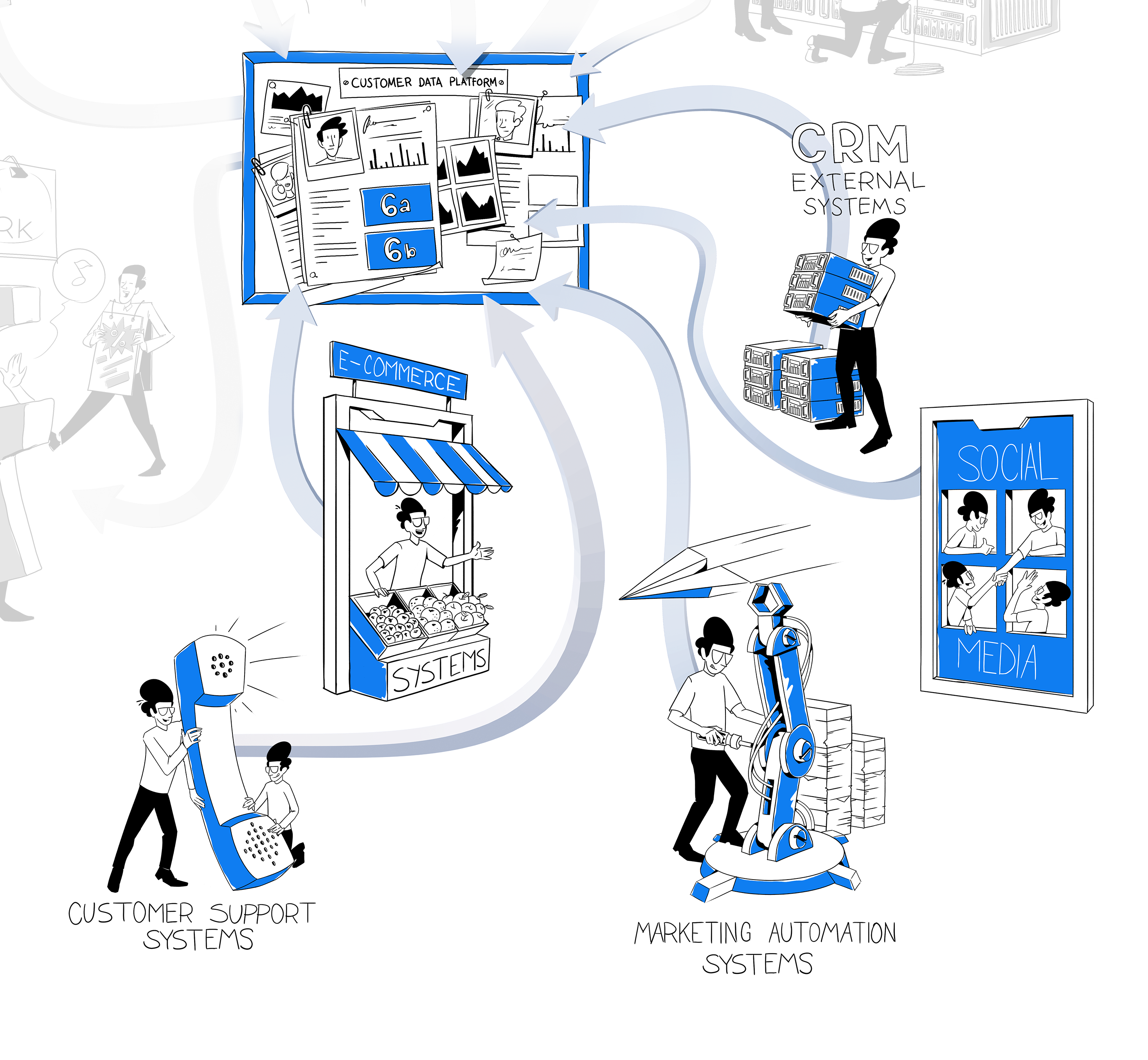
Having this penetrating insight means you’ll be able to connect information about users to how visitors behave on the service and how they renew and cancel memberships. Those connections help you infer what visitor activities lead to higher satisfaction and membership renewals.
Putting the data into action
Piwik PRO allows you to trigger actions based on the CDP audience segments we’ve already mentioned.
You can pick one of the created audiences and tailor your activities – for example, showing an ad, displaying personalized content, sending an email campaign – to your targeted segment. You can activate your audiences with a CDP by sending them to various tools and platforms. It’s up to you what exact user attributes you want to base your campaigns on.
In Piwik PRO, you can use countless integrations and transfer data to numerous destinations like Hubspot, Mailchimp, Slack, Zendesk, Twilio, LinkedIn, Facebook Ads, Google Ads, Zapier, and many more. You can also trigger tags for remarketing ads, A/B testing, on-site retargeting, personalization, and other tools in real-time.
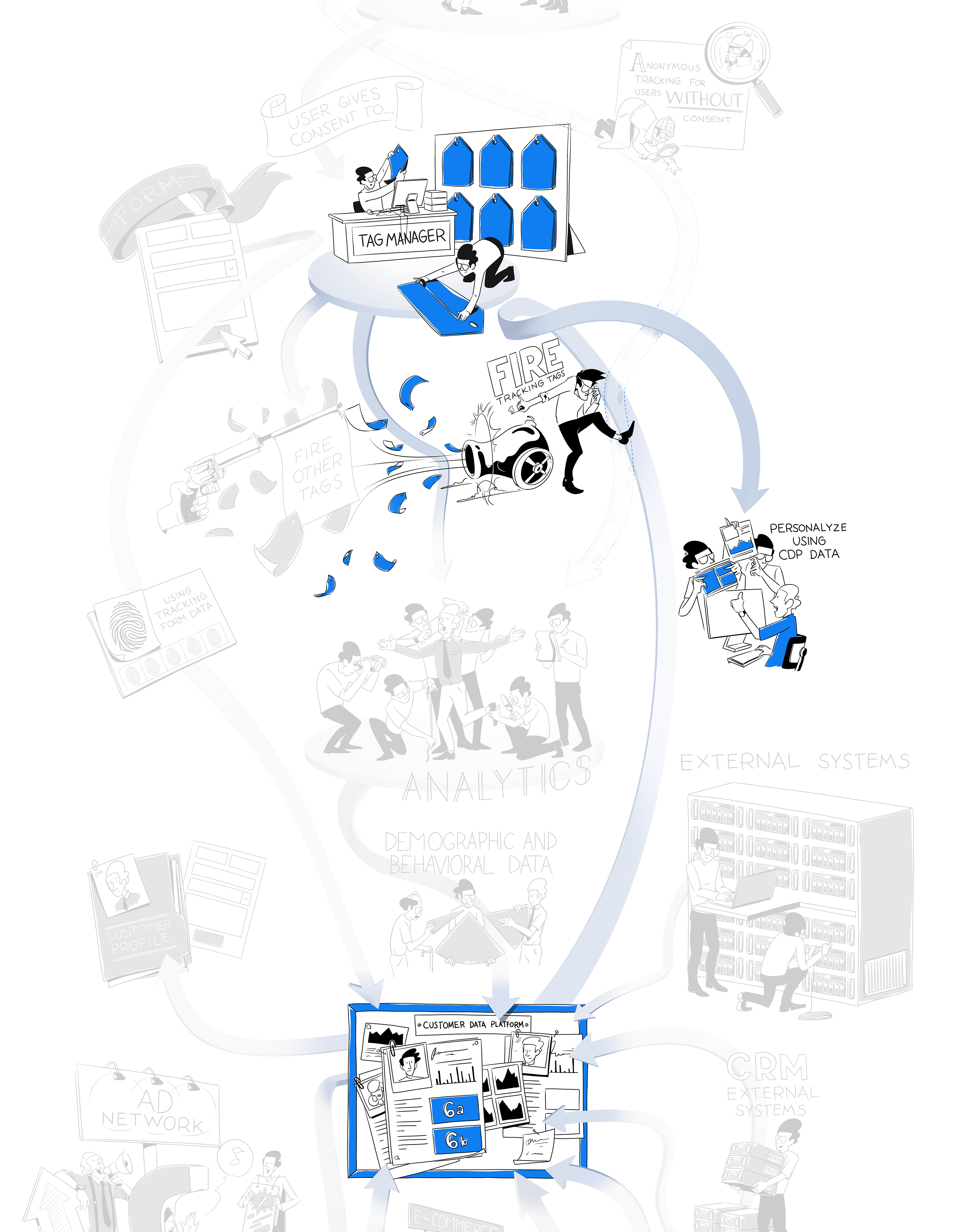
For example, you can segment existing customers who haven’t filled out a survey but have scheduled and completed an online or in-person consultation in the last 14 days. You can then email them a survey to get feedback on their consultation.
Or, you can create an audience of customers who have used your services before – for example, completed three consultations with the same specialist in the last 12 months. You can show them an ad banner with a complementary offer, such as a discount for another consultation.
Or, let’s take an audience of clients that paid for the premium service but haven’t visited your site or app or used your services in the past 6 months. You can serve them branding ads talking about the benefits of your platform and presenting its features.
Activating your audience on ad networks
You can also use the information you have to enhance your marketing outside the Piwik PRO ecosystem. One such option would be activating your CDP audience on Facebook Ads, Google Ads or other ad networks.
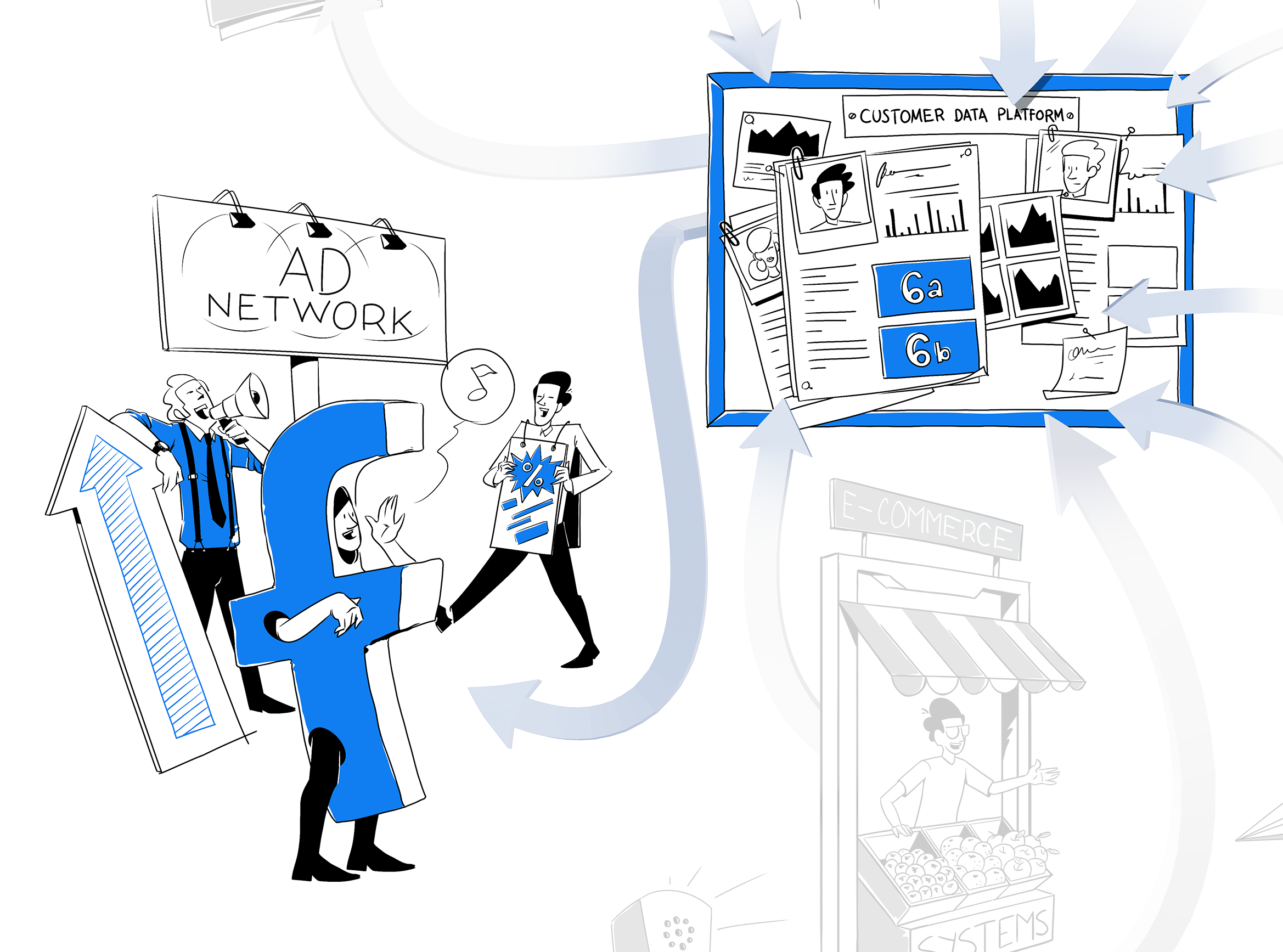
CDP recreates your audience in Google Ads or Facebook Ads but only using the data these two platforms already have. The data you have in Piwik PRO will not be exported or copied to these tools in any way during audience activation. The process is essentially an audience approximation in external ad networks.
You still benefit from targeting your CDP audiences and running personalization campaigns on external platforms while maintaining high data privacy and security standards.
Infographic
Data flow for analytics with consent and anonymous data
Learn how your data pipes are connected to ensure that data stays safe and private
The benefits of understanding how data flows
Analytics users often focus exclusively on deciding what data to gather, interpreting it, and making strategic decisions based on the results. These are all good things to think about, but you should still understand how your data pipes are connected to use the gathered data to the full extent of its capabilities.
Understanding data flows empowers you to make new connections with the help of complex platforms like Piwik PRO Analytics Suite. You can do so while ensuring the data stays safe and private throughout the process.
- 6 ways analytics software collects data online – plus a comparison of 5 popular platforms
- How Analytics & Customer Data Platform Can Help You Track the Full Customer Journey
- What is privacy-friendly analytics?
If you have any questions about the data analytics process or the features of Piwik PRO’s modules, reach out to us! Our team will be happy to address any questions.
The post Data flow in an analytics platform: How to set up your data collection and analysis process appeared first on Piwik PRO.
]]>