The post “Cookieless future” is just a buzzword – Here is all you need to know about the end of third-party cookies appeared first on Piwik PRO.
]]>SUMMARY
- The “cookieless” future won’t be entirely cookieless. While major browsers are transitioning away from third-party cookies in the face of user privacy and security concerns, first-party cookies remain an integral part of the web.
- The demise of third-party cookies will particularly impact digital advertising practices. Advertisers and marketers need to adapt to new methods and technologies for tracking and targeting users across different websites and devices.
- Alternatives to third-party cookies are emerging, including Google’s Privacy Sandbox initiative, contextual targeting, data clean rooms, and cookieless identifiers like universal IDs. However, new ad industry standards without third-party cookies are yet to be developed.
- Marketers should turn to first-party cookies, which still dominate in marketing and analytics tools. They should prioritize first-party data collection to balance transparency and privacy with effective marketing strategies.
Cookies have been a vital part of web browsing for years. While some cookies provide essential functionalities like maintaining visitor sessions, third-party cookies have been controversial due to their ability to track users across the web without their knowledge or consent. People have grown more conscious about using and sharing their data, and many feel uneasy about the vast amount of personal data amassed through cookies.
Apprehensions surrounding third-party cookies have come to the forefront, spurring legislative changes. This has motivated tech giants like Google, Apple, and Mozilla to transition their browsers away from third-party cookies.
However, while other types of cookies face different restrictions, such as a limited lifespan, they are not going away. Although alternatives to cookies have been popping up, they have yet to be widely adopted. Thus, we don’t know what the future of marketing and advertising will look like.
Today, we will explore the challenges of the demise of third-party cookies for marketers, businesses, site owners, and consumers. We will look into new methods of tracking users and collecting analytics data and show you how to navigate a future that will not be so cookieless after all.
What are cookies
Cookies are small pieces of data stored on a user’s device that contain information about their interactions with websites.
Cookies are used for various purposes, such as:
- Session data management.
- Personalization and authentication.
- Tracking user behavior for analytics.
- Tracking users across different websites for targeted advertising.
Types of cookies and their differences
There are two main types of cookies: first-party and third-party cookies.
First-party cookies
First-party cookies are set by the website the user is currently visiting.
They are usually used to enhance user interactions with websites. For one, they help maintain sessions and remember login credentials, preferences, and shopping cart items. They also enable the personalization of content and advertising based on browsing history and interests and collect analytics data for website improvement.
Some first-party cookies provide essential functionalities on a website and aren’t considered invasive.
Third-party cookies
Third-party cookies are created by domains other than the one that the user is visiting.
Third-party cookies gain access to your visitors’ browsers through external services embedded in your site, such as:
- An embedded YouTube video.
- A social media widget.
- An ad widget from an ad display network.
Third-party cookies are used for cross-site tracking, retargeting, and serving curated ads to users via ad platforms or social media based on browsing history and other online behavior across different websites.
These cookies enable brands and vendors to gather a significant amount of personal information about a user, making it possible to create detailed user profiles. They can also be used for malicious purposes, such as tracking users to steal their personal information or deliver malware.
On the other hand, they let websites provide certain functionalities, such as live chats. However, the absence of third-party cookies does not typically affect a website’s core functionality.
Why are third-party cookies being phased out
When cookies were first created in 1994, sites gained the ability to track information across pages, which enabled many useful functionalities, such as running online shops. At the same time, the vast potential for abusing the technology and violating user privacy and security became clear.
These concerns were so apparent that in February 1996, the Financial Times published the first article about the dangers of cookies.
Third-party cookies allow advertisers and trackers to follow users across the web and collect sensitive information without explicit consent, which can breach trust between all parties. Because of the widespread use of cookies, data is scattered across various apps, websites, and services, making it difficult to control what happens with it.
Consequently, cybercriminals can use cookies to impersonate users, gather financial data, steal passwords, and engage in other nefarious online activities.
Internet users have been sensitive to the unauthorized collection and use of their personal data, viewing it as an invasion of their privacy. For example, users have been turning to ad block extensions to protect themselves from intrusive ads and trackers online. As of 2022, 37% of internet users worldwide had adopted ad blockers.
Concerns about third-party cookies have led to increased scrutiny and regulatory efforts to respect user privacy. Regulations like the CCPA & CPRA and GDPR view cookies containing identifiers as personal data. These privacy laws specify the requirements for gathering consent to track and collect user data online.
Under the jurisdiction of these laws, websites must, among others:
- Obtain explicit user consent before firing cookies, collecting or storing data on users’ browsers, or processing personal data for tracking and advertising.
- Clearly inform end users about the tracking technologies they use, detailing the providers, purposes, and duration of data collection.
- Keep consent records and provide the data in case of an audit or data subject access request.
- Allow users to change or revoke their consent preferences as easily as they gave consent.
These regulations impose severe fines and penalties on data collectors who don’t adhere to their requirements.
For years, cookies have been integral to the online experience. However, as major browsers withdraw support for third-party cookies, they’re paving the way for marketing and advertising that don’t rely on them.
Experts opinion
Julien Coquet
“While the move away from third-party cookies is good for privacy, it is not so good for advertising, targeting, and remarketing. The treasure trove of data hoarded by ad networks for years to identify users and their preferences is becoming worthless “overnight.” But first-party cookies are here to stay, which means that data strategies need to shift to first-party and zero-party data. The problem is that companies should have adopted that shift as soon as the first sign of third-party cookie blocking became apparent.
Customer data platforms (CDPs) offer a way to federate information about a user based on first-party/zero-party data they provided elsewhere. Though CDPs are great for enriching user profiles for activation elsewhere, at this time they aren’t optimal for realistic, real-time updates and personalization. What options are there? My bet is on server-to-server integration and personalization for logged-in users, which we are starting to see.
Concerning advertising, the loss of third-party cookies lowers the targeting accuracy of ads, but that doesn’t mean advertising platforms won’t work anymore. There are various projects to replace third-party cookies, especially the Privacy Sandbox initiative carried by Google, for websites and Android apps. We should now focus on making data collection smarter, privacy-friendlier, and more frugal.”

The deprecation of third-party cookies in Chrome
Compared to other browsers, Chrome has been slower in imposing restrictions on third-party tracking. Third-party cookies power digital advertising, which is a vital component of Google’s business. Also, given Chrome’s 67% market share, Google’s approach to cookies impacts the entire industry.
- In January 2020, Google announced that it would phase out support for third-party cookies in Chrome, beginning with trials on conversion measurement and personalization by the end of 2020.
- In July 2022, Google announced a two-year delay to the end of 2024 for the of third-party cookies.
- Testing started in January 2024 with the rollout of a new Tracking Protection feature. Google restricted third-party cookies for 1% of Chrome users worldwide.
- In April 2024, Google announced it will not complete third-party cookie deprecation during the second half of Q4 as it previously expected and postponed it until 2025.
- On July 22, 2024, Google announced that it will not deprecate third-party cookies in Chrome. Instead, Google will introduce a new experience in Chrome that lets users make an informed choice about their web browsing, which they can adjust at any time.
Despite Google’s recent change of heart on third-party cookies, the technology has declined in prevalence due to the associated privacy concerns and is unlikely to recover. The quality and reach of third-party cookies have been continuously decreasing. If users get the option to opt out of tracking, they may additionally contribute to the technology becoming a thing of the past.
For years, the web has been moving away from third-party cookies in favor of more privacy-first technologies. Due to Google’s continuous promise to move away from third-party cookies and their deprecation in other major browsers, marketers had to adjust their approach by considering alternative solutions. The online advertising industry, which is particularly affected by cookie-related changes, still needs to adopt new ways of targeting users.
While other browsers aim to transition away from third-party cookies, Google’s “cookieless” alternatives don’t necessarily focus on privacy. Google wants to preserve control over the majority of online advertising and the revenue generated from it. As the world’s largest ad platform, Google is strongly interested in maintaining its ad-targeting capabilities.
When Google announced it wouldn’t be deprecating third-party cookies in Chrome, the company vaguely explained its next steps. Google stated that it has been discussing its new path with regulators and will engage with the industry as it rolls out. The company will also continue working on the Privacy Sandbox API, which it has been developing as a privacy-focused alternative to third-party cookies.

To get another perspective on Google’s recent decision to retain third-party cookies, read the interview: Piwik PRO Head of Marketing Dominika Gruszkiewicz On Why Google Third-Party Cookies Will Stay
What will replace the third-party cookie in Chrome?
Introduced in August 2019, the Privacy Sandbox is centered around developing measures to support advertising functionalities without relying on tracking users across websites.
The Privacy Sandbox has been an iterative process, with different APIs developed and deployed for testing. This process reached a breakthrough when the Privacy Sandbox initiative announced the release of six new APIs for Chrome in July 2023.
These APIs include:
- Topics
- Protected Audience
- Attribution Reporting
- Private Aggregation
- Shared Storage
- Fenced Frames
Here are their specifics:
Topics
Topics allow the browser to infer a selection of recognizable interest categories based on recent browsing history to enable sites to serve relevant ads. Unlike third-party cookies, Topics will only share users’ general interests, rather than granular behavior, across multiple sites.

Google’s Topics API is the second iteration of the Federated Learning of Cohorts (FLoC) proposal, which was ultimately abandoned due to privacy concerns.
Protected Audience
Protected Audience enables advertisers to run ad auctions using JavaScript code within the browser. Advertisers can also run targeted remarketing campaigns to custom audiences or groups of people with a common interest.
Attribution Reporting
Attribution Reporting allows measuring conversions from ad clicks and views, and ads on other platforms without tracking user activity across websites. It employs two types of reporting:
- Event-level reports – Providing detailed conversion data without revealing user identities.
- Summary reports – Presenting summarized data across large groups of users.
Private Aggregation
Private Aggregation makes it possible to generate aggregate data reports using data from Protected Audience and cross-site data from Shared Storage.
Shared Storage
Shared Storage allows sites to store and access unpartitioned cross-site data. This data must be read in a secure environment to prevent leakage.
Fenced Frames
Fenced Frames enable securely embedding content onto a page without sharing cross-site data.
Privacy Sandbox and the ad industry
There are mixed opinions about the Privacy Sandbox. Although it’s a viable alternative to third-party cookies, it will only operate in Chrome. While Chrome has a majority of market share, other browsers are still responsible for large chunks of traffic. Chrome is also not representative of traffic from other browsers and devices, where users may behave differently.
The identifiers created with Privacy Sandbox aren’t owned and stored by the advertisers, so they can’t be passed and activated in other systems.
According to a report by IAB Tech Lab:
“In its current form, the Privacy Sandbox may limit the industry’s ability to deliver relevant, effective advertising, placing smaller media companies and brands at a significant competitive disadvantage.”
In the end, Privacy Sandbox will not be the only solution to the deprecation of third-party cookies, but it is one of the alternatives that advertisers can consider. You can monitor the Privacy Sandbox timeline, as various proposals are currently in different development and testing stages.
Experts opinion
Jason Packer
Analytics Architect and Consultant
“Third-party cookies have several functions, and when they finally disappear in Chrome, that functionality will fracture into many solutions for different scenarios.
For example, third-party cookies utilized for ad targeting will be replaced by a patchwork of tech: hashed first-party data sent to ad networks, walled garden logged-in user data, the Topics + Protected Audience APIs from Privacy Sandbox, IP addresses, and probabilistic browser targeting. View-through attribution will be replaced by another set of technologies. From an advertiser’s perspective, this is a big challenge to the old model of open web with no login required.
The third-party cookie is clearly a problematic technology, but its replacement requires learning different things depending on what you are using third-party cookies for. There will be a period of time when we see which solutions really catch on. Despite 1/3 of users already rejecting third-party cookies and all the talk during the run-up to this turndown, the selection and winnowing of replacement tech hasn’t really happened yet.”
The phase-out of third-party cookies by other vendors
Many browser vendors have been employing restrictions on user tracking for years.
Apple
Apple has implemented Intelligent Tracking Prevention (ITP) in Safari. ITP blocks third-party cookies by default and restricts first-party cookies and other browser storage options.
Additionally, Apple has introduced App Tracking Transparency (ATT). This user privacy framework requires all iOS apps to request permission via a pop-up to access the Identifier for Advertisers (IDFA) or device ID and track users across apps and websites.
Firefox
Firefox offers Enhanced Tracking Protection, which lets users block cookies and storage access from third-party trackers. Thus, users can decide what level of privacy they want to set up in their browsers.
Brave
Brave has been a privacy-focused browser from the start, blocking third-party cookies by default. It also enables many additional privacy and security features, allowing users to customize their privacy settings more granularly.
What does the demise of third-party cookies mean
Organizations that rely on third-party cookies will face challenges as certain functionalities won’t be available.
Activities that will be impacted include:
- Audience buying based on third-party data.
- Data activation on the web.
- Retargeting on the web.
- View-through advertising attribution.
The phase-out of third-party cookies signifies a massive transformation in digital advertising, making it more challenging for advertisers to track users across different websites.
As cookies become a thing of the past, the focus is on developing new technologies and methodologies that align with the evolving digital advertising ecosystem and enable marketers to deliver relevant and personalized content.
Experts opinion
Josh Silverbauer
“Third-party cookies have been a fundamental part of the web for nearly three decades. A shift in usage is going to create a huge change for less technical marketers. Advertising companies that rely on “just placing a pixel on a page” will need to adapt to more sophisticated methods of first-party data exchange, data stitching, and data modeling. They will also have to become more comfortable with gaps in tracking due to opt-outs and rely more on AI to “fill in the gaps.” This shift may lead to a perceived loss of control and a feeling of uncertainty and distrust in the data.
As a result, some marketers may pull back on digital marketing spend and return to more traditional advertising methods, while others may allow AI to take more control and operate in a state of ignorant bliss. Couple all of this with the fact that people crave personalization, and the loss of cookies increases the difficulty to personalize results… it’s going to be messy. But dessert is a messy dish, so I’m here for it.”
How to navigate the future without third-party cookies
The “cookieless future” refers to an impending reality in which third-party cookies are no longer part of marketers’ toolkit. It’s a landscape without access to user data collected through third-party cookies, impacting how we perform user tracking, generate leads, retarget ads, and understand user behavior.
This future, although challenging, presents an opportunity for innovation and growth in the digital marketing sector.
Focusing on first-party cookies
If your company uses first-party cookies as its primary marketing fuel, your activities won’t be affected much. These cookies will continue to work and remain an option, delivering measurable benefits even in the face of the changes concerning third-party cookies.
There are many first-party cookie-based methods you can still use in your marketing, such as:
- Web analytics. You can track users visiting your domain and collect analytics insights to improve user experience and drive better marketing results for your business. That’s possible with analytics tools that use first-party cookie identifiers, such as Google Analytics or Piwik PRO.
- Product analytics. Analyzing user journeys in digital products is based on a first-party identifier, like a first-party cookie or mobile app identifier generated by the SDK. In both cases, platforms like Mixpanel or Piwik PRO will function normally and provide useful data.
- Marketing tools. Most marketing tools already utilize first-party cookies, meaning you can use them despite changes to third-party cookies. For example, you can benefit from A/B testing tools (like AB Tasty, Optimizely or Convert) or marketing automation platforms (like SALESmanago, Hubspot or Marketo).
- On-site personalization and remarketing. You can personalize user experience on your website by applying first-party data-based technologies, be it Optimizely or Piwik PRO Customer Data Platform.
- Retargeting and tracking on iOS and Android. You can still retarget and track users across native mobile apps on iOS and Android using mobile identifiers.
Creating a first-party and zero-party data strategy
If you want your company to prioritize customers’ privacy and trust, you should focus on first-party data collection, supplemented by zero-party data.
First-party data is collected through direct interactions between the audience and the brand. It includes personal details, contact information, behavioral data from different channels, social media activity, purchase history, consent records, and more. Companies can enhance their first-party data approach by integrating analytics with data from other tools, such as CRM, marketing automation tools, email software, and many more.
Another valuable type of data is zero-party data, which refers to information intentionally and proactively shared by individuals with a company or organization. Zero-party data can be collected from customer reviews or comments, product-related preferences, newsletter opt-ins, or notification settings.
First-party and zero-party data are valuable because their collection relies on transparent, consent-based data practices and help establish trust between the company and its customers. These types of data are also accurate and reflect your customers’ behavior, making them relevant and practical when applied to initiatives like marketing or advertising campaigns.
Find out how to create a first-party data strategy from our blog post: What is first-party data and how does it benefit your marketing.
“Cookieless future” and advertising
The ad tech industry stands to lose from the demise of the third-party cookie.
Ad tech vendors and digital advertisers have been using third-party cookies for features like:
- Identification.
- Frequency capping.
- Measuring performance and attribution.
- Audience activation.
- Cookie-syncing or matching between, for example, demand-side platforms and supply-side platforms.
The advertising industry needs to adopt effective methods that don’t raise privacy and transparency concerns like third-party cookies did. Striking that balance is often challenging as new industry standards must be created.
Some alternatives for digital advertisers include:
Contextual targeting
Contextual targeting is a form of targeted advertising that focuses on aligning ads with the content of a particular page. For example, it may involve placing an ad for kitchen utensils on a recipe site or an ad for a tour operator on a travel site.
Ads are segmented based on keywords, site topics, language, and location, and then matched with relevant content. By making ads reliant on a page’s context, brands can reach audiences with ad placements that are likely to resonate with visitors. Research from Sapio Research and DV shows that 69% of consumers are more likely to look at an ad if it’s relevant to the content they are reading.
Contextual targeting is a more privacy-friendly alternative to behavioral targeting, which is based on personal browsing data. Previously, contextual targeting faced issues with the quality and efficiency of classifying content. However, thanks to AI, modern contextual targeting can understand the nuances of content, thereby increasing engagement and effectiveness.
Contextual targeting offers numerous benefits in the “cookieless” world, such as:
- It offers the ability to reach large, diverse audiences, including acquiring new customers.
- It respects user privacy and doesn’t feel intrusive.
- It can help users find what they want and increase their purchase intent.
- It’s easy to start and optimize.
- It doesn’t rely on third-party cookies or users’ personal data.
- It can positively impact brand perception and reputation.
- It works across different channels.
Learn more about contextual targeting: Contextual targeting – a privacy-friendly alternative to invasive ad tracking.
Data clean rooms
A data clean room is a collaborative environment where two or more participants upload their first-party data and compare it to the aggregate data added by other companies.
Data clean rooms allow brands and advertisers to glean insights from each other’s first-party data under strict controls. They can use data clean rooms to:
- Run targeted advertising campaigns.
- Apply frequency capping.
- Perform audience analysis and enrichment.
- Measure and report on campaign performance.
- Run attribution.
All the data stays within the data clean room. Even though user-level data is added to a data clean room, it is not exposed to other companies.
There are different types of data clean rooms:
- Clean rooms as a service – Many data clean rooms exist as a service, meaning they are provided by independent vendors or platforms. These clean rooms are often the most flexible regarding what data can be used and how users can configure it. Examples include AppsFlyer, Habu, InfoSum, LiveRamp, and Snowflake.
- Private clean rooms – This generally includes large publishers with massive amounts of user data and content, like Disney, Spotify, and TikTok. These companies have proprietary private clean room technologies to monetize their customer base and create their own walled-garden advertising ecosystem.
- Walled garden data clean rooms – Walled gardens operate within a closed ecosystem and are owned and offered by big tech providers such as Google, Facebook and Amazon. They provide hashed and aggregated data to companies that use their advertising platforms, typically without the ability to combine data from other sources.
By securely aggregating and connecting customer data sets in a clean room environment, marketing teams can draw insights from a wide range of sources to better understand their customers while meeting data privacy requirements halfway.
Experts opinion
Vibeke Specht
“The future is not “cookieless” since first-party cookies are in it for the long haul, providing leverage to walled gardens. However, the future is definitely more fragmented and privacy-aware but also more open and diverse thanks to strong antitrust enforcement by the EU Commission, among others. This makes the present moment an excellent opportunity for marketers who want to reassess old truths, KPIs, tools, and where they spend ad dollars.
As marketers, we have the right to demand more transparency and, for example, a way better placement reporting than we have today. So, the future will bring us better marketing and ROI – if we want it to. The choice is ours.”
Cookieless identifiers
Ad tech vendors and the ad tech ecosystem are developing alternative universal IDs to replace third-party cookies. Without third-party cookies, ad tech and data companies can’t perform cookie syncing like they used to.
The advertising industry needs to find alternative ways to create IDs, such as turning a person’s login details (e.g., email address) into an ID.
The selected ID alternatives must:
- Work across all digital channels.
- Provide the consumer with greater control.
- Operate in transparent ways.
- Better explain its value to consumers.
Balancing these aspects is challenging; hence, no solutions have been widely adopted yet. At the same time, this could mean that Big Tech companies will manage to increase their market share with their solutions at the expense of independent ad tech.
Here are some potential identifiers that have been introduced:
Universal IDs
A universal ID is a unique user ID that allows ad tech companies to identify users across different websites and devices. Universal IDs can operate within one environment, such as browsers, or identify users across various environments, such as browsers and mobile devices.
While universal IDs perform the same functions as third-party cookies, the difference is in how they are composed. Universal IDs are created using probabilistic data (e.g., IP address, browser type and model, and user-agent string), deterministic data (e.g., email address or phone number), or both. They help solve issues with cookie syncing and user identity.
Some notable universal ID solutions include:
Unified ID 2.0
Unified ID 2.0 is an identity framework that operates through a single sign-on to capture a user’s email address and consent once they visit a publisher’s page that supports UID 2.0. This consent is applied to targeted advertising across all publishers within the UID 2.0 network. Once the user logs in and consents, a hashed and encrypted identifier is created.
ID5
ID5 provides the advertising ecosystem with a stable encrypted user ID that replaces cookies and Mobile Ad IDs (MAIDs). Publishers, advertisers, and ad tech platforms can use these IDs to recognize users and deliver campaign objectives across different types of devices.
ID and device graphs
ID resolution services like ID and device graphs rely on taking and merging first-party IDs.
These IDs are taken from online and offline channels, such as websites, mobile apps, and customer and data platforms (such as CRMs, CDPs, and DMPs), and sent to the ID graph. Next, they are matched with other IDs in the graph using a combination of deterministic and probabilistic methods.
The main goal of ID and device graphs is to piece together IDs to create a centralized view of consumers rather than use these IDs for online media buying. Thus, companies can identify customers across different devices and channels and run various cross-device activities, such as ad targeting, personalization, and attribution.
For ID and device graphs to be lawful, users sharing their data must provide valid consent.
Learn more about advertising IDs that are alternatives to third-party cookies: Identity in AdTech: Meet The Various Universal ID Solutions.
Piwik PRO and the demise of third-party cookies
The phase-out of cookies won’t impact the web analytics capabilities in Piwik PRO, but it may affect your use of third-party tracking scripts.
Here are the specifics of how cookies work in Piwik PRO:
First-party cookies
Piwik PRO exclusively utilizes first-party cookies for data collection. Users can continue to rely on our analytics platform without concerns about the removal of third-party cookies. Even without third-party cookies, you won’t see any difference in collecting analytics data from Chrome users.

Check out our help center article on Cookies created for visitors by Piwik PRO for more details.
Third-party scripts
Tag Manager allows you to implement third-party scripts like Meta Pixel or LinkedIn Insight Tag. Third-party scripts on your website can set both first- and third-party cookies. As a result, some scripts may not work as before without third-party cookies. This could lead to issues like incorrect campaign displays and difficulties in collecting campaign data.
Handling these issues depends on how ad tech companies like Facebook or Google Ads approach the transformation and what alternative solutions they provide for their pixels and other tracking tags. At Piwik PRO, we will do our best to adapt to any changes the vendors make.
For now, the consensus on the new ad tracking methods is not there yet. There are already things you can do to prepare for restrictions on third-party cookies:
- You can export goal conversions from Piwik PRO to Google Ads or Bing Ads. These exports will be helpful if Google Ads or Bing Ads cannot collect this data due to the lack of support for third-party cookies.
- The Meta Pixel has the option to rely on first-party cookies, which you can adjust in the pixel’s settings.
- Use the Piwik PRO Customer Data Platform to activate your data in other marketing tools and create targeted campaigns, send personalized emails, show relevant ads, and more.
Cookieless tracking
Piwik PRO also offers cookieless tracking, which involves alternative user tracking mechanisms, such as with a session hash.
Since cookies play a pivotal role in recognizing and tracking returning visitors along with their browsing sessions, cookieless tracking has certain limitations and can impact the precision of data.
However, cookieless tracking helps you align with strict cookie requirements. It still lets you collect valuable analytics data, such as events and traffic sources. This makes it a great option if you can’t use cookies for tracking purposes due to privacy laws.
Learn more about tracking options in Piwik PRO: Collect data in a privacy-friendly way.
Getting ready for the end of third-party cookies
To make your company well-prepared for the future, make sure to:
- Revisit all your tools and understand your first-party and third-party cookie situation. Analyze what role these cookies have in your current marketing and advertising strategy.
- Develop a first-party data strategy. Focus on trust and transparency in your relationship with users. You can support your efforts by showing users the value exchange behind sharing their data.
- Make sure you adopt any relevant data privacy and transparency measures. Implement a consent management system (CMP) to collect and manage user consent.
Google’s Consent Mode v2 APIs communicate with GA4, Google Ads, and a range of Google’s other ad-tech products. Google has also made Consent Mode v2 mandatory, so to continue using Google’s products, ensure the CMP has a built-in integration with Google Consent Mode v2 – such as Cookie Information.
- Adjust your KPIs to focus on quality metrics. Prioritize engagement and conversion metrics. Focus on KPIs that reflect direct engagement and conversion on your site, such as session length, conversion rate, and goal completions.
- Get familiar with alternative marketing and advertising methods. Monitor the status of developments, like the Privacy Sandbox, and consider how they could fit into your company’s strategy.
Even without third-party cookies, you can benefit from a range of Piwik PRO’s features to collect, draw, and use valuable insights from your data. Reach out to us if you want to know more:
The post “Cookieless future” is just a buzzword – Here is all you need to know about the end of third-party cookies appeared first on Piwik PRO.
]]>The post How you can drive growth for your business with an integrated analytics platform appeared first on Piwik PRO.
]]>How can organizations best adjust and grow in the ever-transforming digital world?
This article will explain the importance of data integration and activation in analytics today and how companies can use them by turning to integrated analytics platforms.
What trends do companies need to follow in today’s marketing and analytics
Businesses face significant challenges in navigating the changing digital marketing standards.
Nowadays, they must find ways to recognize and incorporate several approaches:
Focus on personalization
Personalization is no longer just an option. Research by McKinsey shows that 71% of customers expect companies to deliver personalized interactions.
Companies in many industries are increasingly fighting for consumers’ attention. As statistics show, 89% of businesses compete primarily on the basis of customer experience. In a recent study by Qualtrics, over 65% of customers said their experience on the website or app would be at least a very important factor in their willingness to recommend a brand.
With rising competitiveness across industries comes stakeholders’ growing demands for better business results. Companies that utilize personalization generate 40% more revenue from these activities than the average. Additionally, 61% of people are willing to spend more with a company that offers them a customized experience.
Organizations should aim to reach customers with tailored campaigns, offers, and products to increase sales and grow their business. Their best bet to achieve that is by activating their data.
Data activation involves utilizing collected information to target and engage with audiences strategically. Activating customer data helps teams personalize campaigns and messaging across channels.
Through that, businesses can:
- Improve customer experiences.
- Convert prospects into customers more quickly and at higher rates.
- Drive positive business outcomes.
Follow privacy compliance standards
It’s understood that strict privacy and security requirements must be prioritized when handling customer data. Both companies and consumers are aware that data is valuable and must be protected, which is additionally enforced by data protection regulations. Users expect their data to be used responsibly and for their benefit. Acquia’s survey shows that consumers are becoming more comfortable sharing personal data with brands for a better experience.
Companies should use this opportunity to stay transparent about data collection and respect users’ choices concerning their data and its use. Privacy compliance requirements also push companies to analyze what digital data they collect and own and evaluate what tools they use to handle it. Organizations should work with vendors that give them complete control over what data they collect and what happens with it.
Collect first-party data
Since most browsers are moving away from third-party cookies, marketers need to move on from them. According to Acquia, 84% of people say that scrutiny of browser cookies has increased the importance of first-party data obtained through direct interactions between a company and its audience.
Among many others, first-party data lets companies:
- Create more targeted campaigns.
- Enhance customer relationships and trust.
- Improve overall marketing effectiveness.
- Support compliance with relevant privacy regulations.
As a result, to remain competitive, companies must establish a first-party data strategy. It should involve collecting valuable data from users through analytics, social media, contact forms, email, user accounts, and others and strategically activating it. Organizations can also benefit from gathering zero-party data, which is the type of data that customers willingly share with brands.
For more on first-party data, check out our blog post: What is first-party data and how does it benefit your marketing.
Establish a data strategy
Businesses today have access to staggering amounts of data, not to mention the number of tools they use for marketing, sales, customer support, and other purposes. According to a 2017 study, the average enterprise used 91 marketing cloud services, 90 for HR, and 70 for collaboration, to name but a few.
As companies plan their first-party data collection, they need to strategize what information they need and how they want to use it. Instead of randomly collecting every possible piece of data, digital analysts must focus on what’s relevant and ensure the data is high-quality and reflects actual customer behavior. It’s also easier to collect valid user consent if you inform users why you need the data and how you will use it.
Integrate your data
Companies must work on complete data sets in order to gain insights that will help them more effectively target their ideal customers. For this purpose, they need to merge user data from different sources, understand the connections between data points, and determine how customers’ behavior impacts their decisions.
They need to be able to analyze the complete customer funnel, including information relating to marketing, sales, finance, and customer experience interactions. This will help them understand users’ paths from their first interaction with a brand, through their responses to marketing activities and sales communication, to the decision-making process and becoming customers.
Above all, integrating and segmenting data allows teams to better understand their existing customer base and how to reach new ones that match their traits.
Experts opinion
Emanuele Celoria
“For the last few years, marketing and product analytics tools have been launching new modules allowing the import of external data. This is not surprising since companies rely on diverse platforms to collect very different kinds of data. For example, analytics platforms collect behavioral data, CRMs provide customer details, and advertising platforms share marketing budget spend and campaign performance. There is a clear need for data hubs that put together all collected information and act as unique sources of truth.
All these data sources provide complementary information about users and customers. This is why integrating them enables a better business understanding and helps answer complex business questions to deliver real value. A strong prerequisite for obtaining unique insights is to have meaningful join keys across the different input data.”
How to fulfill the demands of modern digital analytics and marketing
Businesses have been looking for tools to help them address the above trends.
MarTech’s 2023 Replacement Survey demonstrates that it’s common for organizations to upgrade their marketing software in favor of solutions with better features that integrate seamlessly with the rest of their marketing technology stacks. The 2022 edition of the MarTech survey showed similar trends. The top two criteria for choosing a replacement tool were integration possibilities and open API, as well as data centralization and data capabilities.
A research report from Pandium shows that 86% of the Top 100 SaaS companies in the world now have a public integration marketplace. Other martech trends involve incorporating products from multiple vendors and having them well-connected with each other.
One solution companies can use today is integrated analytics platforms. These platforms allow businesses to merge all tools into a coherent data system and efficiently collect, analyze, and act on user data. Ultimately, they offer data integration and activation capabilities that let companies maximize the effectiveness of their insights.
What is an integrated analytics platform
An integrated analytics platform combines various data analytics components, such as data collection, processing, storage, and visualization, under a single, unified system. These platforms are characterized by flexibility and connectivity.
Crucially, an integrated analytics platform provides seamless integration with other tools and systems in the stack, consolidating online and offline data from multiple sources in one place.
You can combine analytics with tools such as:
- CRM systems
- Ad platforms
- Email marketing tools
- Data warehouses
- Ecommerce tools
- BI and data visualization tools
- Marketing automation systems
- Social media platforms
- And many others
Teams gain access to consistent data sets and can choose what data they import to the platform, where they send it, and how they activate it in destination tools. They might also define and create their own integrations with third-party tools.
Examples of integrated analytics platforms include:
- Piwik PRO Analytics Suite
- Amplitude
- Piano
- Adobe Experience Platform
Benefits of an integrated analytics platform
Integrated analytics platforms help facilitate a more efficient, cohesive approach to marketing and analytics.
The most important benefits of integrated analytics platforms include:
- Removing data silos – Data from all sources is unified and consistent, creating a comprehensive set and enabling the constant evolution of data models. Organizations work on more accurate and complete customer data.
- Being easy to use and collaborate – The platforms are easy to set up and contain the necessary products within one tool, allowing teams to get their work done faster and collaborate effectively.
- Reducing costs – Your team will spend less time implementing and updating different components of the platform. They don’t need to put as much effort into integrating multiple products.
- Combining data from multiple sources – You can easily integrate data from diverse sources and confidently manage data quality. This allows you to perform advanced analytics, visualization, and other processes in one place.
- Creating complete customer views – You can compile and access all user data in one platform. You’re able to merge customer identities and build a full picture of each customer and their interactions with the brand.
- Allowing insight into all touchpoints – You can collect data from all measurable touchpoints and stitch them together to analyze customer journeys in full detail.
- Offering well-integrated modules – You can swiftly make the data stack more powerful by using the combined powers of all available modules, such as tag managers or consent management platforms.
- Providing integration with external tools – You can enhance the platform’s capabilities by integrating analytics with BI tools, data visualization software, marketing platforms, CRM, etc. For example, you may export data for further analysis or activate it in marketing tools to better reach prospects and customers.
- Enabling data activation – You can fuse data into everyday workflows and applications to make smarter decisions and improve customer communication at all lifecycle stages. For example, you may apply the data to create effective marketing campaigns, optimize revenue, predict trends, and evaluate marketing strategies.
Experts opinion
Celina Belotti
“The fragmentation of digital platforms, particularly due to stronger regulations in Europe, leads to technical limitations. These prevent us from creating a seamless picture of our users’ experience and evaluating the results of our marketing efforts. Bridging data silos and enriching data will help you overcome this fragmentation with increased data quality.
Secondly, with the rise of machine learning applications in digital marketing, advertisers should be aware that the more data they can inject, the better their output will be. Platforms are demanding more data, and advertisers should use their analytics platforms and CDPs to organize and distribute it safely.”
Use cases for integrated analytics platforms
Integrated analytics platforms support a coherent understanding and leveraging of data for a whole scope of functions. They streamline data processes, serving the needs of multiple teams beyond marketers and data analysts. Their possibilities extend to product- and business-related decisions, sales, customer support, and others.
Here are some purposes for using integrated analytics platforms:
Identity resolution
Identity resolution involves merging data from different sources to create customer profiles. Profiles can be merged using matching identifiers. These can include persistent identifiers, such as an e-mail address or user ID, or non-persistent identifiers, like session ID, that work for in-session personalization or activation. This removes the need for manually merging and organizing customer records.
Saving costs and resources
An integrated analytics platform reduces reliance on multiple standalone tools. Companies don’t have to pay for a few subscriptions or create various setups. Once they configure tracking, they have hundreds of data points to use across the platform.
Data integration limits tedious manual work and data manipulation, minimizing the risk of errors. Companies can avoid complicated and time-consuming implementation issues, such as creating custom integrations.
Additionally, integrated analytics platforms also increase productivity and help teams collaborate, exchange user data, and complement each other’s efforts.
Optimizing customer journeys
Brands can segment users based on their shared traits or behaviors to better target them at different customer journey stages. Marketers can analyze how users move around the site, identify where they drop off the funnel and help them complete the intended paths.
For example:
- To encourage a user in the consideration stage to choose your solution, show them product-related content, such as an ad for a product comparison whitepaper.
- To support a user who is ready to buy, create a pop-up on your website with the form to request a free demo.
- To retain a customer, assign a dedicated account manager to provide ongoing customer service and prevent churn.
Improving the customer experience
Marketers get the complete picture of a customer’s interactions with the brand to analyze the content they consume, products they purchase, traffic patterns on the website, and other details. With an in-depth understanding of users, marketers can provide relevant product offers, display messages matching their preferences, or prefill forms with previously input data.
For example, you can:
- Send email campaigns with product recommendations based on a customer’s browsing behavior.
- Request product reviews and referrals from engaged users a few days after purchase.
- Send a text encouraging an existing customer to download and use your mobile app based on their device type.
Through these activities, marketers can provide personalized customer experiences and deliver the information, capabilities, products, and services their audience wants most.
Providing insight for predictive and prescriptive analytics
Brands can leverage historical data on previous purchases, communication preferences, loyalty status and more to forecast trends and prescribe actionable strategies.
For example:
- Identify high-value customers and plan actions to nurture and retain them. For example, you may prepare an exclusive offer and share it with them via email.
- Discover cross-sell and upsell opportunities. For example, you may send users recommendations for related products that complement the other products they have bought in a given category.
- Find customers close to churning and encourage them to stay. For example, you may offer a discount for renewing a customer’s subscription to let them use your service longer and discover more of its value.
Supporting the sales department
Data from support tickets, ecommerce browsing history, previous sales call records, and other information about a prospect all come together. Sales teams may also enrich existing data sets. For example, they can combine intent and CRM data to have more dimensions for segmentation.
This lets sales agents communicate with context and familiarity, enabling a better sales experience.
For example, sales reps can:
- Prepare a more tailored offer for each prospect that addresses their requirements in advance.
- Maximize lead conversions and revenue by prioritizing specific leads based on their scoring rules.
This leads to more sales, increased customer retention, and a higher likelihood of recommending the service to others.
Helping customer support
Customer support agents gain immediate access to detailed customer profiles with data integrated from every system. This includes previous interactions with the sales and customer support teams, the support tickets they have created, any relevant notes from the sales team, and more.
For example, customer support reps can:
- Efficiently answer customers’ questions about their current subscriptions.
- Make recommendations for using the product.
- Steer conversations toward new purchases or brand experiences.
This allows them to meet customers’ needs quickly and form stronger relationships, increasing customer retention.
How can you benefit from Piwik PRO Analytics Suite as an integrated analytics platform
Piwik PRO’s integrated analytics platform gives you connectivity and freedom to integrate and activate your data. Regardless of your industry and business goals, you can benefit from high-level privacy and security features in every aspect of the product.
Below, we break down the top assets of Piwik PRO Analytics Suite.
Flexibility
With Piwik PRO, you can connect various tools and systems, create reports, and perform additional analyses. For example, you’re free to set up dashboards that show you the most vital metrics for your business or complex custom reports for particular scenarios. You also own your data and can decide who has access to it. Through this, you can better adhere to privacy regulations.
Integration
Piwik PRO gives you various options for supplying the platform with data imported from other sources. You can also extend the platform’s analytics capabilities and apply the data to your work processes through different tools and systems.
You’re able to connect ad platforms, A/B tools and others, or integrate BI or visualization tools like Looker Studio or Power BI. You can export raw data to tools like Amazon S3, Azure Blob or BigQuery. Additionally, you get to activate data in other tools to reach your customers better and get practical benefits from your data.
In 2023, Piwik PRO merged with Cookie Information, a leading consent management platform (CMP) vendor. You can also benefit from a seamless integration between Piwik PRO Analytics Suite and Cookie Information CMP.
Using some integrated analytics solutions can lead to vendor lock-in. For example, you are limited to integrating GA4 with Google’s products, such as BigQuery and Looker Studio. However, Piwik PRO doesn’t lock you in its ecosystem – you have possibilities for integration with external tools.
Data activation
Our customer data platform (CDP) allows you to unify, segment and act on your customer data.
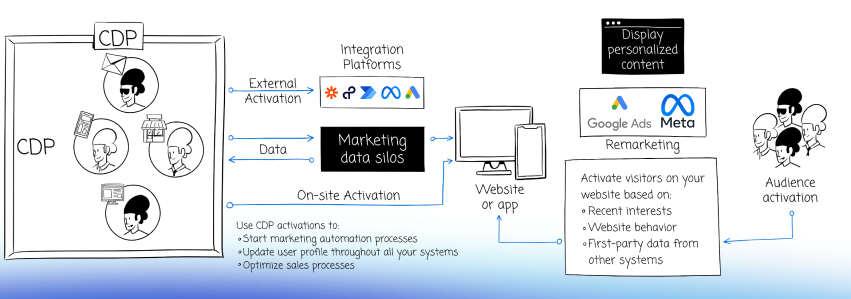
Some of the most important capabilities of the CDP include:
- Connecting visitor data scattered across channels and touchpoints and enhancing insights with data imports from any tool in your tech stack. You can now also import data into the CDP through the API.
- Gaining a detailed overview of user characteristics and interactions with your brand in single customer views (SCV). This lets you view all data gathered about a user in one place to ensure consistent and up-to-date information across systems.
- Triggering audiences across multiple touchpoints, including real-time customer interactions. Create audience segments based on demographic and behavioral data to define audiences more precisely and target them with relevant ads, content, or messaging.
- Activating user data with webhooks and automation tools to send desired attributes to various destinations, such as CRM, ad platforms, email marketing tools, internal communication channels, etc. You can also define advanced integrations if needed.
Connecting multiple touchpoints
Piwik PRO allows you to map out full digital experiences across channels and touchpoints and analyze every step of the customer journey. Your team can swiftly explore and analyze user behavior to inform sales or marketing optimizations. To get insight into customer journeys, you can use the available reporting features, such as multi-channel attribution reports, user flows and funnels.
Tightly integrated modules
Piwik PRO offers much more than Analytics. You can combine other tightly integrated Piwik PRO modules – Tag Manager, Customer Data Platform and Consent Manager – to expand on the features from Analytics and leverage the combined powers of all modules.
- Tag Manager lets you control all aspects of data collection and activation. This saves time and ensures that your tag setup is consistent and effective across different tools.
- Consent Manager helps you maintain transparent consent processes. You can streamline the collection of valid user consent and manage records of user preferences.
- Customer Data Platform offers the ability to integrate user data from multiple sources and segment them into relevant audiences. You can gain detailed insights into customer behavior and act on the data.
Conclusion
Despite the wealth of information at every marketer’s and analyst’s fingertips, many organizations struggle to make sense of their data. The vast technological landscape complicates the process of choosing and combining different tools to create a comprehensive data setup. Not to mention establishing cooperation between teams and making the data usable and applicable to improving business processes and results.
An integrated analytics platform can address these challenges. It’s an effective solution for promoting a culture of data-driven decision-making and supporting continuous development across the organization.
Reach out to us to discover the full potential of Piwik PRO as an integrated analytics platform:
The post How you can drive growth for your business with an integrated analytics platform appeared first on Piwik PRO.
]]>The post Activate data for a personalized customer experience with the Piwik PRO Customer Data Platform appeared first on Piwik PRO.
]]>Arpit Choudhury, data strategy expert and CEO at databeats and Glenn Vanderlinden, co-founder at Human37, explain how to activate data with the Piwik PRO customer data platform (CDP) to drive actions and campaigns that lead to meaningful insights, improved experiences, and business growth. Their advice proves that data activation is an essential component of data-driven decision-making in organizations.
Let’s discover the key tips our experts recommend to build personalized customer experiences.
What is data activation
Data activation refers to leveraging collected data to generate actionable insights and drive specific outcomes within an organization. This process involves transforming raw data into valuable insights and using them to make informed decisions, improve operational efficiency, enhance customer experiences, or drive business growth. It is a critical component of a data-driven organization, enabling it to unlock the full potential of its data assets and drive meaningful business outcomes.
Activation is not just about moving data – it’s about running experiments with it or doing anything else where you’re personalizing user experience. But also, it’s not just about personalization. You’re using the data to offer a better experience to the user. And that’s what data activation is.
Arpit Choudhury, data strategy expert and CEO at databeats
Data activation entails:
- Running tests or campaigns: Activation involves using data to conduct real-time experiments or campaigns, leveraging data analysis insights to inform decision-making and drive actions.
- Building audiences: It can also involve building audience segments based on data properties and events – an initial step for targeted activations or personalized experiences.
- Improving customer experience: Data activation aims to improve customer experiences by implementing changes, such as optimizing a website’s elements, adjusting product filters, or personalizing user experience.
- Deriving insights: Activation is also about deriving more insights from data. By activating data through experiments or campaigns, organizations can gain deeper insights into user behavior, preferences, and the effectiveness of different strategies.
- Repetitive processes: Data activation is an iterative process where insights gained from previous activations inform future actions and experiments, creating a continuous improvement cycle.
- Holistic approach: Activation encompasses various stages, including data collection, analysis, insight generation, experiments, and measurement of outcomes. It involves cross-functional collaboration processes to leverage data for organizational growth and improvement.
What are the main obstacles to data activation
There are a few obstacles that may occur while activating data. Addressing them requires strategic planning, investment in resources and infrastructure, cross-team collaboration, and a clear understanding of the goals and outcomes of data activation efforts.
One of the challenges is the perception of the value of data analytics and the difficulty in quantifying the return on investment (ROI). Some organizations may struggle to allocate a budget for analytics, preferring to invest in other areas where ROI is more immediately apparent.
Also, many organizations need to invest more in building a solid foundation for data, which includes collecting the right data, ensuring its quality, and making it available for activation. There may be a misunderstanding of what activation entails. It’s not just about moving data, but also about running experiments or campaigns using it to provide a better customer experience.
Measuring the outcomes of data activation efforts is crucial to determine if they have improved customer experience or led to growth. This requires cross-team collaboration and a solid setup for measuring outcomes. Teams may need more support, including resources, tools, and expertise. Effective data activation and measuring its impact can be challenging without adequate assets.
While revenue growth is significant, it’s also essential to consider other outcomes of data activation, such as increased efficiency or higher customer satisfaction. Focusing only on revenue may overlook other valuable aspects of your business.
Finally, it’s important to remember that data activation isn’t just about acquiring new users – it’s also about ensuring that existing customers continue to use and derive value from the product or service. This requires ongoing engagement strategies informed by data.
Activate your data with the customer data platform from Piwik PRO
Our experts gave a step-by-step guide on how to activate data with Piwik PRO. By following these rules, you can make the most out of the collected data, which means targeting specific audiences and customizing their experiences based on their behavior and preferences.
Piwik PRO allows you to create an audience and use it as a trigger – it’s a powerful feature. In other platforms, you have to do a lot of work to configure the specific data layer. Here, a UI lets you do it, which is a mega plus.
Glenn Vanderlinden, co-founder at Human37
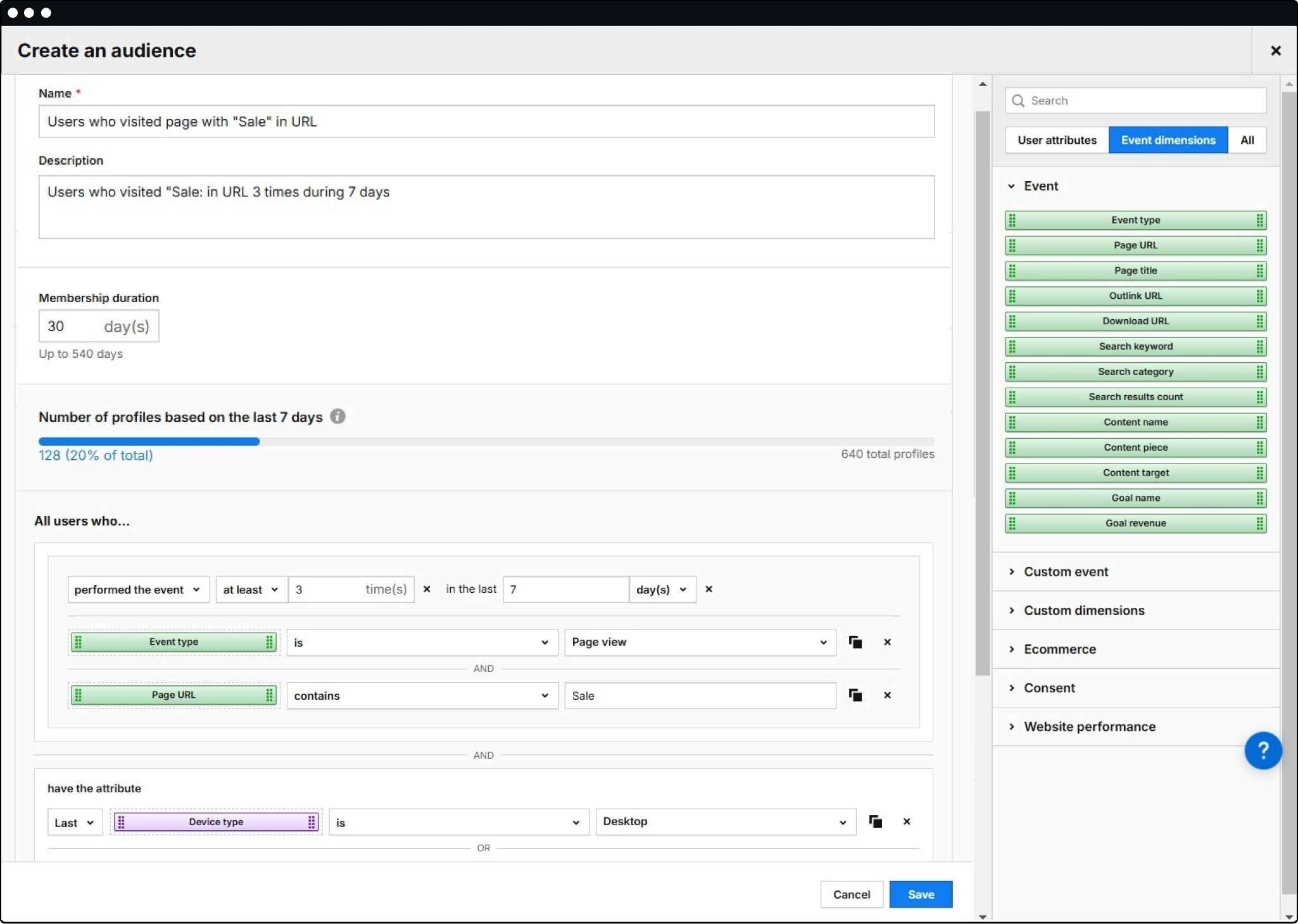
Define the audience
Start by defining the audience you want to target for activation and define the needed criteria. Create rules to filter users based on their behavior, such as page titles containing specific keywords. Optionally, you can set up exclusion criteria to exclude particular users.
Implement triggers
Set up triggers to detect when users meet the criteria defined for the audience. Triggers can be based on user behavior, such as visiting specific pages or engaging with certain content.
Manage consent
Ensure that data collection and activation processes comply with relevant privacy regulations by incorporating consent management. Associate data collection and activation with appropriate consent categories, such as personalization or marketing automation, depending on how the data will be used.
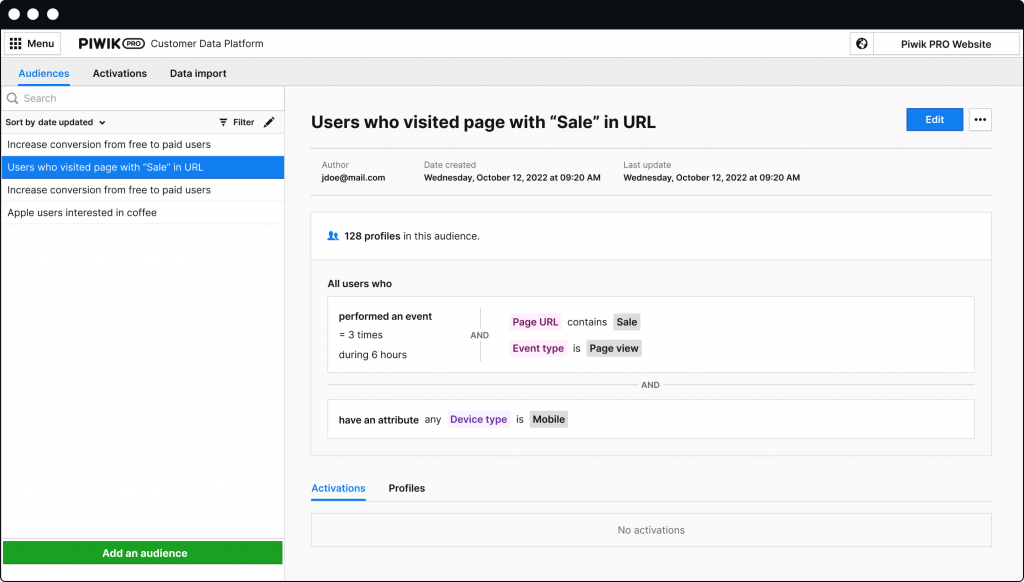
Customize user experience
Use JavaScript code to customize the user experience based on the defined audience. For example, add a navigation item for users who meet the audience criteria.
Track performance
Implement tracking mechanisms to monitor the performance of the activation strategy. This could include tracking impressions and click-through rates (CTR) for the customized user experience elements.
Test and iterate
Test the implementation in a controlled environment to ensure everything works as expected. Continuously monitor and analyze the data to refine audience definitions and activation strategies based on insights gathered from performance metrics.
Enrich your audience data with Piwik PRO
Enriching your audience with Piwik PRO involves a strategic approach that integrates various components to optimize data activation while prioritizing privacy and compliance. You can extend data activation possibilities to numerous destinations through webhooks and automation tools, such as CRM platforms, email marketing tools, and ad platforms.
For more details about activating data, read our articles:
- What is data activation and how does it fit into your data analytics stack
- Customer Data Platform: Generate meaningful insights with customer data activation and import
- 8 customer data platform (CDP) use cases that will drive your business growth
Watch the full episode and learn how to activate data with Piwik PRO CDP
The post Activate data for a personalized customer experience with the Piwik PRO Customer Data Platform appeared first on Piwik PRO.
]]>The post How to use omnichannel analytics for more effective marketing appeared first on Piwik PRO.
]]>
Modern customers interact with brands through various channels. Their interactions can include website visits, mobile app usage, email checks, text messaging, social media browsing, magazine reading, and exposure to outdoor advertising like billboards.
The traditional four-stage customer journey model of awareness, consideration, purchase, and retention, while logical, is rarely followed by consumers.
Users frequently transition between different devices prior to finalizing their purchase, extending the shopping experience over time and making it unpredictable. According to Google, 90% of multiple device owners change devices to complete tasks, with an average of three different combinations of devices used every day.
Customers expect the shopping experience to be as easy and frictionless as possible. As the Gartner 2021 survey showed, creating positive customer experiences can have profound benefits for businesses:
- There’s a 97% chance that customers will spread their good experiences through word of mouth, boosting brand recognition and drawing in new clients.
- 86% of them are likely to spend more, suggesting greater value over the customer’s lifetime and a rise in revenue possibilities.
- There’s an 82% probability they will remain loyal customers, demonstrating the potential for fostering enduring loyalty and repeated transactions.
However, creating smooth customer experiences isn’t easy. Companies tend to struggle with data closed in silos and often lose the big picture while trying to analyze the information they’ve gathered.
These challenges have led omnichannel analytics to grow into one of the most promising solutions. Why? Because its goal is to provide customers with a seamless experience through their entire path to purchase, regardless of the channels they use.
What is omnichannel analytics?
Omnichannel analytics, the foundation of data-driven omnichannel marketing, relies on gathering customer data from all channels used by brands. It’s a customer-centric approach aiming to recreate users’ real paths to conversion, consolidate information from disparate sources and garner a full understanding of consumer actions.
By accessing a 360-degree view of what exactly made a client convert – to buy, send a demo request or register as a user – marketers gain a holistic picture of marketing performance. With that, they are able to evaluate their activities and effectively allocate budget.
Seems simple? In theory – yes. In practice, however, the omnichannel approach’s essence is often lost. Marketers tend to focus on multiplying separate channels and touchpoints rather than creating an ecosystem of seamless connections between them.
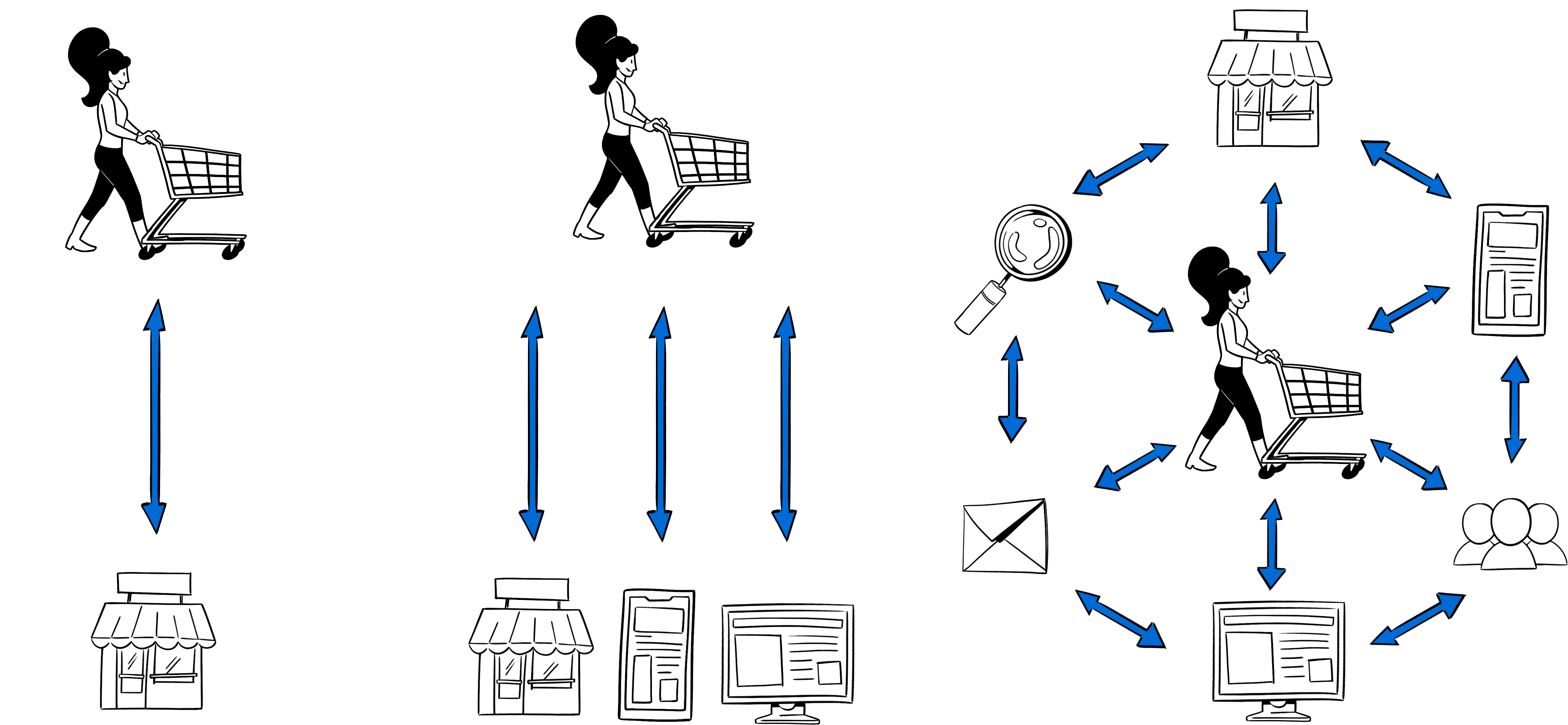
| Single-Channel | Multichannel | Omnichannel |
|---|---|---|
| An approach where a business reaches customers through only one distribution option, like online, face-to-face selling, or traditional retail. | An approach that combines different distribution options to be present when a purchase decision is made. Channels operate independently, offering distinct shopping experiences. | An approach that incorporates all possible touchpoints with a brand, regardless of the purchase point, focusing on integration and consistency across all channels. |
| Single distribution channel. | Multiple independent channels. | Integrating and maintaining consistency of customer experience across all channels. |
| Allows businesses to concentrate on refining one channel, particularly if resources are limited. | Offers flexibility with each channel operating independently. | Provides a seamless experience that focuses on all channels as a whole. |
Why is omnichannel analytics important?
Customers desire a seamless and homogeneous experience across all touchpoints, seeking comfort and loyalty that influence their future purchase decisions.
This isn’t just about securing a one-time sale; it’s about fostering long-term relationships through consistently positive experiences.
By utilizing comprehensive data from various channels, businesses are not confined to the limitations of simplistic attribution models, such as last-click or first-click. These models often fail to capture the full customer journey and don’t provide insights into the underlying motivations of the audience.
With omnichannel analytics, marketers gain a deeper understanding of user motivations, which is crucial for optimizing marketing strategies. This understanding allows them to concentrate resources on channels that drive sales rather than squandering budget on ineffective avenues.
The key lies in recognizing that maintaining and nurturing existing client relationships tends to be more cost-effective and productive than acquiring new ones. By focusing on long-term engagement and satisfaction through a well-integrated omnichannel approach, businesses can enhance customer retention, ultimately leading to sustained revenue growth and stronger brand loyalty.
And this is not just a hollow marketing statement:
- Existing customers also contribute significantly more to a company’s revenue, generating 65% of a company’s revenue compared to new customers, who bring in 35% (source: OnlineDasher)
- They are also 50% more likely to try new products and spend 31% more compared to new customers (source: Invesp)
- In the SaaS industry, it can cost four to five times more to acquire new customers versus retaining current ones (source: HRB)
What are the benefits of omnichannel analytics
Better insight into customer behavior
Omnichannel analytics provides a comprehensive view of customer interactions across various channels, enabling businesses to better understand their audience.
Predictive analytics
By analyzing data from multiple channels, businesses can predict customer behavior and make informed decisions. For example, they can optimize their inventory or logistics resources.
Improved engagement
Omnichannel analytics helps businesses identify the most effective channels for customer engagement and allocate resources accordingly, leading to higher customer satisfaction.
Improved personalization
By focusing on the right channels, businesses can create more experiences tailored to each channel. For example, they may craft more informal communications for TikTok or Instagram rather than targeting customers with the same average messaging at all touchpoints.
Consistent brand experience
Omnichannel analytics helps ensure that customers receive the same level of service and recognition, regardless of the platform they use.
Optimized marketing campaigns
By analyzing the performance of marketing campaigns across various channels, businesses can identify the most successful strategies and channels, leading to more effective marketing executions.
Sample use cases of omnichannel analytics
Healthcare
In the healthcare sector, omnichannel analytics could involve integrating various channels depending on the specific subset being covered. Typically, this can include physical locations, online platforms, mobile applications, and wearables.
By integrating experiences across physical and digital platforms, including mobile and desktop, healthcare provider companies could use omnichannel strategies to provide patients with easy access to health records and benefits such as electronic prescriptions and online doctor appointments.
With unified patient interaction data, healthcare providers can offer personalized patient care. For instance, if patients frequently search online for information about a specific health condition, they might receive tailored educational content or personalized check-up reminders.
By analyzing appointment booking data, healthcare providers can optimize physician schedules and reduce patient wait times in clinics and telehealth appointments.
Finance & Insurance
The finance and insurance industries are at the forefront of digitization, and thus, the integration of data from all channels – including transactions at branches, online banking activities, mobile app usage, and call center interactions – is fundamental to their operations.
With this integrated approach, finance companies can offer personalized financial advice and product recommendations. They can also improve service quality on both digital platforms and in branches and streamline sales processes by providing clients with a seamless experience. For example, if a customer begins a query in the mobile app but then calls a service center, the representative can immediately access the previous interaction, improving customer service quality.
Moreover, omnichannel analytics is fundamental to risk management and fraud detection. Comprehensive data is essential to effectively “feed” the AI and ML systems designed to identify unusual patterns in customer transactions.
Additionally, analyzing data from branch visits and ATM usage helps decision-makers optimize branch locations, ATM placements, and staffing requirements.
Ecommerce
Ecommerce businesses can integrate data from multiple channels such as online stores, mobile app usage, social media interactions, and customer service records.
The omnichannel approach is their answer to the limitations of traditional multichannel marketing tactics, which often failed to build customer loyalty.
Customers’ purchasing intentions often originate on social media before they visit the website, sometimes delaying their purchase decision.
A company can tailor messages to a given stage of the customer journey to sustain their interest. This may involve:
- Using targeted social media advertising on platforms like Facebook.
- Focusing on SEO to improve their products’ visibility and performance in search results.
- Implementing remarketing strategies to re-engage those who visited the website but did not make a purchase.
After a purchase, maintaining the customer relationship becomes vital. Companies can achieve it by integrating data from email and chat to create personalized mailings, including promotions, loyalty program invitations, and cross- or upselling offers.
Finally, analyzing sales and marketing data across channels supports predicting demand patterns, leading to efficient inventory management and reducing the risks of stockouts or excess inventory.
What tools can you use for omnichannel analytics
Customer data platforms (CDPs)
A customer data platform (CDP) is software that consolidates first-party customer data from various sources, including websites, mobile apps, email, and physical stores, to create comprehensive, up-to-date customer profiles.
The primary goal of a CDP is to enhance the effectiveness of marketing strategies by optimizing the timing and precision of messages, offers, and engagement activities through data activation. A CDP enables businesses to fine-tune their marketing and customer engagement strategies more effectively than traditional data management tools.
Customer Relationship Management (CRM) and Enterprise Resource Planning (ERP)
These systems provide a comprehensive view of customer interactions by integrating data across channels, including sales, marketing, and customer service. They facilitate better customer relationship management by consolidating information into a single framework.
Business Intelligence (BI) and data visualization tools
Business intelligence (BI) software utilizes APIs, automation, AI, and other tools to simplify the process of data compilation, organization, analysis, and visualization. Meanwhile, data visualization tools help create visual representations of large data sets. All these tools specialize in deep data analysis, offering critical insights by processing and presenting data from various points and channels.
Data analytics platforms
Data analytics tools are designed to analyze distinct aspects of the customer experience, such as purchase behavior or interactions with the product or website. They vary in their specific features, usability, and focus areas, allowing businesses to choose the one that best fits their unique data analysis needs and objectives.
When it comes to omnichannel analytics, one of the most optimal options is an integrated analytics platform. These platforms provide a more expansive range of analytical capabilities that extend beyond marketing use cases. They offer insights into operational efficiency, financial performance, and market trends, catering to various business intelligence needs.
Integrated analytics platforms offer seamless integrations of tools and data sources while providing you with features to effectively act on the analyzed data, letting you utilize them for a multitude of marketing, sales and business use cases.
How to choose the right tool for omnichannel analytics
As businesses grow, diversify their product lines, or enter new markets, the need for an extendable tool becomes critical. Such a tool should help them adapt to changes by incorporating new data sources, metrics, or advanced features like AI and ML as required. Importantly, it should integrate seamlessly with the existing infrastructure, enhancing it rather than necessitating re-platforming or redesigning data flows.
Scalability is equally crucial, especially as the volume of data requiring processing grows exponentially. A scalable tool is essential to handle this increasing volume efficiently and maintain performance standards.
In a data-centric world, security concerns are paramount, as any data breaches can lead to significant financial and reputational damage. That’s why the tool should adopt sufficient privacy and security measures.
In summary, extendability, scalability, and robust security are foundational elements for any business tool, especially in an era where data is a vital asset for business growth and innovation
A step-by-step process for implementing omnichannel analytics
Selecting a platform:
Begin by choosing a suitable platform. The market offers a wide variety of tools, so your choice should depend on your budget, objectives, and considerations for future scalability and integration capabilities. You must determine your data volume and sources, and assess your customization needs.
Integrating data sources:
After selecting the platform, connect your data to it. This process often involves integrating other tools, such as email software, social media channels, online advertising platforms, and more. Ensure that data quality and consistency are maintained during this integration.
Customizing your reports and dashboards:
Once connected, you will be able to use various reporting features to cater to your company’s needs. For example, you can create dashboards depicting specific channels, demographics, or customer segments. Customize them to align with your specific business objectives, whether that involves comparing trends, analyzing the impacts of ads, or examining product performance within a category.
Measuring key metrics:
Choose what metrics you want to track first. To simplify the process, consider starting with three main metrics: user engagement, attribution, and revenue. Understanding these is vital for advancing to more complex analyses, such as assessing lead quality and conversion rates. Each of these metrics offers valuable insights into business performance.
Businesses often fall into the trap of focusing on vanity metrics that don’t directly impact their business goals, or trying to improve every metric. Instead, concentrate on actionable metrics that directly influence your business strategy and decision-making processes.
The most significant challenges to avoid when implementing omnichannel analytics starts with three “lacks”:
- Lack of a clear strategy, which leads to inefficient use of resources.
- Lack of a unified customer view that results in inconsistent and irrelevant marketing messages.
- Lack of the right technology that makes the integration of data and channels difficult.
How can you use Piwik PRO in omnichannel analytics
The main point of an omnichannel approach is to break down data silos to get a comprehensive picture of user behavior. Therefore, technology that successfully integrates data from a variety of sources is at the heart of the omnichannel approach.
With this in mind, an integrated analytics platform can be considered the core of omnichannel analytics. This is where data is gathered, cleaned, consolidated, analyzed and, crucially, transformed into actionable insights that can be acted on by different teams within an organization.
However, data integration is also the most challenging part of the process. Data may be stored in different systems and in various formats. It is often incomplete, inconsistent, or very complex. Not to mention there are still many companies that handle data manually, keeping it in spreadsheets. And that’s just the first part of the problem. Once data is gathered and collected, it must be utilized to derive meaningful information. Otherwise, all the effort has no real business significance.
This is why the Piwik PRO Analytics Suite should be on your shortlist when evaluating integrated data platforms available on the market. The platform boasts key data integration and activation features, offering broad possibilities for reaching customers in personalized ways, improving conversions and driving better business results. You can easily integrate all the modules of Piwik PRO Analytics Suite, including the Customer Data Platform (CDP), supply the platform with data ingested from different tools and export the data to other tools to activate it.
If you want to find out more about Piwik PRO’s integrated analytics platform, reach out to us:
The post How to use omnichannel analytics for more effective marketing appeared first on Piwik PRO.
]]>The post Contextual targeting – a privacy-friendly alternative to invasive ad tracking appeared first on Piwik PRO.
]]>Though Google has postponed the end of cookies several times, advertisers relieved by the 2024 delay shouldn’t get too comfortable. Popular advertising methods, like behavioral targeting, have become less reliable and sustainable.
As of July 22, 2024, Google announced it wouldn’t deprecate third-party cookies in Chrome. Instead, Google has now said it’s going to let users decide whether they will be tracked by cookies.
However, with third-party cookies’ decreasing effectiveness, the move away from them by major browsers, additional restrictions planned by Google and the industry’s preference for privacy-first technologies, third-party cookies are bound to become a thing of the past.
Marketers and advertisers are now shifting focus to acquiring first- and zero-party data, where consent is given knowingly, as well as revisiting methods such as contextual targeting. It has been known since the dawn of online advertising and is now circling back in a completely new form.
It’s time to reshape your advertising strategy to serve ads that grasp users’ attention while not invading their privacy. Is contextual targeting the silver bullet?
What is contextual targeting?
Contextual targeting is a form of targeted advertising that focuses on aligning ads with the content of a particular page rather than targeting based on user data.
This method examines factors like keywords, topics, language, and location to match ads with relevant content and gain visitors’ attention without invading their privacy.
The essence of contextual targeting is ensuring that ad content is relevant and timely for viewers while respecting their privacy rights.
The return of contextual targeting
Contextual targeting is hardly a new form of advertising – it has been around since pretty much the dawn of digital advertising.
Initially, it worked by matching the content of a webpage with the content of an ad based on keywords.
Given the questionable effectiveness of this method and the lax approach to privacy rights on the Internet, businesses shifted toward behavioral targeting to serve more personalized and, as a result, more effective ads.
The rule was simple: the more personalized the ad is, the more impact it has.
90% of leading marketers say personalization significantly contributes to business profitability.
Think with Google
Back then, it all made sense. First, before the enforcement of stringent privacy laws like GDPR, user data was a low-hanging fruit. Second, personalization was and still is a valid way of driving conversions.
This pitch-perfect theory, however, didn’t hold up when tested in the real world, which changed significantly in the meantime.
Behavioral targeting and privacy issues
The problem with behavioral targeting was that marketers rarely bothered to align with the particular stage of the buyer’s journey. For example, it meant that a one-time coffee-maker purchase labeled you a coffee-maker lover indefinitely.
When users were being followed on a massive scale by highly personalized but often not very relevant ads, intrusive remarketing became annoying for them. Eventually, this led to so-called banner blindness, which was unacceptable for companies.
Just 29% of RSA’s respondents agreed that handing over their data resulted in better products or services, down from 31% the previous year.
Insider Intelligence
More than half of the US Facebook users were “not very” or “not at all comfortable” with Facebook tracking their activity to compile their “ad preferences”.
Banner blindness was followed by multiple data breaches and misuses, such as Cambridge Analytica and the so-called Russia Gate, to name but a few, that exposed how maleficent data-based business models could be. Users were confronted with the harsh reality that “if something is free, you are the product”.
The rise in privacy laws and consumer concerns around data privacy necessitated a remodeling of Big Tech’s strategies. Thus, contextual targeting re-emerged on the runway, albeit in a more sophisticated and refreshed version.
Contextual targeting is a safer alternative to behavioral targeting, providing a privacy-compliant way to monetize websites and apps amidst tightening data privacy regulations such as GDPR and CCPA.
How does contextual targeting work?
The modern iteration of contextual targeting has been fueled by AI algorithms that are fully capable of understanding the nuances of the content, summarizing it, and extracting the most relevant information. This allows marketers to match ads to content more precisely and place ads where they are more likely to resonate with the audience. Content matching no longer relies solely on keywords.
What is more, AI enables the use of first-party datasets to predict how users will consume content. AI can find behavioral patterns based on previous user behavior, bridging the gap between contextual and behavioral targeting techniques while prioritizing privacy, as it doesn’t require personal information.
The last aspect is contextual data. Previously, contextual targeting was based on a limited amount of data, which significantly impacted its effectiveness. Now, the range of available contextual data is broader. It can include local weather, time of day, local current events and trends, and the content that is being presented to viewers.
AI techniques that support modern contextual targeting
Natural language processing (NLP)
Natural language processing (NLP), a subset of AI focused on enabling computers to understand text or speech in a human-like way, is crucial in revitalizing contextual targeting.
AI equipped with natural language processing (NLP) algorithms can understand content not only by scanning keywords, but also by analyzing the overall sentiment and intent of the content. By understanding the content’s intent, marketers can make ads more relevant to users’ needs.
Image and video recognition
For years, images were a blind spot for search robots. They could not go beyond analyzing meta descriptions such as ALTs and titles and could not “see” the content of the graphics. It was especially problematic due to the rise of video content, widely praised as the most engaging format.
Advancements in image recognition technology have enabled AI to comprehend imagery and video content on a page seamlessly in real time, filling a huge gap and supporting better ad targeting.
Machine learning (ML)
Machine learning (ML) enables a continuous learning cycle where the system improves as more data is collected and analyzed over time.
This leads to a better understanding of which combinations of contextual data contribute to improved ad performance. This way, advertisers can leverage a potent combination of contextual data, machine learning, and AI for smarter advertising strategies.
Contextual vs. behavioral targeting
| AI-driven contextual targeting | Behavioral targeting | |
|---|---|---|
| What is it? | AI-driven contextual targeting analyzes content using various AI technologies such as natural language processing (NLP), machine learning (ML), and image & video recognition to assess text, images, page structure, and other content elements and serve relevant ads. | Behavioral targeting utilizes browsing history, clicks, purchases, and other behavioral indicators to show targeted ads. |
| How does it affect user privacy? | Contextual targeted ads don’t rely on personal data. Thus, they are unlikely to be impacted by privacy concerns. | Behavioral targeting is based on personal browsing data, and as such, it can be perceived as intrusive. |
| How did it develop over time? | Contextual targeting has been considered less effective than behavioral targeting due to limited real-time adjustment capacities, but thanks to AI this belief is changing. With AI capable of “understanding” a website’s content, contextual ads can be both precise and privacy-friendly. | Behavioral targeting, once a marketer’s gem, gradually lost its sheen due to overuse. Incessant personalized ads began to unnerve users, making them feel stalked across the web. Although these ads were personalized, their relevance decreased over time. |
| What does it look like in practice? | If a user is reading a blog about gardening, they may see ads for gardening tools. | If a user often shops online for gardening tools, they may see ads for similar products on different websites. |
Contextual targeting in advertising
The latest iteration of contextual targeting, supported by AI models, has grown into one of the most promising privacy-first targeting methods in the advertising industry. This targeting method resonates with users’ need for personalized experiences and, simultaneously, with their reluctance to share their data too easily.
Only 33% of Americans believe that companies are using their personal information responsibly.
McKinsey & Company
Contextual targeting in Google Ads
What does contextual targeting look like on one of the most popular advertising platforms in the world? The process is quite standard.
Setting up campaign parameters
During the setup phase of their ad campaign, advertisers pinpoint the specific contextual categories and/or keywords they wish to bid on, referred to by the platform as “Topics.” Once the campaign parameters, including reach preferences, have been set, the campaign is ready for launch.
Matching ads with relevant content
Google then sifts through the Google Display Network (GDN) to identify publishers that resonate with the campaign’s contextual benchmarks.
Placing the ads
The creative assets provided by the advertiser are then showcased on the website(s) selected by Google. The scope of ad placement within the GDN is guided by the advertiser’s reach preferences.
Contextual targeting – pros and cons
Pros
- Privacy compliance: Adheres to data privacy regulations like the GDPR.
- Relevancy: Ads are relevant to content, enhancing user experience.
- Less intrusive: Seen as less annoying compared to behaviorally targeted ads.
- Trust building: Helps build trust with the audience.
Cons
- Limited personalization: Lacks personalization as it doesn’t utilize user data.
- Time-consuming: Requires time and attention in selecting appropriate keywords and content for targeting.
- Scaling challenges: Difficult to scale, especially in branded contexts.
- Broad content issues: May not be effective on sites with broad or generic content.
Conclusion
Contextual targeting is emerging as one of the most promising methods of privacy-conscious advertising, facilitating more organic and less intrusive ad deliveries without compromising performance. The modern iteration of contextual targeting is significantly enhanced by advancements in AI that enable a more nuanced understanding and analysis of content regardless of the device on which it is displayed.
The impending phase-out of third-party cookies, assisted by Google’s initiative to sunset them, accentuates the relevance and timeliness of contextual targeting as a viable, privacy-friendly alternative.
The post Contextual targeting – a privacy-friendly alternative to invasive ad tracking appeared first on Piwik PRO.
]]>The post 8 customer data platform (CDP) use cases that will drive your business growth appeared first on Piwik PRO.
]]>This blog post will explore the concept of a customer data platform (CDP) and demonstrate how it can benefit modern companies. You will learn how to apply a CDP to your company’s operations to help it achieve its goals.
What is a customer data platform (CDP)
A CDP is a single platform that facilitates customer data collection, management, transformation and activation.
The traditional definition of a CDP states that “a customer data platform is packaged software that creates a persistent, unified customer database that is accessible to other systems.”
Here is how we can unpack it:
- “Packaged software” means that a CDP is a prebuilt system whose setup and management don’t require high technical skills as many other types of tools, such as data warehouses, and is associated with less risk, cost and implementation time.
- A CDP “creates a persistent, unified customer database” containing individual customer and visitor profiles. The platform captures and links information related to each user and stores it, expanding the database over time.
- Data in a CDP is also “accessible to other systems,” meaning you can find further uses for the stored information. For example, you could send the data to sales tools to improve how you manage interactions with current and prospective customers.
Advanced CDPs can also store machine-learning-powered predictions, such as the likelihood to purchase.
Piwik PRO’s CDP represents a unique type of software. The CDP is integrated with a web and app analytics platform, rather than seeking to replace it, which is the case with many other CDPs available on the market.
Key functionalities of a customer data platform
Let’s walk through a few specific aspects of a CDP and how Piwik PRO’s CDP benefits you.
Collecting first-party data
A CDP consists of individual-level data from the organization’s online and offline sources. This data reflects a company’s current and prospective customers and their behaviors. It is also more precise than second- or third-party data collected by another entity.
Operating on first-party data can help you comply with international data protection laws. You are more likely to obtain valid consent to the collection of first-party data by asking users directly.
Data import won’t be available in Piwik PRO CDP Beta. In future versions we plan to enable data imports from your CRM, ecommerce platform, data warehouse and other tools using incoming webhooks and no-code automation platforms. A built-in integration with web and app Analytics and Tag Manager will enable you to benefit from a steady stream of valuable user data.
Read more about the benefits of first-party data: Why first-party data is the most valuable to marketers [Updated]
Data privacy and management
The CDP enables you to address data quality at the point of collection, so you’re able to retain its integrity throughout the data pipeline. You have governance over the data you collect and maintain in a CDP and control the sources of information.
It provides a single source of truth regarding a customer’s data and the data processing purposes users have agreed to. It lets you quickly modify or delete specific user data if requested.
With Piwik PRO CDP, you can:
- Integrate Consent Manager and make actions related to activation dependent on whether users grant consent. You can keep the latest consent information in the visitor profile. Moreover, webhooks can be fired based on the consent category in the profile.
- Handle sensitive data. For example, you can add an extra layer of privacy by replacing identifiable data with custom scoring values.
In the future, we have plans to enable an activation log.
Single customer view
Because the collected information gets unified and attributed to the same user, you are able to access it in single customer views. Customer profiles include all the information you’ve gathered, like demographics, purchase history, behavioral data, etc.
Knowing all touchpoints of the customer journey provides insights into their interests, what they’re likely to buy next, or if they need a personal discount to re-engage after some time of inactivity.
Piwik PRO CDP allows you to explore single customer views.
Find out more about single customer views: Single customer view (SCV): what is it and how does it work?
Identity resolution
A CDP can attribute all disparate data from multiple channels to the same customer profile. User profiles are created by merging the data using matching identifiers, such as e-mail address, user ID or cookie ID.
The ability to use multiple identifiers differs from options in analytics tracking tools – these often rely on cookies that tie the data to a browser, not a user. Connecting cookie-based user data to other tools and systems can lead to downstream data quality issues. For example, you will have no way of differentiating between individuals using the same device within the same cookie. Plus, privacy-focused legal and technological solutions make relying on cookies a short-term solution.
The Piwik PRO CDP works on both:
- Persistent identifiers (like user ID), which is how most CDPs on the market work already.
- Non-persistent identifiers (like session ID) for in-session personalization or activations. If there is no other data on a visitor, the session ID will be dropped and the profile will become unusable after the session ends.
Non-persistent, short-term identifiers enable you to perform the following actions:
- Open a chat window during the session for visitors that have bumped on the pricing page twice within the last 5 minutes.
- Alter the look-and-feel of the site to allow more contextual ad slots on it for those who have opted out of targeted advertising.
- Send warnings to your company Slack in case of rage clicks on your most important contact form.
Audience segmentation
Segmentation allows you to create audiences that group customer profiles matching certain conditions.
Once audience segments are built in your CDP, they can be forwarded to downstream tools in your growth stack for data activation. Centralizing audience segmentation saves time on audience building and ensures the segments are consistent and up-to-date across systems.
Piwik PRO’s CDP lets you build audiences based on attributes, such as data relating to:
- Traffic, e.g. source, medium, keyword, channel, and campaign details
- Device and platform
- Location
- Consent
- Other details, like last order time or total revenue
This information is gathered through analytics events and matched with the user profile with first-party identifiers, such as e-mail or user ID.
Another option is to set up audiences based on user behavior (event dimensions). In this case, behavioral conditions are based on the number of occurrences of events over a period of time. For example, you may segment profiles of users who visited specific product pages a few times in a specified period.
By combining the CDP with Tag Manager, you’re able to fire tags based on audience conditions.
Data activation
Data activation involves putting customer data insights into action in other systems and tools. For example, you can add users from a given audience to an email list and send them a discount code for a product. Or you can show an ad banner on the website with a complementary product based on a customer’s previous purchases.
All of this is possible through integrations offered directly from the CDP, enabling businesses to access the data where and when they need it and relieving engineers of managing third-party code.
Piwik PRO’s CDP lets you activate data by sending selected attributes to thousands of destinations through webhooks and automation tools – CRM, ad platforms, email marketing tools, internal communication channels and more. Example platforms include Hubspot, Slack, Mailchimp, Google Ads, Shopify, Marketo and others.
You can also create activations through templates and an intuitive editor without involving tech teams. If needed, this allows you to define more advanced integrations.
Learn more about data activation: What is data activation and how does it fit into your data analytics stack.
Work in real-time
CDPs let marketers work in real-time, which improves the process of preparing audience segments or targeting users with relevant content.
Customer information is also reflected in real-time in the updated profiles. As a result, the data sets expand, and you can constantly access up-to-date customer details.
Now that we’ve defined what a CDP is and how you can use it, it’s equally important to understand the functionalities of similar types of data management software and learn the nuances that determine the best applications of them.
CDP vs. DMP
A DMP predominantly influences advertising to better target ads and reach audiences. DMPs mostly rely on third-party data and reflect anonymous customer identifiers (like cookies, etc.), making them systems with less accurate data. Due to the rise of GDPR-friendly solutions, DMPs are far from optimal for managing and utilizing user data.
Read about 4 key differences between data management platforms and customer data platforms.
CDP vs. CRM
A CRM reports on current or potential customers, so it will primarily help you with analyzing the sales pipeline and forecasting. CRMs cannot register offline data unless it’s manually entered, so you would mainly use them with online data sources.
8 customer data platform (CDP) use cases
The capabilities of CDPs allow you to achieve several things that can positively influence business growth. Below, we elaborate on eight of them.
1. Improving operational efficiency
A fundamental aspect of any enterprise-grade CDP is its ability to unify data from various data-producing channels and platforms.
A CDP resolves the issue of data silos – situations when an assortment of data is available to one department but isolated from the rest of the organization. Data silos make the working environment less collaborative, slow the pace and productivity of the company, and threaten the accuracy of customer profile data.
Removing data silos improves efficiency and productivity and makes it easier for teams like marketing, sales, support, customer success, product and others to collaborate, exchange user data and complement each other’s efforts.
With a CDP, the organization works on more accurate and complete customer profile data and is able to automate many of its operations. For example, since a CDP creates individualized profiles for your customers and prospects, you won’t have to spend hours manually inputting your audience’s information and verifying its correctness.
2. Developing targeted marketing campaigns
A CDP enables real-time campaign activation, allowing marketers to deliver highly-personalized marketing campaigns across all areas of customer engagement. You can effectively use a CDP with a marketing automation platform, simplifying time-consuming activities like lead qualification and campaign creation.
With a CDP, you can quickly decide what content to target visitors with and what channel will be the most effective. At the same time, you can measure and track the performance of the campaigns and channels to refine and improve the assets or messaging in the next campaign.
For example, you could segment users who often open your marketing emails and have browsed products on your website but abandoned their shopping carts. Then, you can send reminders about viewed products to re-engage your audience.
Similarly, a CDP can tell you what message not to send to a customer. You can combine online data from your digital channels with offline customer data from a POS system. A complete view of the customer could prompt you to pinpoint those who have recently purchased an item in your physical store. Then, you can remove them from your next social media ad campaign for that exact item, letting you focus resources on those who are more likely to buy it.
3. Personalizing the customer experience
More than 77% of people choose, recommend and pay more for brands that provide personalized experiences tailored to their interests. Personalized messaging and interactions are more relevant, timely and effective in moving users toward engagement, conversion and customer loyalty.
From the data collected through your sources and stored in a CDP, you will know how users move around your website, what actions they take and whether they complete the funnels. Personalization can involve content recommendations and offers that are contextually added to the site based on a visitor’s past behavior. It can also consist of displaying messages matching the user’s industry, appealing to them with relevant visuals or colors, referring to the user by their company or personal name or prefilling forms with previously input data.
For example, imagine a potential customer browsing your sports website. They have viewed several pages for products in the same category – tennis equipment. Then, the user left your site without making a purchase. The next time they are on your website, you can set your homepage to display tennis equipment offers rather than a generic assortment of sports items.
4. Optimizing customer journeys
A CDP allows you to track a customer’s entire journey and assemble every interaction a prospect has had with your business. But the role of a CDP is far from over after a user makes their first purchase. It helps you optimize every stage of the customer journey, including retention and advocacy.
Your sales team can view where your leads are in the sales funnel to reach out with the right information at the most suitable time. Similarly, marketers can analyze where users are in their journeys, how they move throughout your site, and where they drop off.
To acquire more customers for your business, you must understand which interactions encouraged them to convert into paying clients. You can see which content is not as effective and requires improvement along with what resonates with users the most and should be replicated. This way, you can focus your resources on the strategies that drive the best results for your company.
5. Enhancing customer support
According to research from Zendesk, 66% of B2B customers will stop buying from a brand after a bad customer service interaction.
A CDP offers valuable insights for anyone who contributes to the customer experience in their everyday work, including customer success teams and customer support representatives. They are at the front of customer interactions daily, and they significantly impact overall business performance and long-term customer loyalty.
Agents that interact with customers have immediate access to their detailed customer profiles. The agent can efficiently and effectively answer customers’ questions, make recommendations, or steer conversations toward new purchases or brand experiences. This can lead to meeting their needs quickly and forming better customer relationships.
When agents understand details such as how users are engaging with the brand or what their customer status is, they can easily tailor the conversation to them. There is no need to dig for information, figure out the most accurate details or put customers on hold for long periods to find relevant data.
For example, agents can now reference what product the customer purchased and the channel it was purchased through and get an idea of what topics on your site interest them. They can also see when and what previous interactions occurred with the company, such as opened tickets and their status, issues or requests discussed in conversations to date. This way, they can refer and respond to them and close the tickets faster.
6. Identifying high-value customers
Having all your customer data housed in one spot will help you identify the customers who bring your company the most value. You can do this by analyzing the users’ purchasing habits and history. It’s no secret that a customer who is either spending a lot with you or purchasing regularly is one of your most valuable customers.
Your best customers are also those who, on top of buying from you, frequently interact with your brand, whether through social media or email or by leaving positive reviews on third-party pages. Nurturing and retaining those segments should be a priority for you.
You can also identify shared characteristics of your best customers, such as demographic details (age, location, occupation or industry they operate in) or behavioral data (most visited pages, common user flows on your site or app, most purchased products or services, etc.).
This information allows you to create specific campaigns and customer journeys to target lookalike audiences. It’s worth nudging the users currently in your database who share these traits and approaching them with relevant content that will encourage them to get your product.
7. Preventing churn
A CDP can be useful in pinpointing customers who might be close to churning.
A declining number of interactions with your brand, like fewer email opens, social media or blog engagements, or a decrease in product adoption, may indicate a weaker bond between your business and a customer.
With a CDP, you can identify such individuals and get a step ahead by improving the messaging or experience. For example, you can help show customers the features of your product, or send a time-limited promo code to apply to their subscription and give them more time to try your product for less.
8. Identifying cross-sell and upsell opportunities
Apart from retaining customers, a CDP allows you to discover cross-sell or upsell opportunities among your existing clients. You can hone in on what the customer may need next with information on products or services purchased in the past, the timing of previous purchases, communication preferences and loyalty status.
A CDP solves major issues that often impede a brand’s ability to convert cross-sell and upsell opportunities. These include data silos, problematic identity resolution and the lack of real-time access to data.
For example, you can use a CDP to look at the current customers who use your email software and have been browsing pages on your other products. They may have recently started consuming more of your content on product use cases and features, and visiting pricing and contact pages. Consider targeting these users with a promo code for your other product or start a dedicated campaign with content on using your products together.
How to choose the right CDP for your business
Before deciding what CDP to use, you need to think carefully about your specific use cases and identify a CDP that most closely addresses your needs.
Ask yourself the following questions:
- How often do you interact with your customers and visitors?
- What platforms do you use to reach and communicate with them?
- What are their needs and behavior patterns?
- What tools currently handle your customer data?
- How are these tools connected to each other?
Examine the scale of your customer outreach, the depth of integration with your existing systems and your budget. Discuss the needs and expectations of the key stakeholders, especially those who regularly interact with customer data. Address their concerns and plan out a smooth transition, guaranteeing the CDP works with your current tools.
We are reinventing the Piwik PRO CDP, equipping it with extensive functionalities that will make it an essential component of any enterprise-level analytics stack.
The module will allow you to:
- Collect and integrate customer data from multiple sources, including web/mobile SDKs (soon also: online forms, CRM systems, e-commerce platforms, and social media).
- Segment customers based on their behavior and demographics.
- Trigger personalized marketing campaigns based on real-time customer activity, such as abandoned cart recovery emails or personalized recommendations.
- Monitor and measure the performance of the CDP.
Read more about our CDP’s features and learn why it could be the right fit for your company.
Free comparison of 7 enterprise-ready customer data platforms
Get a detailed overview of their characteristics and choose the right CDP for your company.
Final points on customer data platforms
We hope you now have some idea of how your organization can apply the features of a CDP to its processes and drive business results.
Your company has a shot at bridging potential information gaps, enhancing data integrity across departments and stitching together channels, touchpoints and devices.
We’ve published a few other blog posts related to Customer Data Platforms that may help you get more familiar with these systems:
- Customer data platforms: The best choice in the post-GDPR landscape
- How Analytics & Customer Data Platform Can Help You Track the Full Customer Journey
- What is Data Activation and How Does it Work?
If you have any remaining questions about the use cases of Piwik PRO’s CDP, reach out to us:
The post 8 customer data platform (CDP) use cases that will drive your business growth appeared first on Piwik PRO.
]]>The post How to perform successful audience targeting with a CDP appeared first on Piwik PRO.
]]>If you want to reach your target audience without wasting resources on the wrong crowd, your best shot is to use the user data your company already has. You will need to scan through the data to gain insights about visitors and customers, define relevant user segments, and address their needs with applicable campaigns.
Technological advances can make customer targeting easier, and the name of the game is the customer data platform (CDP). This is a tool that lets you integrate data from numerous sources to build highly customizable audiences that different departments at your company can apply to their work.
Whether it’s improving the quality and capabilities of your product, adapting marketing and sales communications to your customers’ preferences, or adjusting interactions with support, a CDP will help you create a better customer experience.
Read on to learn about choosing audience segments for targeting, what you can do to get users to convert, and how a CDP can help you do it efficiently.
What is audience targeting
Audience targeting means dividing consumers into segments based on specific criteria, such as interests, behavior or demographics, and targeting them with relevant content through their preferred channel.
Effective audience targeting engages visitors and customers to draw them toward your brand, help them move down the marketing funnel, and get them to convert. You can adjust your messaging and lower the odds of wasting resources and budget on people who aren’t likely to be interested in your offer.
Consider your Facebook and Google Analytics campaigns. Both platforms provide audience targeting, but that comes with a price. Your options are limited, and you have to work on separate data sets. Building intricate audiences isn’t possible if you only use Facebook, Google Analytics, or another similar tool that serves just one purpose.
So, what tool do you need to conduct successful audience targeting?
CDP – the game changer in targeting audiences
A customer data platform (CDP) is a flexible and interconnected piece of software that can be easily linked with every element of your marketing stack.
One of the key advantages is that a CDP facilitates the integration of data from a range of first-party sources, working across channels and devices.
This is critical because each department handles its data sets differently. Marketing keeps data in web analytics and ad platforms, whereas sales and customer success teams store their data in a CRM and live chat, and so on. All these systems contain siloed data on purchase history, transactional details, web and in-app actions, user personas, customer interests, and more.
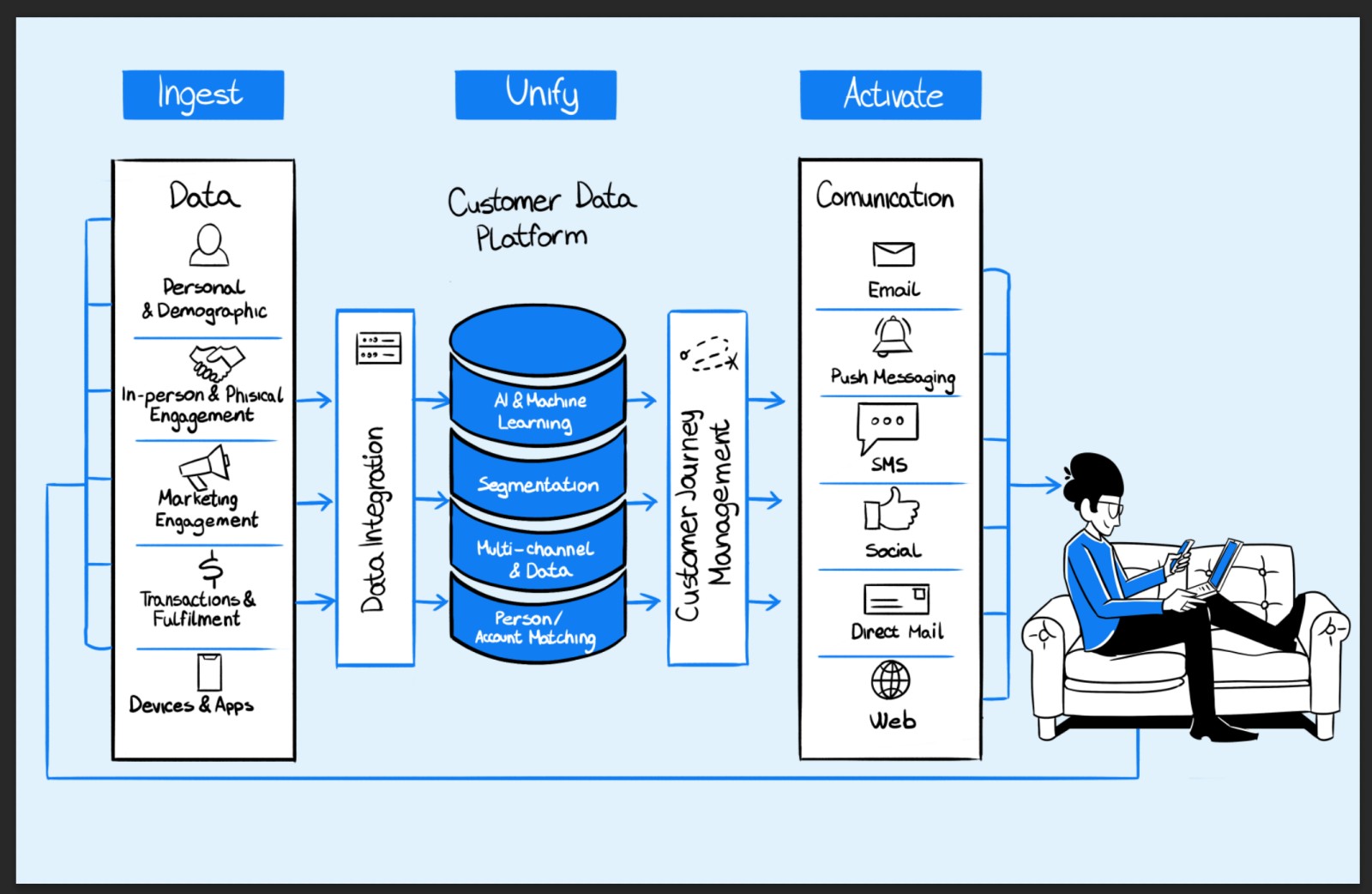
A customer data platform lets you combine data from sources like:
- Ad platforms
- Ad networks
- DSPs
- Analytics platforms
- CRM
- Analytics
- Ecommerce systems
- Offline sources
- Lead capture forms
- Data warehouses
A CDP allows you to build persistent, highly complex single customer views, serving as principal sources of information for effective personalization and informed decision-making. Each 360-degree customer profile in a CDP contains various attributes representing each customer’s details.
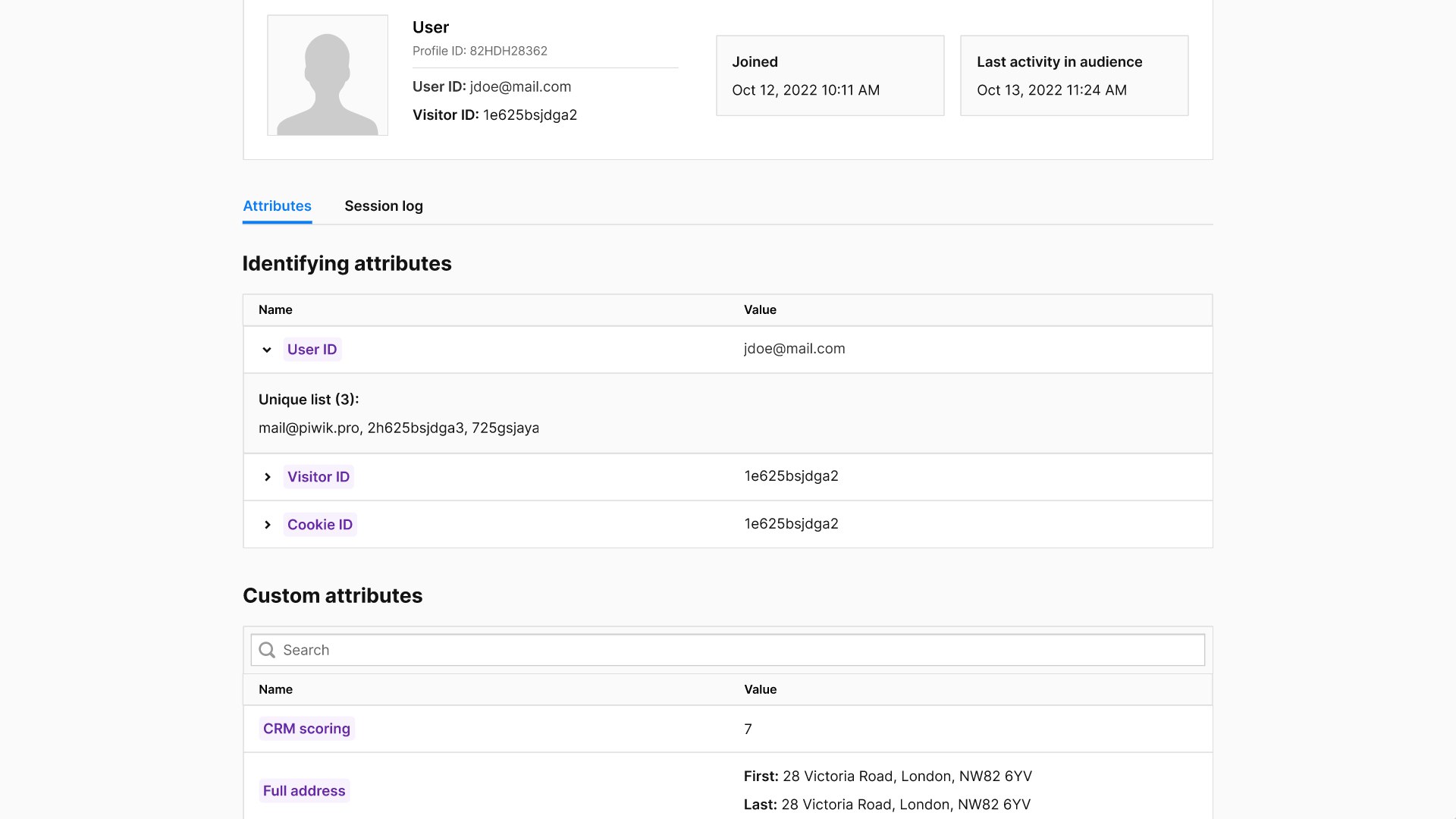
You can also develop custom audiences created by matching and filtering customer profiles based on selected attributes and adding them to specific audience segments.
Another defining feature of CDPs is that they are created to let marketers work in real-time. It’s one of the strongest aspects of these platforms, as every action your customers take is reflected in updated and enriched profiles. Furthermore, it lets you act on new information straight from the platform.
Last but not least, a CDP is predominantly fueled by first-party data. For marketers and advertisers, this is the most valuable type of data. It comes directly from your customers and visitors, meaning you can expect it to offer the highest levels of precision and reliability. At the same time, first-party data translates into legal compliance, keeping you aligned with GDPR and the ePrivacy directive. You acquire this data transparently after receiving appropriate consent from visitors, plus you are in charge of deciding how the data is used, managed, and stored.
You can take advantage of these benefits in Piwik PRO’s CDP. It allows you to combine data from numerous sources into a single customer view and construct comprehensive audience segments.
However, the platform’s main asset is that it enables data activation. This means that you will be able to send all the accumulated data to other tools. You then act on your insights to provide a personalized customer experience and optimize your campaigns.
Read on about data activation and how it fits into your data analytics stack.
How to use a CDP for effective audience targeting
There are two fundamental stages you should focus on to successfully target your audience:
1. Building complex audience segments
As you conduct marketing and advertising campaigns, you collect invaluable user data. Use a CDP to connect data from various tools to get a complete picture of your users.
After gathering customer data, you should analyze it to recognize trends and patterns in customers’ traits and behavior. Using this information, you will be able to segment your audience. This involves selecting relevant attributes and filtering the data to identify a target audience that matches them.
You have a lot of flexibility in segmenting your audience – for example, you can create a group of:
- People who have abandoned their shopping carts
- Users who live in a specific country or region or communicate in a particular language
- People who live in cities, small towns or rural areas
- Visitors who have or haven’t given consent or gave consent only for specific processing purposes
- People who have completed specific goals – downloaded a whitepaper or ebook, visited a contact or demo page, or submitted a form
Your segments can be much more complex too. They can combine countless user characteristics and behaviors, allowing you to slice the segments razor-thin. This will significantly boost the promotional reach of your ads and offers.
For example, if you work at a telecom company, you can segment users that match all the following criteria:
- Has been a customer for 3 years
- Is a business client
- Bought at least one additional phone number within this year
- Contracted for a minimum subscription of $35/month
- Uses an iPhone
- Twice refused to extend the subscription via call center, only 2 months left before termination
How do you decide what segments you should build? Start by answering the following questions:
- Who are the potential customers I’m trying to reach?
- What needs do they have that my product or service can address?
- What traits or behaviors do my current customers tend to have in common?
- What are my customers’ buying habits?
- What channels should I use to reach them?
- What type of content do they engage with the most?
Always build segments focused around your business goals.
Pay attention to the segments most likely to prove profitable for your organization. The most receptive segments should lead to a higher ROI and generate higher customer lifetime value (CLV) in the long run.
2. Activating the data
Once you’ve decided on the segments, you can activate your audience data by sending it to other tools and acting on the insights you gain from analyzing it.
Examples of data activation include:
- Delivering ads that resonate with visitors.
- Running an A/B test to see which version of a message, page, or ad converts better.
- Showing personalized content to users, such as a home page or landing page, to improve customer experience and display the right message to the right user.
- Sending a targeted email based on the users’ interests or demographic characteristics.
- Integrating web or app data about user activity (visited pages, last activity, goals achieved) with a CRM to uncover and prevent a potential churn.
The way to draw people into the orbit of your products or services is to leverage the typical characteristics of users who purchase from you. This is possible because a CDP helps you make your audiences as granular as possible and implement a “segment of one.” In other words, you treat an individual user as your audience and provide one-to-one personalization.
This type of personalization allows you to wield more influence when targeting your audience with a compelling message, both in the B2B and B2C sectors. You can make the members of your audience feel like you understand and value their needs and are able to satisfy their expectations.
Challenges in audience targeting to watch out for
Even if you follow advice from the previous chapters, you still need to watch out for several challenges. Any mistakes in the following aspects can hinder the execution of your audience targeting strategy:
Targeting the right size and type of audience
You might struggle to meet your KPIs if you target too broad of an audience. You can tell your reach is too vague if you focus on very few generic traits.
For example, you may create segments of people between 18 and 49, those who use Windows, or users who viewed at least one page on your website. And even if you combine all three of those traits in one segment, the created audience won’t reflect the intricacies of your users as individuals.
You may hit the goal of reaching many people, but that would work better for other marketing initiatives, such as a branding campaign. To effectively approach people who will convert and buy your product, you should create and target a more granular segment of users.
Showing the right amount of personalized content
Another challenge is ensuring you don’t oversaturate an audience by showing too many ads or sending too many emails or recommendations. This creates a frustrating experience for the customer and can also be a waste of money and effort for you.
Always keep a close eye on the results of your campaigns. You can then decide if your audience members are responding as you expected, or if you should tweak your efforts by adding or removing some content.
Targeting each stage of the user journey
Remember that each stage of the user journey is essential and requires attention. Specifically, don’t neglect the stages after a user purchases your product.
You need to plan the communications and campaigns you will show users after they buy from you.Here again, a CDP comes in handy – it will help you access data across different touchpoints, whether before, during, or after the purchase.
Providing data privacy
In today’s privacy-focused world, it may seem challenging to balance collecting as much valuable user data as possible in a way that won’t violate their rights as set out by privacy laws around the world.
Customer data platforms can help you achieve better privacy compliance in several ways.
They let you collect first-party data from users and combine it into single customer views. You can see what data you have gathered about each individual, including consent details, and use the SCVs as a single source of truth across the company.
You can store consent records, keep track of user requests and respond to them promptly. If you integrate the CDP with a consent manager, you can facilitate these processes, including informing users about ways their data will be processed.
A CDP centralizes access to a customer’s personal data and shares it with other systems without having them access each other’s data directly. You can track and manage privacy controls and permissions and control the accuracy and granularity of collected data.
Providing adequate safety measures while remaining compliant with regulations is at the core of Piwik PRO’s CDP – find out how our CDP can deliver to your company the data privacy and security it needs.
Applications of a CDP for powerful audience targeting
Let’s now analyze a few specific ways you can apply a CDP to your audience targeting.
CDP use case #1: Reactivating cold signups
People don’t use your product the way you want for various reasons. You can employ a CDP to uncover users who have signed up for your service or a free trial but haven’t used it. You might select and target such users with personalized follow-up emails and ads.
To start with, define the users, messages, and target channels. For the group of users, look at people who signed up for your service but haven’t logged into their account in 7 days. To get all this information, unify user-wise product usage stats, lifecycle stage, and behavior information in a CDP.
Now segment them and send the information to email tools and ad platforms like Facebook or Google Ads. Then, use them to promote messages with use cases and success stories for your product.
CDP use case #2: Seamlessly upselling or cross-selling new features to existing customers
If you get repeat visits to your website from an existing customer, you could personalize website content or live chat messages to showcase new product updates and features. You may want to direct them to support documents or inform them about new features that will be useful to them.
Once customer data is enriched, instead of multiple API calls to numerous tools, a CDP can deliver account and user-level information (lifecycle stage, account score, support requests, subscription details, email engagement) to one place within seconds. You can use it in your personalization tools, such as Optimizely, to populate live chat or web pages.
CDP use case #3: Personalizing cross-channel communication at any stage of the customer journey
Ensure you send personalized content to users before making a purchase and follow up with them afterward. This can increase their engagement with your company, leading to higher customer lifetime value.
Let’s say you work for a car dealership where customer data is merged from four different sources: purchase, aftermarket sales, service department, and the customer’s personal data.
If a customer has purchased a vehicle from you, you could keep the communication going:
- Three weeks after the purchase, the dealership sends a text message to the customer asking if they have settled into their new vehicle and offering assistance if needed.
- Three months after the purchase, the aftermarket sales department follows up with optional equipment that can be retrofitted to the car model the customer purchased.
- One year after the purchase, the service department contacts people who have purchased a vehicle a year prior and haven’t scheduled a service yet to invite them for the vehicle’s annual tune-up.
Through targeted communication, the company ensures they retain the customer’s attention. The knowledge of the customer and their potential needs enhances their trust in your company and opens up additional opportunities for communication.
CDP use case #4: Improving ad spend by polishing your audiences
A CDP can help you better manage your digital advertising. For example, you are able to:
Manage suppression lists
Data merged in a unified profile allows you to focus more on who you don’t advertise to, so you aren’t spending money with display or social campaigns that won’t drive clicks.
You can remove people from your ad activations who currently aren’t in the market for your product or shouldn’t receive your ads.
A CDP allows you to do it even for complex scenarios. For example, you could remove a contact from being shown ads targeting your top-of-the-funnel audience after they’ve opted in. You may also change the communication channel after a prospect fills out the online quote form on your website.
Focus your lookalike audiences
After you take steps not to display ads to the wrong groups of people, you can plan how to improve targeting for those you want to advertise to.
Using the first-party data collected from your CRM and enriching it with demographic and psychographic data, you already have a crucial amount of data to find similarities or differences within your audiences.
If you add all this data to a CDP, you can analyze it and narrow your audiences to multiple micro-audiences using the platform’s machine-learning capabilities.
You can build micro-audiences for:
- Product categories
- Customer spending (based on average order value, total spend, etc.)
- Geographic differences
- Use cases or solutions
- High-profit customers
Starting with these smaller audiences allows you to offer more targeted advertising to a more relevant audience, thus increasing your return on ad spend.
CDP use case #5: Tailoring offers to the needs of B2B clients
You can effectively personalize your offer by connecting different data points and recognizing the user account they are associated with. The data you possess can tell whether the visitor is a new or returning user, what kind of company or industry they work in, and their position at the company.
For example, you can adjust the lead generation form you show after identifying the user as a new visitor. Highlight the benefits of your solution and explain how it can address the users’ pain points, or encourage them to schedule a free product demo to see the product in action.
You can target an existing customer with a cross-sell or upsell campaign, depicting the features and benefits of your other products. Alternatively, you can create a referral campaign, offering incentives for recommending your solution to others.
Audience targeting with a CDP: Final thoughts
Audience targeting is an intricate process requiring you to get thorough, in-depth knowledge of your customers to implement it successfully. Luckily, you can ease the burden by implementing solutions such as analytics and a customer data platform and integrating them into your MarTech stack.
If you’re looking for a complex yet easy-to-use platform comprising Analytics, Consent Manager, Tag Manager, and, soon, Customer Data Platform, learn more about how Piwik PRO Analytics Suite can fulfill your needs.
Reach out to our Piwik PRO team with any questions about our products, and we’ll give you all the answers:
The post How to perform successful audience targeting with a CDP appeared first on Piwik PRO.
]]>The post What is data activation and how does it fit into your data analytics stack appeared first on Piwik PRO.
]]>Data ecosystems differ between organizations based on their needs and resources, but every data stack should consist of components used to acquire, integrate and transform the data.
Collecting, organizing and managing data are key aspects of every data analytics stack, but how can you put the data to use to your business’ advantage? What are your options for uncovering valuable insights and applying them to your company’s processes?
One option you have is data activation, which is the final piece of the data stack puzzle.
What data activation is
Data activation involves working on customer data to convert it into insights and actions. It’s the step that comes after data collection, warehousing and management.
You can activate data by sending it to various tools, such as:
- Ad platforms like Google and Facebook Ads
- Email marketing platforms
- Marketing automation tools
- Analytics and business intelligence (BI) tools like Microsoft BI or Tableau
- Personalization software
- Customer support platforms, such as chatbot or live chat
- CRMs
You’re able to benefit from the data in ways that suit your business needs while making it more actionable and usable for your teams. It allows them to better target various groups of users at the different stages of the funnel.
In doing so, data activation gives the people in your organization the ability to tie their efforts to business outcomes.
Why data activation is important
Data activation aims to solve the issue of data silos. These occur when data at an organization is held in a repository controlled and accessible by one department, often incompatible with other data sets.
For a long time, the default solution to data silos were data warehouses. However, with time, they developed the same problems.
Specifically, data in a warehouse becomes stagnant since it does not sync between platforms and isn’t accessible across different teams. As a result, teams need to move back and forth between tools used by sales, marketing, product, support and other parts of the company.
In this situation, the user information lacks actionability. You can’t actively use it to automate and optimize business processes to create seamless customer experiences. Marketers and advertisers strive for actionability because storing and managing data in a platform are no longer enough. This is why they are now focused on the next level of data management — data activation and audience activation.
With technologies and tools such as customer data platforms (CDP) and data management platforms (DMP), you can activate your data quickly and thoroughly. These platforms help you tackle the issue of data silos by providing single customer views across the whole organization and simplifying how you gain insights from customer data.
Want to understand the differences between various data platforms? Read our article: Find the most suitable data gathering platform – pros and cons of DMPs, CDPs, DWs and CRMs.
The benefits of data activation
Data activation means lots of new opportunities for your company — in particular, you can:
Get a better understanding of your users
You’re able to recognize essential patterns in visitors’ behavior through access to countless sources of information. You can compare and surface shared behaviors and traits of particular groups of people, and you’re able to predict customer behavior.
This lets you spot customers and prospects who require your attention and focus your efforts on what’s likely to bring the best results.
For example, you could focus on discovering sequences of actions that precede conversions, upgrades to a higher pricing plan, or churn, then encourage customers to follow specific actions to shift them in the right direction.
Or, you may identify specific groups, segment them and plan dedicated campaigns. These groups could be:
- Prospects who fit the behavioral and/or demographic profiles of high-value customers.
- Prospects that express genuine interest in your product or service but haven’t contacted you yet.
- High-value customers who haven’t engaged with your brand in a while.
Based on your improved understanding of users, you can make informed, data-driven decisions and:
- Reduce acquisition and retention costs
- Boost loyalty with new upsell opportunities
- Reengage customers who’ve dropped off your funnel
Act on your customer insights in real time
Because all your tools are integrated into the CDP, you get continuous feedback on your efforts. You can make faster decisions based on real-time information rather than waiting for reports or manual analysis.
For example, see if the users opened an email enticing them to purchase new products in your store or if those who received a promo code for the higher plan upgraded their accounts. You can then plan your actions accordingly.
You are also able to see which users have abandoned their carts. Then, you can send a one-time offer with a discount for the products in the users’ cart to encourage them to purchase.
Improve targeting and content personalization
You can focus on personalizing your communication and adjust it to the stage of the given user’s journey based on every bit of information you can access. All the details you collect about people’s behavior and preferences allow you to group them into specific audiences and choose how exactly you want to target them.
You can engage with users through ads, email campaigns, chatbot messages, or direct contact with a representative and catch them with the right message at their preferred touchpoint with you.
This lets you create highly personal communication. You don’t need to rely on run-of-the-mill campaigns or try to engage with users based on general criteria or unreliable information.
Optimize the work of different departments
The benefits of data activation extend to many departments at your organization and help them in highly relevant ways:
Marketing team
Marketing teams get an option to build sophisticated audiences using attributes, behavioral signals, actions performed by users and more, without the need for data engineers. Marketers can centralize data from different sources and cultivate customer lifecycle marketing.
Customer success team
Customer success teams can gain insights to improve the customer experience. For example, they can create automated alerts for customers that are likely to churn based on a downward trend in usage. Reps can prioritize and route support tickets based on customer activity, contract value, and other criteria. This way, they can keep their efforts more focused and reduce response times.
Sales team
Sales teams can empower account managers with relevant product data to make their conversations with people more effective. Sales reps can combine all customer data to ensure accuracy and consistency in reporting across all business apps. They can also maximize lead conversions and revenue by prioritizing certain leads based on their own scoring rules.
Data team
Data specialists will be able to meet the competing demands for their time and empower other teams with the ability to perform more actions on their own. Data engineers don’t need to waste time building integrations and connectors. Instead, they get to delegate ownership of data to others by assigning them rights and permissions.
Make the data processes at your company more efficient and cost-effective
Your company will be able to expand and work on a unified set of data rather than trying to locate relevant pieces of information every time someone wants to use it in another application or process.
This way, you can reduce the time spent on repetitive tasks such as manually reviewing and analyzing reports.
What platform you should use to activate your customer data
A customer data platform (CDP) is the most powerful tool you can use for data activation.
A CDP is a single platform that lets you collect, manage, transform, and activate customer data from various sources. It unifies touchpoints and matches them to customer profiles. Its activation features separate it from other data management systems, like data warehouses and Excel databases.
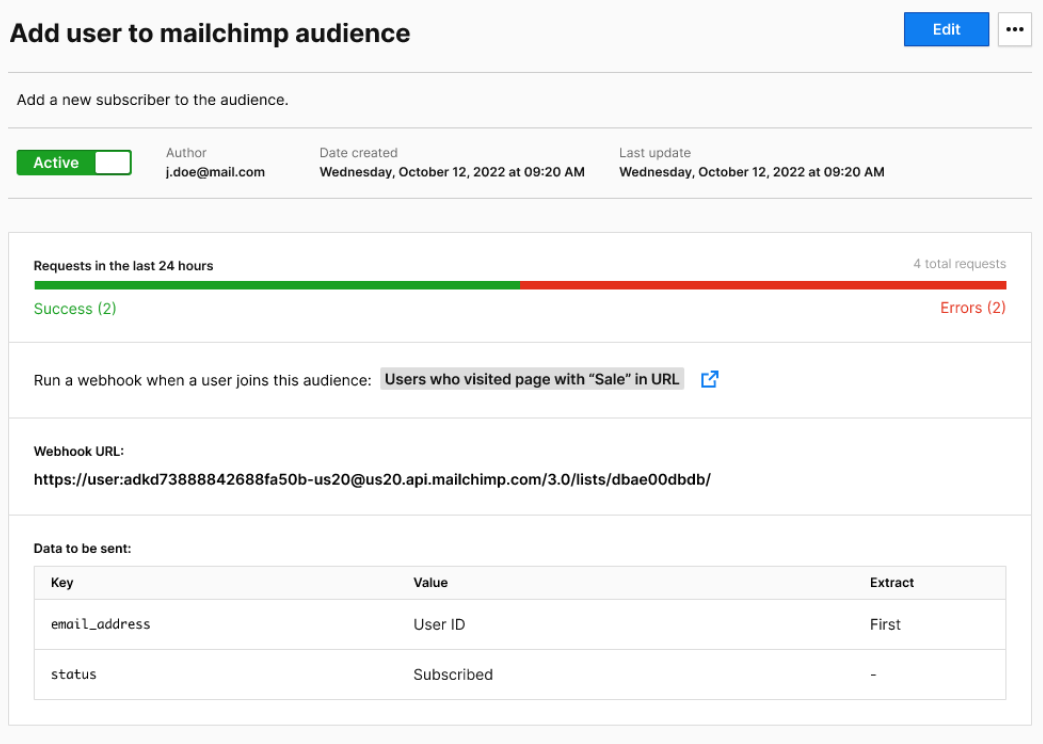
For CDPs, data is like fuel in a car, and audience data activation is the ignition — until you turn the key and start the engine, the car doesn’t do much.
A CDP lets marketers scale data-driven customer interactions. Marketers and other teams within an organization can make the data flow into systems like ad platforms, product and customer journey analytics software, CRM tools and more. CDPs are becoming an industry standard, with a growing amount of complex platforms emerging.
In the past, companies often employed a data management platform (DMP) to perform data activation. DMPs helped them control the data flow in and out of an organization and assisted data-driven advertising strategies.
But DMPs have some drawbacks – for one, DMPs work mostly on third-party data that might come from an unclear source, be vague and lack precise user attributes. Some DMP aspects can’t be ignored in the GDPR era, where data privacy is a priority. For instance, a DMP will require you to take additional steps to ensure you’re on the safe side of privacy regulations.
To learn why a CDP might be a better choice than a DMP, read our blog post on Customer data platforms: The best choice in the post-GDPR landscape.
CDPs have extensive usage options, like content personalization, upsell and cross-sell campaigns, retargeting, email marketing and others. They can also push raw data to other platforms for running external business intelligence analysis.
Moreover, CDPs can help you build single customer views, giving you access to comprehensive and reliable 360-degree customer profiles.
CDPs are also highly customizable and allow for the creation of detailed segments of cross-channel data. Segments can encompass user profiles based on behavioral data, purchase intent signals, predicted order value, lifetime value and more.
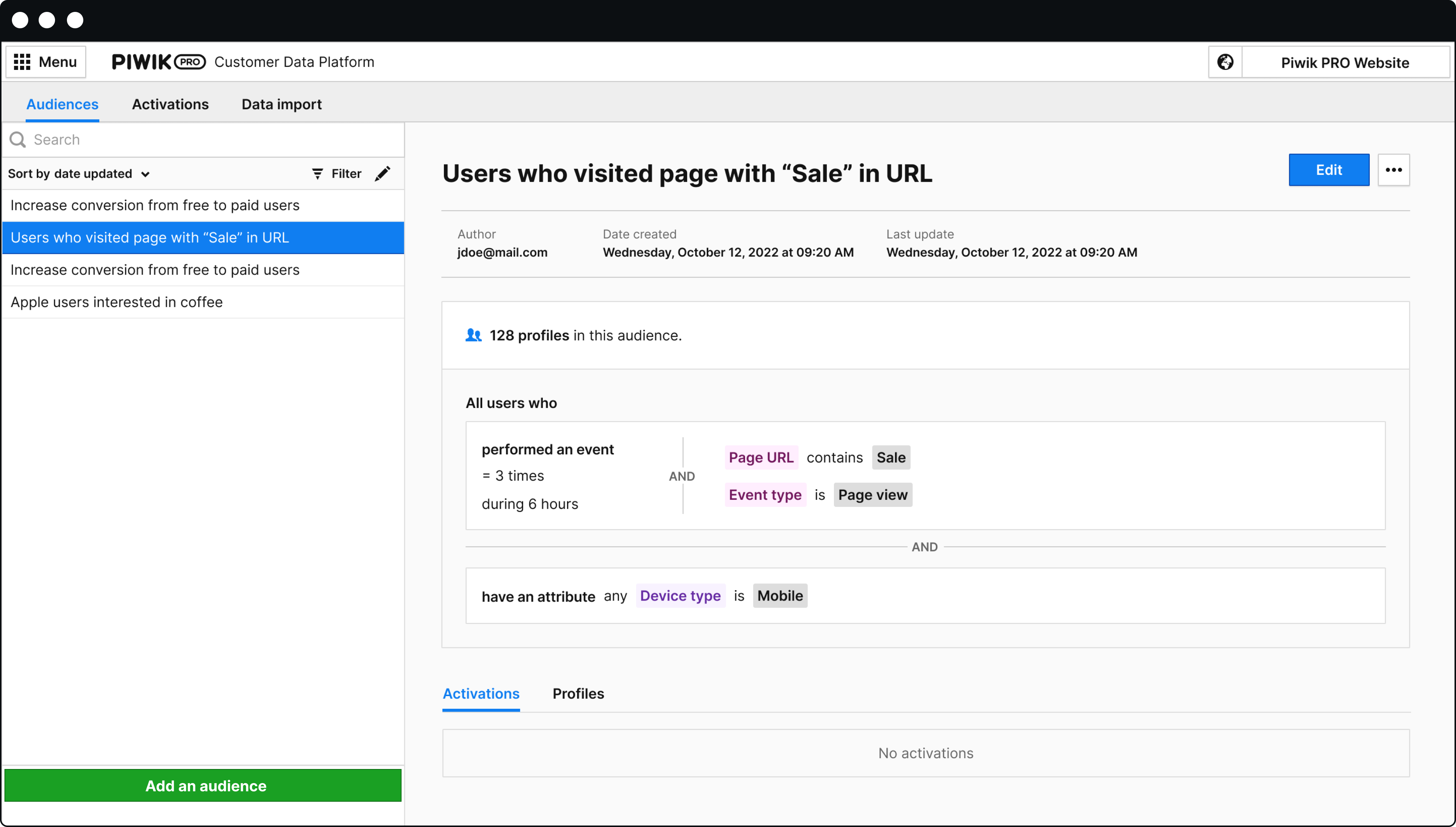
Many modern companies focus on acquisition. Often, they also put effort into 1-on-1 personalization, engagement and retention based on a deep understanding of user interactions with the brand. Because of that, operationalizing a CDP’s data activation features should become a priority.
When selecting the right data activation platform, you should base your decision on the available integrations and the platform’s flexibility to handle your company’s use cases.
4 steps to effectively activate your data
The process of data activation should consist of the following stages:
1. Data collection
All elements that could help you build a complete customer view are likely already in your possession, but they might be spread across different databases and tools.
At this stage, you bring all of your data sets together. You combine data from websites, mobile apps, CRM systems, offline databases, POS systems, marketing tools, ad platforms, etc. Then you transfer them to a consolidated platform, such as a CDP.
When the data is in a CDP, you can build on it over time and expand the customer profiles to make them more meaningful and accurate.
For example, you can continue collecting users’ behavioral signals, like site visits, app purchases, or engagement on social media, and use them later to find new ways to engage with them.
2. Data analysis
Once all the data has been collected in a single location, you’re ready to start analyzing it.
You can explore historical data, comparing it to find patterns and surface trends. The information you uncover can be basic, such as cart abandonment or users who browsed product pages but didn’t purchase. But it can also be more nuanced, such as user activity by segment and time of day.
You can also gain an updated understanding of your target audience. You may have thought your target market was between 20-30 years old, but the combined demographic information may indicate an older audience, between 30-40.
The results of your analysis can be utilized to combine users into specific, relevant groups and drive outbound marketing promotion and optimization. You can use the information you discover and trigger actions based on it.
For example, you may create a segment of prospects who fit the profile of some of your current customers but haven’t converted, and plan steps that would get them to make a purchase.
Or, you might gather users that visited a product page but left it without requesting a demo into one segment.
They can then be targeted with an email campaign that explains more about the product and how it can suit their needs.
3. Data activation
At this point, you are ready to put your analysis into practice by taking action on behalf of your business.
Here, you should plan your strategy, prepare offers and design content for upcoming campaigns. For example, if your business is looking to increase customer loyalty, this is where you would decide what kind of loyalty scheme you want to offer based on the analysis of user behavior.
It’s crucial to bring together people from relevant teams – like marketing, product, sales, and IT – who focus on specific consumer segments or journeys. These teams have clear ownership of consumer priorities and responsibility for delivering on them.
The cross-functional team should continually:
- Develop new ideas
- Design hypotheses to engage customers
- Implement the offers and campaigns
- Test the impact of the efforts
- Tie everything together to draw insights for future adjustments
4. Data measurement
The last stage of data activation is assessing the effectiveness of the implementations. Here, you should quantify how well your decisions have worked out by measuring if you are achieving your goals. Measurement helps provide insights into areas where you can improve performance or change your strategy.
Piwik PRO Customer Data Platform
Piwik PRO’s CDP allows you to connect disparate data sources and unify them to create 360-degree customer profiles that map all their interactions. You can import data into the CDP from a CRM, eCommerce platforms, data warehouses, and other tools using incoming webhooks and automation tools.
The CDP module is one of the components of Piwik PRO Analytics Suite, which also consists of Analytics, Tag Manager and Consent Manager. Together, these modules make up a robust set of tools that help you collect and activate data in an efficient and compliant way.
Specifically:
- Due to the native integration with Analytics, you get a constant stream of user data from the website and mobile app.
- Thanks to Tag Manager, you can trigger tags for remarketing ads, A/B testing, on-site retargeting, personalization, and other tools.
- You’re able to adjust your campaigns to users’ privacy choices recorded through Consent Manager. This allows you to meet the demands of privacy laws such as GDPR, TTDSG/TDDDG, CPPA, etc.
Due to the control you have over the data, you can integrate sensitive information into customer profiles. If you want to enhance privacy levels even more, you can switch identifiable data with your chosen scoring values so only you can understand them.
The CDP relies on first-party data, and you’re able to control the quality and granularity of customer data with detailed import and activation logs.
How data activation works in Piwik PRO’s CDP
Data activation is what defines Piwik PRO’s CDP.
It involves integrating data from different sources and activating it in various places of the product stack through webhooks integrations.
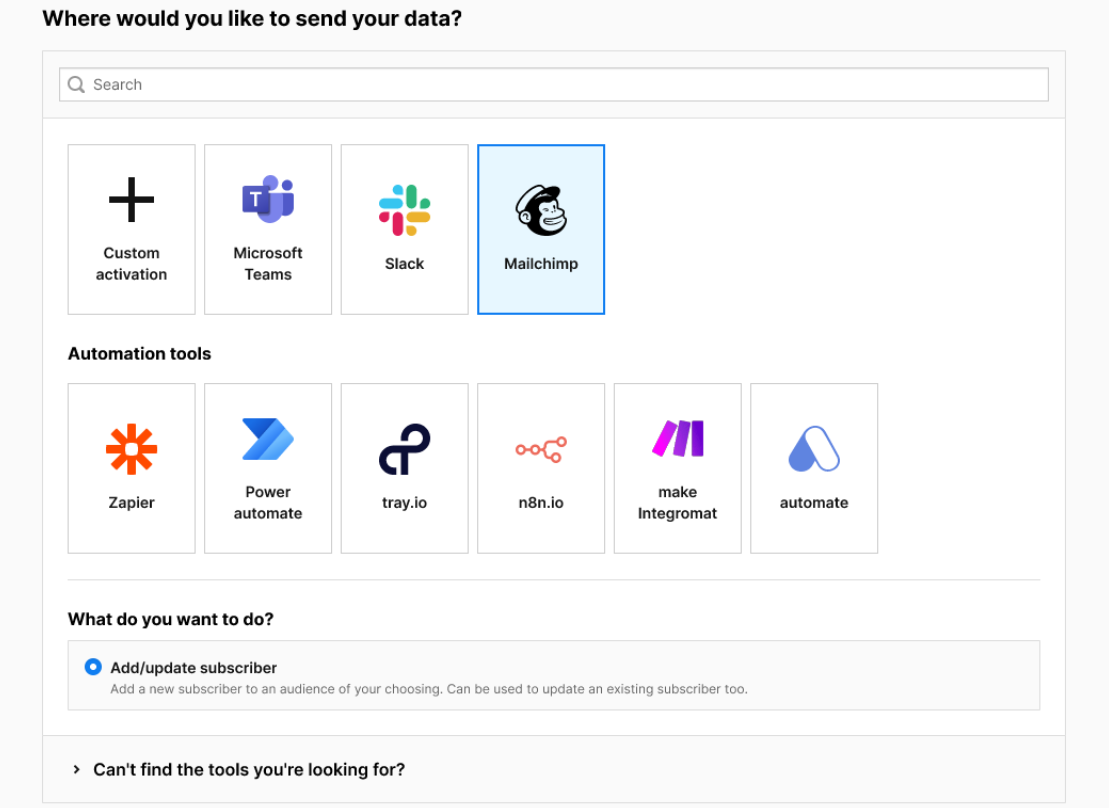
You will be able to import and export selected customer profile attributes from and to countless locations using numerous no-code integration tools and webhooks.
You may also personalize user profiles with custom attributes such as purchase history, persona types, support tickets they’ve created, etc.
For example, you can import your data into the CDP from web and app analytics or CRM, then activate it in Piwik PRO’s Tag Manager or an email platform like Mailchimp.
In order to create relevant audiences, you need to group customer profiles matching certain conditions, such as user attributes or behavioral information.

Then, you can set up and enable an activation, which sends selected customer profile attributes to thousands of endpoints through webhooks and automation tools.

You can use template connectors for Slack, Mailchimp, Microsoft Teams and others, as well as webhook templates to create your own integrations between the CDP and your tech stack.
To give you a better idea of the possibilities offered by Piwik PRO’s CDP, here are some examples of audiences that you can create based on the given conditions:
- Visitors who spent more than $1,000 in the last month
- Users who visited a page with “loan” in the URL 3 times in the last 7 days
- Users who entered the checkout page and didn’t enter the thank-you page in the last 24 hours and made no further actions in the last 6 hours
- Visitors who viewed product pages with “keyboard” and “monitor” in the URL, didn’t visit pages containing “speakers” and didn’t make a purchase
- Users who started filling out a form and didn’t complete it and made no further actions in the last 6 hours
Here are some ideas for data activations that you can conduct:
- Send a message to a user in real-time via a chatbot when they become a part of an audience
- Email a user who opened a URL (e.g., clicked/visited a URL with “Sale,” so you include a discount code in the email)
- Send an email to a visitor with the list of products that they visited and might be interested in
- Retarget visitors who didn’t complete the funnel or those that completed it X days ago/immediately after completing the funnel
- Send an email to a user with items from their abandoned cart
Piwik PRO’s data activation is, above all, easy to use. It can be successfully performed by marketers and other people within the company who have little or no experience working with API calls.
Data activation: final thoughts
The customers who use your services or buy your products interact with your brand in their own unique ways. Data activation is a method of exploring and addressing the uniqueness of their interactions, helping you improve the quality of your campaigns to target new and existing customers.
You can make significant improvements in how you engage with people by developing more personalized communication within a single channel or across multiple ones.
To learn more about data activation and ways to benefit from a CDP, browse our blog posts:
- Audience targeting: how to successfully use a CDP
- Single customer view (SCV): what is it and how does it work?
- Free comparison of 7 enterprise-ready customer data platforms
The post What is data activation and how does it fit into your data analytics stack appeared first on Piwik PRO.
]]>The post Marketing and advertising in a privacy-first world appeared first on Piwik PRO.
]]>Government regulations introduced worldwide and modifications to tracking and cookie technologies have been taking a toll on marketers.
All these changes don’t come as a surprise.
According to a 2021 survey by McKinsey, only 33% of Americans believe that companies are using their personal information responsibly.
According to a survey conducted by BCG and Google, over 60% of respondents want personalized ads. But almost half of them are uncomfortable sharing their personal data to personalize the displayed content.
You may be facing a dilemma. How do you provide the best possible experience tailored to users’ needs without compromising their privacy?
You need strong, trust-based relationships with consumers to build a solid foundation.
Forget about easy fixes and workarounds. Only taking the time to craft a sustainable, effective data strategy gives you a long-term competitive advantage.
We will outline the data protection changes that affect your digital marketing, describe the potential alternatives to making your marketing, analytics and advertising privacy-friendly and effective, and provide steps to follow from 2022 onwards.
How the landscape in user privacy has changed
We can divide the changes in consumer privacy on the Internet into two categories:
- Legal – regulations and laws introduced or enforced worldwide.
- Technical – the demise of third-party cookies, tracking protection mechanisms, etc.
Let’s examine the laws and technical aspects impacting your marketing today.
Changes in legal aspects concerning data privacy
Government regulations introduced worldwide to protect people’s privacy forced many businesses to reevaluate their approach to users’ data.
Collection and use of data
The law that completely turned around how personal data is collected, processed and shared is the EU’s GDPR from 2018.
Other regions in the world followed, resulting in their own pieces of legislation, such as:
- California: CCPA
- Brazil: LGPD
- India: PDPB
- Thailand: PDPA
- The UK: PECR
- Germany: TTDSG/TDDDG
These laws complicate the use of third-party data. For example, most of them mandate websites to get users’ permission to have their information processed.

Learn more about the data privacy laws introduced in different countries
But European data privacy laws don’t end at GDPR. There are additional regulations that are meant to supplement it.
Another relevant EU legislation is the ePrivacy Directive, which came into force in 2002, long before GDPR. The directive mandates each EU country to pass its own laws corresponding to electronic communications, specifying what they should focus on in their legislations. However, how the laws are structured is up to the countries’ individual interpretations.
Apart from that, the ePrivacy regulation has been in the works since 2017, focusing on the rules of online privacy of EU citizens, such as the use of cookies, direct marketing and B2B communications. The ePrivacy regulation will replace the ePrivacy Directive and standardize the laws around processing data of EU residents in electronic communications in Europe.
With time, relevant court rulings clarified certain aspects of the GDPR and indicated how websites should approach privacy matters.
For instance, the ruling on Planet49 case specified that visitors have to give explicit consent by performing an action. It means pre-ticked boxes no longer do the trick in the EU unless they apply to essential cookies.
Data protection officers (DPAs) in some European countries have issued regulations that specify their interpretations of data collection.
Some acknowledge that data can be collected without consent for web analytics purposes:
- CNIL in France – Data can’t be shared with third parties or used for other purposes, such as profiling or cross-domain tracking.
- The Danish Business Authority – Data can be only for the site owner’s purpose and can’t be passed to third parties or used to build a visitor profile.
Transfer and storage of data
Another complicated issue is the transfer and storage of personal data.
The Privacy Shield, a framework that enabled the transfer of EU personal data to the US, was invalidated in 2020. It was done to prevent US intelligence services from accessing the personal data of EU residents.
Anyone transferring data to the US based on the Privacy Shield framework lost their legal basis for doing so.
Crucially, invalidating the Privacy Shield complicates the legality of transferring data to US servers when using Google Analytics.

Changes in technical aspects concerning data privacy
Browsers have introduced new privacy features over the years, concentrating on restricting third-party tracking. Doing so prevents vendors from following visitors across websites and sending information about their browsing history to other companies, typically for advertising purposes.
Here are some specific mechanisms introduced in the past few years:
- Apple has implemented Intelligent Tracking Prevention (ITP) in Safari. It blocks third-party cookies and limits the retention of first-party cookies to avoid workarounds for setting third-party cookies as first-party.
- Apple has additionally been making changes to its identifiers for advertisers (IDFA) – unique identifiers assigned to a user’s device, which advertisers employ for customized advertising. All apps will be required to follow the App Tracking Transparency (ATT) framework by displaying a prompt where users need to opt in to enable tracking across apps and websites.
- Firefox has implemented Enhanced Tracking Protection (ETP) to limit third-party tracking.
- On top of that, Google is phasing out third-party cookies in Chrome in 2024, making it the last browser to do so. It will be a paramount move as Chrome holds the most market share for browsers.
As of July 22, 2024, Google announced it wouldn’t deprecate third-party cookies in Chrome. Instead, Google has now said it’s going to let users decide whether they will be tracked by cookies.
However, with the decreasing effectiveness of third-party cookies, the move away from them by major browsers, additional restrictions planned by Google and the industry’s preference for privacy-first technologies, third-party cookies are bound to become a thing of the past.
So, how do the cookie changes affect MarTech and AdTech?
Though third-party cookies are on their way out, companies like Google, Facebook and Amazon won’t suffer as much. Since they own the most first-party data, they can utilize it to increase their gains.
Analytics, marketing automation platforms and A/B testing won’t be affected by the demise of third-party cookies since they already rely on first-party cookies.
However, mechanisms like ITP impact them because of the limited lifespan of the first-party cookie, which in Safari is only seven days.
If a Safari user enters a website, leaves it, and returns after eight days, they will be classified as a new visitor. This means that the data you gather will lack accuracy.
Let’s not forget about the impact of ad block extensions that users have been turning to in response to intrusive ads online.
As of 2022, already 37% of internet users worldwide adopt ad blockers.
Though adblocking extensions were intended to block ads, some also block invasive trackers, such as Google Analytics.
Read other blog posts to learn if Google Analytics is privacy-friendly:
Increased adblocker adoption may be reflected in your data, depending on your analytics platform and audience. For instance, younger demographics are more likely to install ad blockers than the older generation, so their data could be incomplete.
Experts opinion
Hopefully we see more innovation that aims to apply privacy-by-design principles in the ad-serving infrastructure
Rotem Dar
VP of Innovation at eyeo
What do you think is the future of effective digital marketing that respects user privacy?
Hopefully we see more innovation that aims to apply privacy-by-design principles in the ad-serving infrastructure. As users become more aware of how much personal data is out there and how it is being used, privacy is quickly becoming a top concern.
Corporations would be well advised to seize this as an opportunity to position themselves as privacy-first and be able to offer users what they want. I would rather be optimistic that we’re heading toward a better online environment, where users have more confidence in how brands and adtech platforms are allowed to engage with them. With that said, there are of course contradicting trends too.
More and more online targeting is done via fingerprinting and other less user-centric practices. Realistically, the shift to privacy-preserving marketing technologies can’t rely on corporate responsibility alone, but also on effective regulatory enforcement by authorities and proactive actions of users themselves.
How to do effective marketing, analytics and advertising in a privacy-first world
Given these privacy-first adjustments, you may need to rework your digital marketing strategy and look for new ways to make it effective.
Your MarTech and AdTech platforms need to help you gather valuable audience insights with privacy in mind and let you target them accordingly.
Marketing and web analytics tools
Third-party cookies’ demise primarily affects remarketing, data management platforms (DMPs) and ad platforms that track users across different sites.
Most marketing tools such as A/B testing tools (for example, AB Tasty, Optimizely or Convert) or marketing automation platforms (for example, SALESmanago, Hubspot or Marketo) already utilize first-party cookies. That’s why the end of third-party cookies won’t affect them too much.
Focus on collecting first-party data from your customers and putting it to good use. And even without user consent, there are insights you can gain about your audience.
Collecting first-party data
Accelerating your first-party data collection will help you redefine consumers’ interactions with your brand.
Pros of first-party data collection
First-party data comes directly from people who had contact with your brand, which gives it enhanced quality.
This data gives you better insight into the whole user journey, allowing you to adjust every touchpoint accordingly.
Look around and consider all the places where you get access to user data:
- Web analytics platforms
- CRM systems
- Transactional systems
- Email marketing
- Social media
- Paid search
- SEO tools
Don’t forget that you can also gather first-party data from offline sources, such as sales calls or in-person customer encounters. You can then combine it to create single customer views in customer data platforms.
Add an option for users to create an account to access additional data shared through logged-in experiences.
The level of insight gained from first-party data allows you to personalize content recommendations and advertising messages at a more granular level.
For instance, use it to:
- Send personalized emails
- Show tailored messages to visitors
- Display dynamic creatives, like ads

Learn about specific ways to incorporate first-party data into your marketing.
If you process the information of users that are subject to data privacy laws that require consent, you need to display an appropriate cookie banner and collect consent from them. Otherwise, your first-party data collection won’t be compliant. Ensure no pixels or marketing tags are fired on the site until a user gives appropriate consent.
The consent form determines how far you can take communication with users.
To improve the accuracy of your first-party data collection, consider implementing server-side tracking, for example, through server-side tagging or tracking with a first-party collector.
Learn more in the blog post: Server-side analytics tracking with first-party collector: What you need to know
Cons of first-party data collection
Though first-party data is high-quality and valuable, certain aspects of collecting it in a privacy-friendly way make it complicated.
The main drawback is that not everyone will accept your consent requests and agree to share their information. Consequently, your data profiles won’t be complete.
Showing a consent bar might also negatively affect user experience on the site, especially if it interferes with important content or contains lots of text.
And although first-party data is effective for marketing to members of your audience (such as site visitors or customers), it won’t work for prospecting, such as advertising to the right target group to bring them to your site or app for the first time.
Anonymous tracking
Fortunately, you can collect anonymous data.
Pros of anonymous tracking
This approach lets you maximize the data you acquire, including from visitors who opt out or ignore the cookie banner.
Anonymous data is valuable for understanding user behavior on your site.
It lets you track most actions, like the number of visitors, page views, conversions and time spent on the site, displays basic attribution and helps credit actions to a single visitor.
There are a few methods for collecting anonymous data, all of which are available in Piwik PRO Analytics.
With cookies and session data
A session identifier in the form of a cookie is deployed and removed from the browser after 30 minutes. This method is sometimes not desired because specific regulations (e.g., PECR in the UK or TTDSG in Germany) prevent using cookies without consent.
Without cookies but with session data
This method deploys a session identifier in the form of a temporary session fingerprint. It ties events, such as page views, to one session. This option is compliant with numerous regulations, like TTDSG or PECR.
Without cookies or session data
This option shows data about events but provides no context of users or sessions.
Here is what all of these methods have in common:
- You don’t need consent under GDPR
- You don’t store personal data in the database
- You cannot identify individual visitors on the website
Cons of anonymous tracking
Naturally, anonymous data has certain limitations, such as:
- You can only attribute a specific type of action to a single visitor throughout one session
- You can’t identify if a returning visitor performed the actions
- You can’t connect data from multiple sessions (e.g., for multi-channel conversion attribution)
For example, you will not be able to attribute conversions to actions taken over several site visits.

Be sure to follow our guide to anonymous tracking to learn about the technical details and implementation options.
Paid advertising and remarketing
The demise of third-party cookies, widespread adoption of ad blockers and legal regulations significantly impact advertising and remarketing.
Advertisers and publishers need to depend primarily on first-party data or combine it with other options, such as adding paywalls or subscriptions.
Other solutions include Google’s Privacy Sandbox, walled gardens, or contextual targeting – let’s analyze their pros and cons.
Privacy Sandbox
Google has taken the stage by launching the Privacy Sandbox – an initiative to set new standards to replace third-party cookies. The center of the project is a suite of suggested protocols to satisfy the myriad of use cases that third-party cookies offer advertisers.
FLoC
One of the proposed alternatives was Federated Learning of Cohorts (FLoC), a form of behavioral targeting.
While FLoC had the potential to resolve some privacy issues, some of its characteristics posed additional risks. Specifically, FLoC would enable fingerprinting techniques to identify users within a cohort and share sensitive user data, allowing discriminatory ad targeting.
Google has ultimately withdrawn the proposal of FLoC, replacing it with another system of interest-based advertising, Topics API.
Topics API
Topics API was an alternative option that Google proposed after stepping away from FLoC.
As part of Topics API, Chrome will calculate and store the top five topics for a user weekly based on their web activity – it could be things like “Fitness” or “Travel & Transportation”. When you visit a website, Topics will show the site and its advertising partners three of your interests, consisting of “one topic from each of the past three weeks.” After three weeks, the topics are deleted.
Pros of Topics API
Ultimately, Topics API is meant to reflect a consumer’s interests rather than placing them into interest-based cohorts like FLoC. And the advantages over its predecessor don’t end here.
First, the topics are stored on the consumer’s browser, not an external server belonging to Google or another party.
Topics API won’t contain any sensitive categories, such as race or gender. There will also be fewer, more generalized categories – it’s been mentioned there would be 350 interest groups. In the end, users might even be able to adjust their preferences – for example, add or delete topics and turn off the feature altogether.
This doesn’t mean that Topics API solves all the issues with FLoC, but it beats it in terms of user privacy and security.
Cons of Topics API
The main downside to Topics API is the unlikeliness of its widespread adoption.
We can expect that other browsers, like Firefox, Safari, or Brave, won’t adopt Topics, just like they refused to adopt FLoC. As a result, collecting cross-browser or cross-device data wouldn’t be possible.
Even if Topics API is added to Chrome and demonstrates its value for advertisers, you shouldn’t rely on it exclusively.
The question remains about Google’s motivation for introducing the Privacy Sandbox. Many argue it’s another one of Google’s attempts to establish control over the web and advertising.
And let’s remember that Google will continue to collect and use its first-party data to improve ad revenue in other properties, like Google Search and YouTube.
Walled gardens
Another frequently discussed alternative for third-party cookies is walled gardens.
A walled garden is a closed ecosystem in which the platform provider controls the content, applications, and media and restricts access as it sees fit.
In the AdTech world, the primary examples are Google and Facebook, with Amazon catching up to them. In 2021, the three companies together accounted for more than 74% of global digital ad spending.
Pros of walled gardens
Walled gardens offer publishers some definitive benefits, namely:
- Immense audience reach
- Monetization options
- Opportunities to boost referral traffic
Platforms like Facebook or Amazon tend to provide better ROI than others due to the massive amounts of data and how refined their algorithms are. It lets them target the right audiences with compelling ads.
The most evident advantage for user privacy is that the platforms collect first-party data. Many users log into their Google or Facebook accounts on multiple devices, allowing them to combine more data for cross-device targeting and attribution.
Within a closed platform, the service provider is in charge of the data and creates effective systems for securing it, such as through encoding. Also, consent is required to make specific tracking options available to advertisers.
Large publishers, like the New York Times or the Washington Post, are already investing in audiences based on their first-party data. They use them for ad targeting and, effectively, build their own walled gardens.
Cons of walled gardens
At this point, you probably see how the above-mentioned aspects of walled gardens are simultaneously causing issues.
The biggest downside is that the platforms have a monopoly in the ad world, preventing independent publishers from reasonably competing with them.
Another problem is the lack of transparency in measuring and reporting data. Each platform does it differently, so the audience information you get on one platform can’t be applied to another.
The provided data is aggregated, which poses a challenge to extracting audience insights, monitoring user journey and understanding how visitors respond to your offer.
On top of that, advertisers and publishers don’t have sufficient control over the data, as companies that develop walled gardens use marketers’ data for their purposes.
If you decide your business may still benefit from walled gardens, don’t focus on them exclusively but combine them with other methods. Over-reliance on the same few platforms will be detrimental to your marketing efforts.
Contextual targeting
Since behavioral and audience ad targeting is tricky, think about turning to contextual targeting.
With contextual targeting, a display ad is placed on a website. The ad is directly related to the content on the page or site. To implement the ads, you can turn to advertising platforms that offer complete solutions for contextual targeting, for example, by keywords, subjects or categories.
Pros of contextual targeting
The undisputed asset of contextual targeting is that it doesn’t require user-level data. Instead, contextual targeting uses session data, such as the browsed website, to determine their intentions and interests.
Targeting based on the context rather than user data complies with legal regulations concerning data privacy. This makes it a safe and preferable system for most companies that must follow regulations like GDPR.
With the right audience and keyword selection, contextual ads can be highly relevant and add value to the site’s content, potentially driving more conversions. They will be a great option for niche, highly specific sites.
Since contextual ads are specifically designed for an audience already interested in the subject, they are less disturbing than traditional banner ads.
Cons of contextual targeting
Contextual targeting also comes with challenges.
The process of contextual advertising takes time and attention. Your ads lack the amount of data on the visitor profile, which limits your knowledge of what the user wants.
You need to carefully consider the choice of keywords while writing the content. Make sure the keywords match user intent.
Many sites have content that is too broad or generic to target contextually. One example is news sites where contextual targeting may fall short compared to behavioral advertising, for example, in Google’s display network.
In the end, you may end up showing content that your visitors won’t be interested in.
Additionally, contextual targeting is challenging to scale organically, especially when it comes to branded contexts.
Experts opinion
Marketers and advertisers need to acknowledge the path to a privacy-preserving online ecosystem is not a zero-sum game
Rotem Dar
VP of Innovation at eyeo
As marketers and advertisers consider different privacy-friendly solutions in their marketing, analytics and advertising, what are the things they need to think about first to make sure whatever they do is right for their organization?
The big picture. Marketers and advertisers need to acknowledge the path to a privacy-preserving online ecosystem is not a zero-sum game. Sustainable success will come from winning users’ trust “in the system”. The only way to do this is through straightforward practices, transparency and respecting choice. All of these are key to ensuring a thriving web economy in the future.
If users feel that they are treated fairly, then they don’t have to read the small print, and they can trust their selections about which information they share are being respected. This leads to users having more trust in buying online and in being addressed through advertising. We have to choose between short-term earnings, or doing the right thing that will also result in long-term success.
Adapting to the new privacy-friendly state of digital marketing
The changing cookie-tracking landscape and new data protection laws mean we have an opportunity to revisit the tools we’ve been relying on. We can verify how to get better insights and access to our audience.
Let’s outline the key points of how you should refocus your digital marketing strategy.
Focus on trust and transparency in your relationship with users
Showing users that their privacy and preferences regarding it are important to you increases their trust in you in business contexts.
Users who perceive your brand as trustworthy are more likely to complete the desired customer journey and conversions.
You need to pay attention to sensitive data and respect your customers’ privacy preferences.
Ensure you communicate:
- What data you collect
- How you use the data
- How this usage benefits visitors
Present this information in a way that highlights the security measures you take to protect the data.
This should remain consistent across touchpoints, but you need to first communicate it through the cookie consent form, where the message should be clear and written in plain language. Don’t resort to an overly legal, convoluted style of writing that some users may struggle to understand.
You can A/B test your consent form to see which version gets you the most opt-in rates.
Piwik PRO’s Consent Manager does the heavy lifting of getting consent for you.
Consent Manager allows you to:
- Provide an easy way for users to opt out
- Fully customize the layout and text on the form
- Clearly state what data you are collecting and why
- Give your visitors a way to change or withdraw their consent
- Make sure your tags aren’t fired before you obtain legal consent
- Collect all consents and preferences in one place
Show users the value exchange behind sharing their data
You need to focus on the value you get through direct engagement with your prospects and customers. Be aware of what benefits your brand gives customers and how to make their experience worthwhile.
It’s much easier to convince your customers to share their information if they understand how it is used, especially since it often serves their best interests. For example, you can employ it to personalize website content or provide clients with customized offers.
There are also ways to encourage people to share their data.
As we learn from BCG and Google’s survey, value exchange plays a vital role for consumers. As much as 90% of respondents said they are willing to share their data when presented with a clear incentive.
Depending on the industry, the incentives can be different – you can offer discounts or free samples or trials, as well as access to unique, valuable content or features.
Evolve your tech and data infrastructure
Revamping your data technology stack is another step to take.
Ensure your analytics and marketing platforms comply with privacy requirements.
In particular, these platforms:
- Should let you respect users’ choices.
- Shouldn’t use data for their own purposes, for example, to improve their algorithms.
- Should allow you to minimize the amount of data to only collect the necessary information.
Additionally, find out which platform will provide you with valuable insights to address users’ needs and deliver business results.
You can facilitate a privacy-first approach with Piwik PRO’s Analytics – here is why:
- It’s fully GDPR-compliant.
- It prioritizes the security of user data, making it suitable even for industries that handle sensitive data.
- It doesn’t share data with third parties.
- It integrates well with other functional modules, such as tag manager and consent manager.
- You can choose between different server locations for storing the data.
- You get extensive data anonymization features to maximize the amount of collected data.
- You have control over the data.
- You can customize how you use the data – e.g., you gain access to unsampled or raw data.
- You get access to accurate data and a stack of reports, dashboards and integrations.
Final thoughts
Privacy legislation and technical changes aim to protect the user from any interference with their private life and let them make decisions regarding their personal data.
The future of digital marketing is shifting, but it’s an opportunity to better understand what your audience wants and give it to them.
Revamped consumer experiences achieved through first-party data need to be your long-term goal.
The sooner you consider your first-party data strategy, the more you get ahead of those competitors that aren’t yet modifying their approach.
And if you want to learn more about how Piwik PRO can help you gather valuable data in a privacy-compliant way, we are always happy to answer your questions!
Additional reading:
The post Marketing and advertising in a privacy-first world appeared first on Piwik PRO.
]]>The post Predictive Customer Acquisition Platform: 4 Ways it Can Help You Win New Clients appeared first on Piwik PRO.
]]>In recent years there has been a big shift in marketers’ attention – from customer acquisition to customer retention.
Many studies have shown that investing resources in keeping existing customers happy rather than chasing after new ones is a very successful and cost-efficient strategy.
We’ve all seen the statistics showing that:
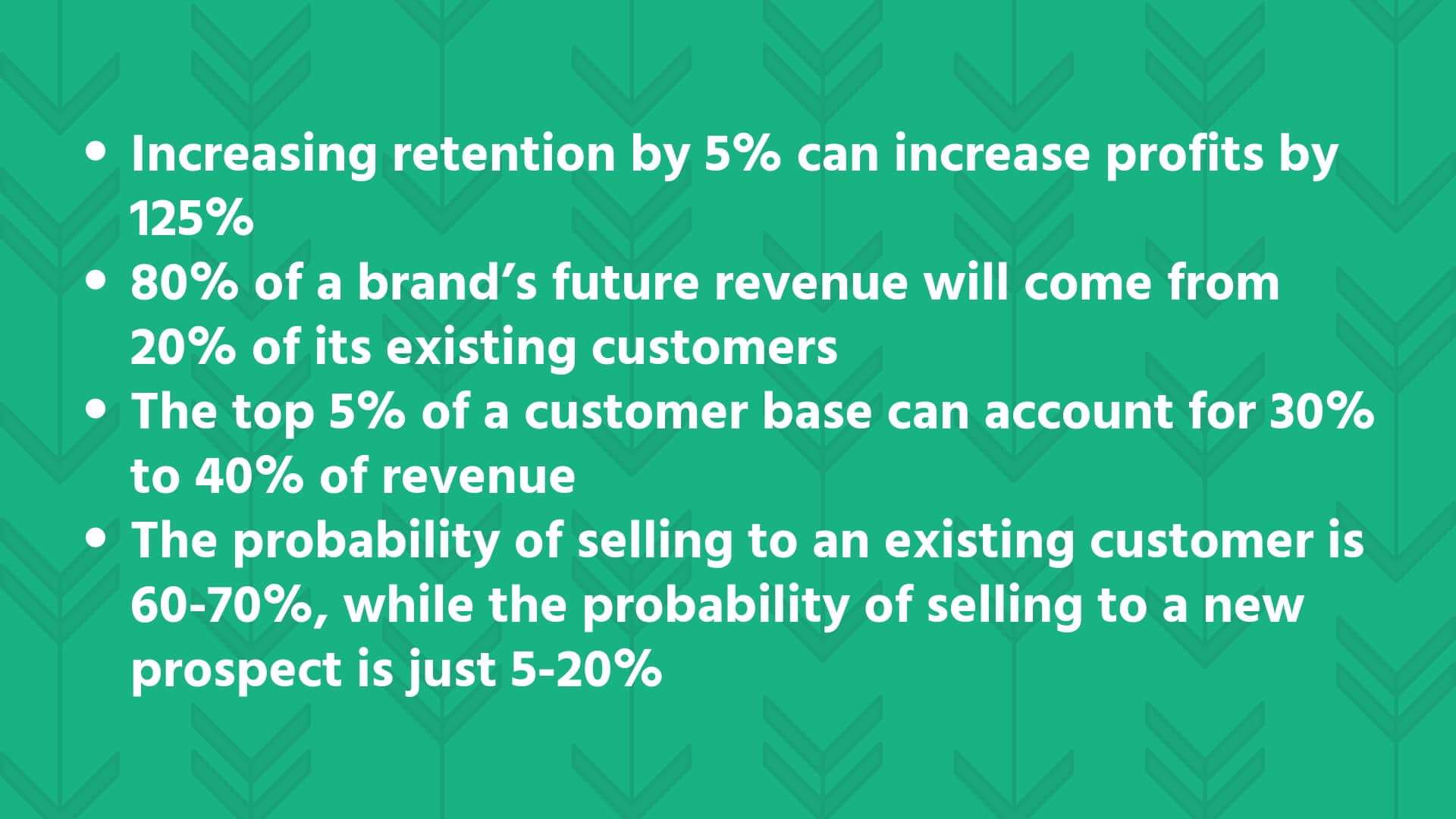
We’ve even reached a point where many marketers state that customer retention is the new conversion/acquisition (1, 2, 3).
However, despite the general trend, it seems that as long as the Earth is spinning, every business will still need a constant flow of new clients to succeed.
Unfortunately, this is becoming increasingly difficult. The main problems seem to be:
- Silos of data scattered across the organization. According to a survey done by Hubspot, marketers on average use now approximately 31 dedicated tools. Those tools aren’t exactly unified, since 60.9% of those marketers surveyed claim that better integration of existing tools and improved data sharing among them would help them make better use of their data technology:

Taking into account the amount of disparate data, tools and channels marketers have at their disposal, it’s no wonder that it’s getting more and more difficult to develop an ideal formula for winning new clients efficiently, especially when data is scattered across teams and departments.
- It’s getting harder to make sense of the data. The amount of data to be analyzed and act on exceeds the potential of the human mind. Especially when we look at the number of variables and factors that should be taken into consideration.
- The cost. Also, getting new clients is turning into a really costly business. According to ProfitWell, overall customer acquisition costs (CAC) have been steadily rising for B2B and B2C companies.
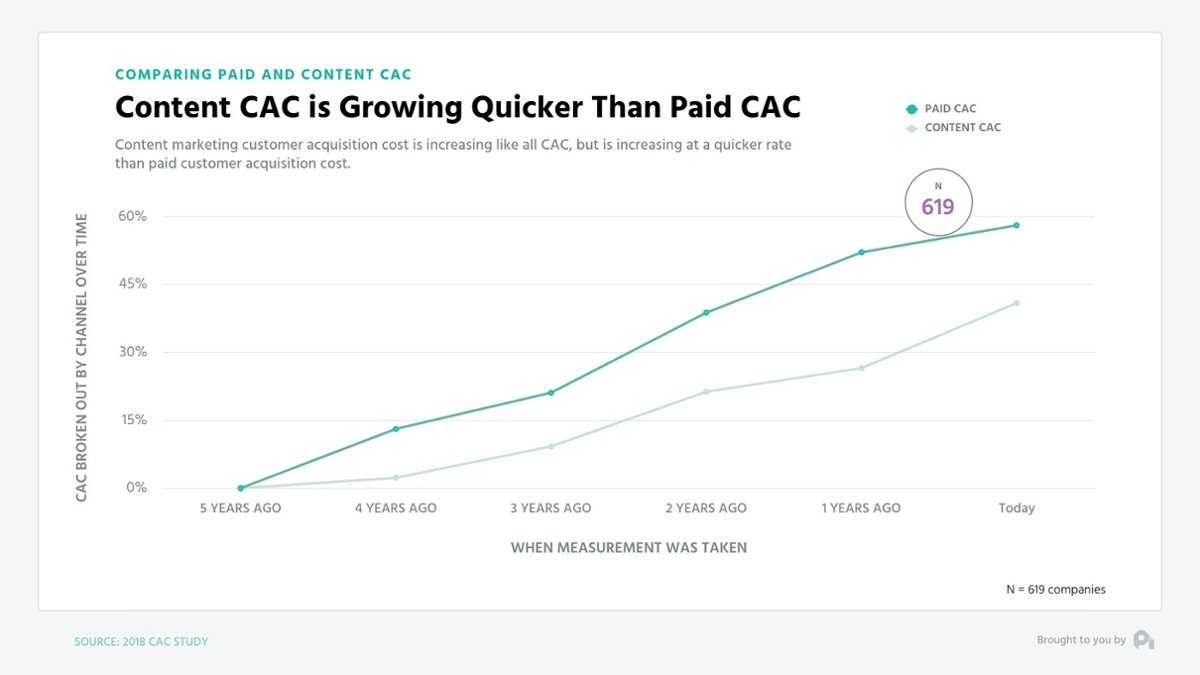
Needless to say, costs go even higher if you’re looking for future clients in the wrong target groups or investing in activities that don’t generate results.

If you want to dig deeper into the current state of customer acquisition, we recommend reading this comprehensive study by Hubspot: The Hard Truth About Acquisition Costs (and How Your Customers Can Save You)
Many marketers may feel trapped and think that their activities will require skyrocketing levels of assets and staff to keep the whole operation running.
Fortunately, the development of artificial intelligence means a significant portion of tasks related to the processing and analysis of data on prospective clients can be done by algorithms.
AI – or to be more specific predictive customer acquisition platforms or predictive analytics – helps marketers consolidate their data and create valuable predictions and granular segments that can be used in the various marketing activities.
Not sure what these terms mean? Don’t worry, in this article, we’ll show how a predictive customer acquisition platform will allow you to optimize your efforts when capturing new clients. We will also showcase the most interesting applications of this technology.
Piwik PRO vs. Google Analytics
Compare Google Analytics and Piwik PRO and Find the Analytics Tool to Fit Your Business’s Needs
What a predictive customer acquisition platform should do
Essentially, predictive modeling is a process in which a piece of software analyzes historical and real-time data about the decisions and behaviors of consumers and prospects to determine what, exactly, gets them to take a specific action (eg. engaging with your brand or making a purchase in your store).

Once the software better understands the various characteristics, behaviors and motivations of your target consumers, it then segments them accordingly. Over time, the algorithm learns more and more about users and can draw increasingly advanced conclusions about their future behavior.
If you want to dive deeper into the mechanics behind predictive analytics, we recommend you take a good look at this extremely informative blog post by Tomi Mester of Data36: Predictive Analytics 101.
And after the software has defined a given customer or prospect as belonging to a specific, granular segment, your marketing team will be in a position to send them laser-focused offers or personalize the content of your website – stuff that will really resonate with them.
While your team will still have to put effort into creating such tailored content and offers, they won’t have to spend near as much time determining who, exactly, will benefit from receiving them. We’ll write more about this later on.
Customer acquisition platform: what types of data you need
The data sets analyzed in predictive platforms typically include:
- transactional data
- user profiles, such as information from registration forms
- campaign histories, including whether customers responded to advertisements
- clickstream data (the patterns of users’ web clicks, website visit flow)
- customer interactions (e-mails, chats, surveys and calls)
- data from external sources (Facebook, Twitter, LinkedIn or ad networks)
So basically all the data about clients and visitors that marketers have at their disposal. Of course, the final set of information will depend on your company’s needs and strategy.
However, you must remember that when it comes to predictive analytics, the quality of your data is essential. Information should be complete and in the correct format. Otherwise, the predictive algorithm won’t be able to do its work, and its predictions won’t be reliable.
Unfortunately, it turns out that dirty data is one of the most pressing issues facing the data scientist:
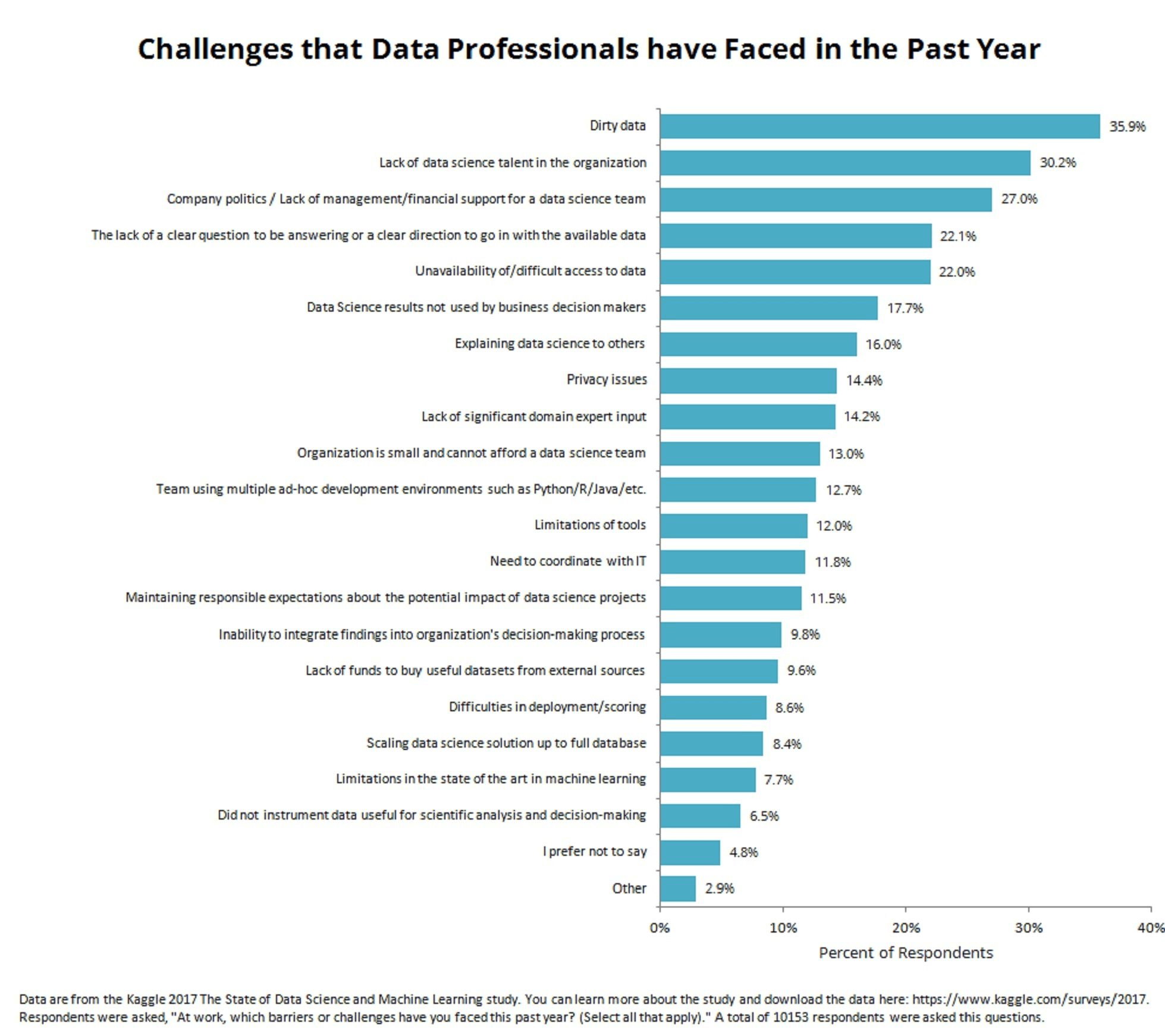
That’s why you need to find a way to clean your data before you begin working with predictive tools. Among other things, you have to detect and correct any records that contain erroneous values and fill in any missing values. You’ll also need to get rid of duplicate records (two customer accounts, for example).
Why investing in a customer data platform might be a good idea
A potential solution could be taking advantage of a data aggregation technology (like data management platforms, customer data platforms or data warehouses) – while they won’t do everything for you, they’ll help you automate a bigger part of the process.
Gathering data on customers and users delivers huge benefits to organizations across all sectors anyway, so this type of software can be a very versatile investment (read more about it here). One application might be unifying and cleaning the data you’ll use later on in predictive analytics modeling.
There are at least several options to choose from – we’ve tackle this issue in a comprehensive comparison you can find here: Find the Most Suitable Data Gathering Platform – Pros and Cons of DMPs, CDPs, DWs and CRMs.
However, we think that in this case, the best option is to use a customer data platform. Unlike with DMPs, all data gathered from multiple sources and merged into a single record allows you to eliminate redundancies and other errors that would skew the outcome of predictive modeling.
Also, it allows you to gather data from virtually any source you choose. At least that’s the case with the Piwik PRO Customer Data Platform.
Sure, there might be still some legwork on your side, but a huge part of unifying the data will be done for you.
This makes it a perfect addition to your predictive customer acquisition platform. However, if you want to learn more about the capabilities of CDP, be sure to check out the Data Management section on our blog.
Customer acquisition platform – 4 actionable use cases
Now, let’s proceed to the most important issue – practical applications of the technology. One of the most vital things to know is that predictive analytics have a huge range of practical applications.
As with regular analytics based on historical data, it’s extremely important to specify the purpose for which you intend to use predictive analytics. The type of model you select will depend on this.
Successful predictive analytics demand a data-driven strategy. The need for data is growing exponentially, not only within the areas of volume but also in regard to insights. This increased need for data coupled with the increased need for insights is driving the innovation necessary to utilize capabilities such as predictive analytics. With predictive analytics, it is now possible to fill the data gaps between what has happened and what can happen. These insightful predictions, via data science dramatically amplify the analytic value of big data which can result in better connected data for greater predictive power and highly impactful data-driven insights.
Dr. Craig Brown, Techpreneur, craigbrownphd.com
Here are some actionable use cases of predictive analytics employed to improve customer acquisition:
1)Lead scoring
By researching all of available information on a lead and matching it with the characteristics of existing customers, companies can score their leads with much better precision.
Precise assessment of leads will help you invest your work and budget in a more thoughtful way. This will translate not only into higher effectiveness of your activities, but also to better allocation of costs related to advertising, campaigns and the working hours of your sales department.
In any given organisation, sourcing and identifying viable prospects is fundamental to driving success. If we focus solely on the sales function, AI is reshaping and moulding a new definition of what sales entails. In our sales division at Cognism, we utilise AI to produce a vast number of high-quality leads, alerting us to the optimal time to make an introduction. In the back-drop, the AI engine is sifting through data at a more efficient rate than a human team can, streamlining one of the most time-consuming elements of selling. This has made the initial process of acquiring customers much less resource heavy and predictive, with a greater allocation of time focused on the latter stages of the sales process, closing deals. This is just one example, but it is certainly adapting and altering the sales profession positively.
Jonathon Ilett, Senior Business Development Manager, Cognism
2) Laser-sharp segmentation and targeting
As in the case of lead scoring, predictive analytics can help you find connections between your prospects’ behavior patterns and the way your current customers behaved at the same stage of their customer journey. Then, they’ll assign your future clients to specific, very narrow segments of users with the same characteristics.
Based on the segment and information about what has worked in the past on those particular customers, you’ll be able to apply the same marketing techniques to future customers who match their traits.
This data will be used, for example, in mailing campaigns, remarketing or other activities. Once again, predictive customer acquisition methods save time and energy, allowing you to focus only on work that will generate the desired effect.
3) Real-time personalization and A/B testing
Creating advanced user segments is also an extremely useful foundation for personalization activities.
Imagine a software discovering segments in real time, testing many ideas at the same time, and serving each individual visitor with tailored experience causing them to convert at that moment. Sounds pretty promising, right?
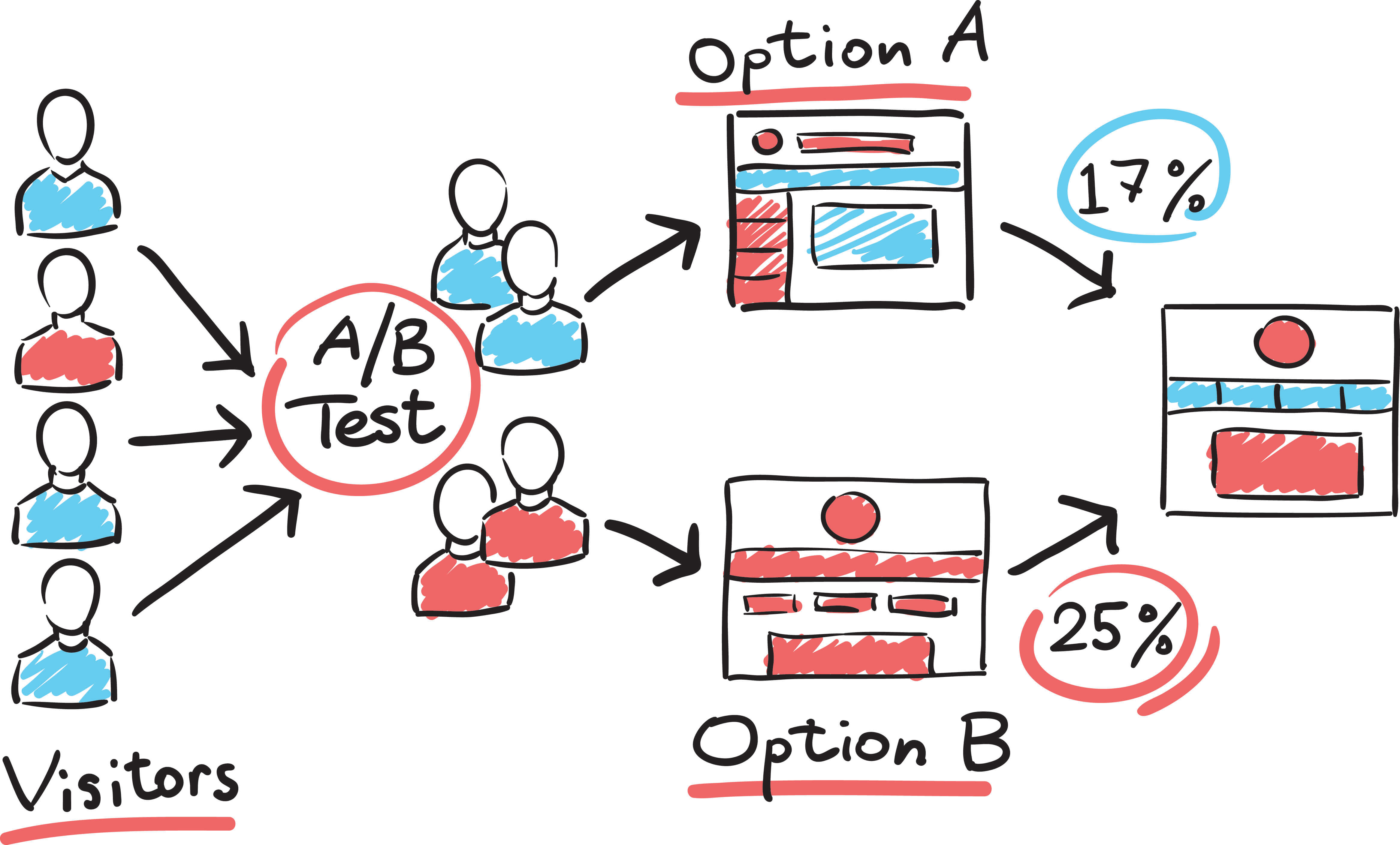
With predictive personalization, a machine will be continuously observing the behavior of your visitors and adjusting the content of your website or app to optimize the experience in real-time.
Predictive personalization can be applied to a number of areas on your website, such as:
- homepage
- list sorting
- calls-to-action
- pop-ups
- infobars
- category page
- blogs/article
- search bar
- ads
- emails
If we look at the results of a survey by Adobe, it seems that predictive modeling used in personalization efforts could address one of the most pressing problems of today’s marketers.
The survey tells us that:
60% of marketers struggle to personalize content in real-time,
but
77% of them believe that real-time personalization is crucial.
Psst! If you want to read more about the benefits of predictive personalization, be sure to check this blog post out: How Can You Take Advantage of Predictive Personalization?
4) Real-time product recommendations
Another application of the technology will be a real-time product recommendation system.
This will allow you to offer visitors specific products (often bought together, you may also like, people like you also bought, etc.) based on their demonstrated behavior. Because it uses machine-learning algorithms, no manual work is required to put these rules into place.

This method proves extremely useful for websites with a broad product offer and considerable traffic volume.
How to choose the right predictive customer acquisition software
Companies interested in applying predictive models in their acquisition efforts have a large number of solutions to choose from. You could pick:
- a solution that you create in-house with the help of your analysts
- a ready-made product you buy from a vendor (as a plugin, dedicated tool or whole suite) or
- a service provided by a third-party vendor that will develop models and visualizations for you
The final choice will mostly depend on your resources, the size of your business and the ways you want to utilize the technology.
Piwik PRO vs. Google Analytics
Compare Google Analytics and Piwik PRO and Find the Analytics Tool to Fit Your Business’s Needs
Some privacy concerns
Marketers must, however, be aware that their actions have to be not only effective, but also lawful. After the introduction of GDPR, and in the face of the California Consumer Privacy Act, one of the most important issues will be to investigate their data sources and to make sure that the data was collected in alignment with privacy laws.
This applies both to first-party information and data bought or acquired from third-party sources.
If you want to read more about the best data privacy practices for marketers, we advise you to visit the Data Privacy section on our blog.
Predictive customer acquisition platform – some conclusions
Predictive modelling has proved to be extremely helpful in many tasks related to customer acquisition. When done right, it will help you better allocate your marketing budget and save your sales reps’ valuable time.
However, with only limited knowledge about predictive modeling among team members, taking full advantage of the potential of this technology can be quite difficult. Also, it’s important to remember about the quality of data – and that’s something a decent customer data platform can take care of.
Still have some unanswered questions? Don’t hesitate to contact us. Our team will be happy to help!
The post Predictive Customer Acquisition Platform: 4 Ways it Can Help You Win New Clients appeared first on Piwik PRO.
]]>